
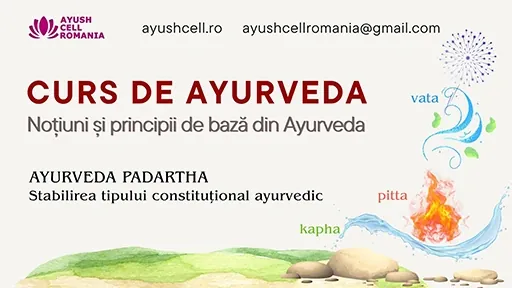
The Ayurveda-Padartha module is a comprehensive, detailed introductory course that provides a broad, well-structured understanding of the fundamental principles of Ayurveda. It is suitable both for those taking their first steps in this science of life and for those who wish to deepen their knowledge of Ayurveda’s holistic approach to health and practical methods of restoring balance.
We invite you to watch this introductory recording to become familiar with the course structure and content and discover the main topics to be covered.
19 lessons, unlimited 24/7 access for 10 months, all lessons available immediately
The Ayurveda-Padartha module explores fundamental Ayurvedic concepts, providing information about how thoughts, emotions, and actions relate to each person’s constitutional type (dosha-prakriti) of each person. This course invites introspection and self-knowledge, with each concept explained clearly to facilitate its application in everyday life.
Ayurveda is a science of life (“ayus” means life, while “veda” means science or knowledge) because it offers systematic, verifiable, and applicable knowledge. Parameterization plays an essential role in this approach, allowing Ayurveda to function as a predictive and adaptive science. Practitioners do not merely observe a problem; they analyze individual parameters, such as constitutional type (dosha-prakriti), current imbalances (vikriti), and external and internal influences. This enables them to anticipate how imbalances may develop and propose precise, effective interventions based on observed and measured parameters.
The course is open to anyone interested in Ayurveda, regardless of prior knowledge. Its structure covers fundamental concepts and provides detailed preparation as a basis for understanding more advanced aspects of this science of life. Previous knowledge of Ayurveda may be an advantage but is not required. The module aims to establish a solid foundation for further study of advanced concepts and practical application of the principles presented.
Over the years, numerous study groups have completed the Ayurveda-Padartha chapter (Basic Concepts and Principles of Ayurveda). It has consistently been included as the first step in studying Ayurveda because its foundational concepts are essential to understanding and applying this science in practice.
The Ayurveda-Padartha module is based on course recordings supplemented by additional explanations and answers to participants’ questions. These additions have made the course a comprehensive and detailed resource, giving participants an opportunity to explore the topics more deeply through clear, practical instruction.
The course consists of 19 lessons. Each lesson lasts more than two hours, totaling approximately 45 hours.
All lessons are available online, with 24/7 access for 10 months from the date access is activated. This format allows participants to study at their own pace and revisit each lesson for review and deeper understanding.
Participation in this specialized module is a valuable investment for those seeking to deepen their knowledge of Ayurveda. The full module costs 1280 lei and includes 19 lessons and approximately 45 hours of content.
This Ayurveda course has received international recognition and validation. Upon completing the module, participants may request a certificate of participation issued within the international collaboration program involving AMN-Romania, Ayush Cell Romania, and Datta Meghe Institute of Higher Education & Research (DMIHER), India, an initiative undertaken at the request of the Embassy of India in Romania.
📖 19 lessons · ⏱️ 45 hours of content · 🔓 24/7 access for 10 months