Ayurveda Agenda 32 / 2026 Contents

Ayurveda Course

1

The 2026–2027 Ayurveda Course – a systematic path of knowledge and practical application of the Science of Life

An original, progressive approach that draws on the traditional foundations of Ayurveda and presents them in a program accessible and applicable to modern life.

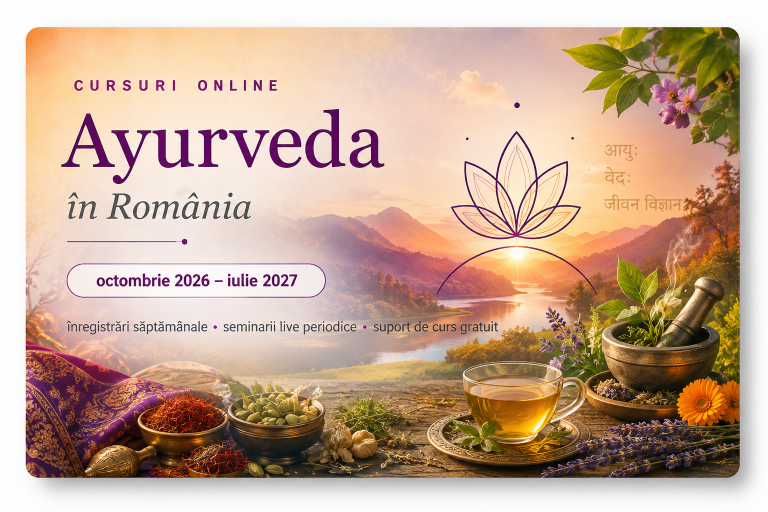
Starting October 6, 2026, a new group will begin its studies in the Ayurveda Course, October 2026–July 2027 session, available through ayushcell.ro.

Held online every Tuesday at 6:30 p.m., the weekly program is open to everyone interested in traditional Ayurvedic knowledge, regardless of previous professional training.

The course offers the opportunity to study progressively and systematically a broad body of knowledge about life, the human being, and ways to support personal balance.

One of the characteristics of the Ayurveda Course is its commitment to connecting the traditional foundations of Ayurveda with the practical needs of modern people. Traditional principles are presented in an accessible, applicable way, so that study provides a substantial theoretical foundation and can gradually become a practical guide for self-understanding and everyday choices.
The knowledge presented originates in authentic writings of the ancient Ayurvedic tradition and is explained clearly and systematically, allowing students to understand the principles and gradually integrate them into daily life.

This orientation gives the program a distinctive character. Ayurveda is presented as an integrated system, combining information on maintaining health, nutrition, and the use of medicinal plants into a genuine traditional science of life. Participants gradually become familiar with ways of observing and interpreting processes within themselves and their surroundings, gaining reference points that may contribute to self-knowledge, adaptation, and the conscious cultivation of personal balance.
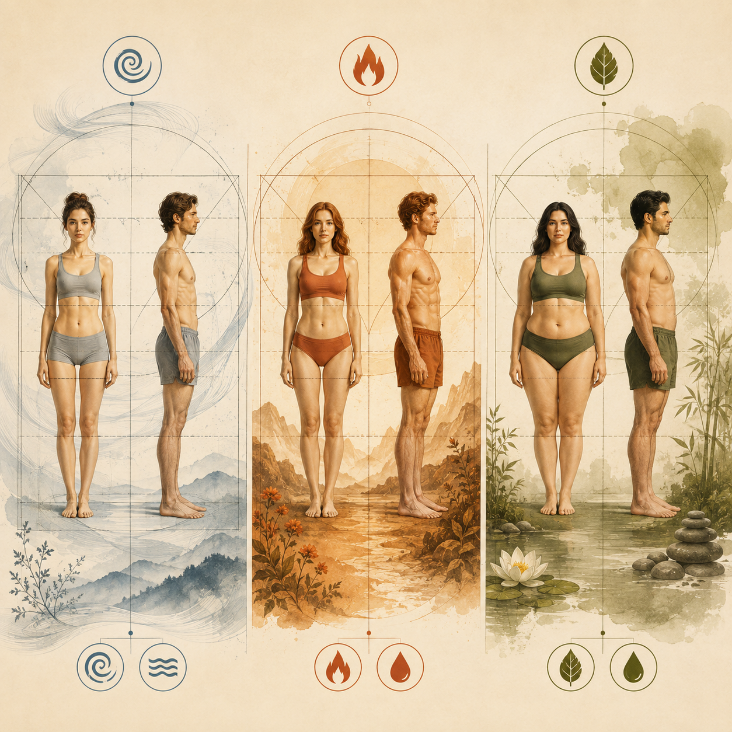
The study of Ayurvedic constitutional types holds an important place in this methodology.

Constitutional analysis offers an individualized perspective on human beings and explains why different people may respond differently to the same foods, environmental conditions, activities, or daily rhythms. Understanding these constitutional differences creates a basis for choices better suited to one’s own nature and makes constitutional knowledge a practical instrument of self-discovery.

This is a significant feature of the program. Instead of uniform recommendations applied to everyone in the same way, the Ayurvedic perspective seeks to identify individual characteristics and choose appropriate measures.

Participants can thus learn to observe their own characteristics, reactions, and the influence of different factors in everyday life.

Knowledge thereby takes on a practical purpose, and studying Ayurvedei becomes an exercise in conscious self-observation.
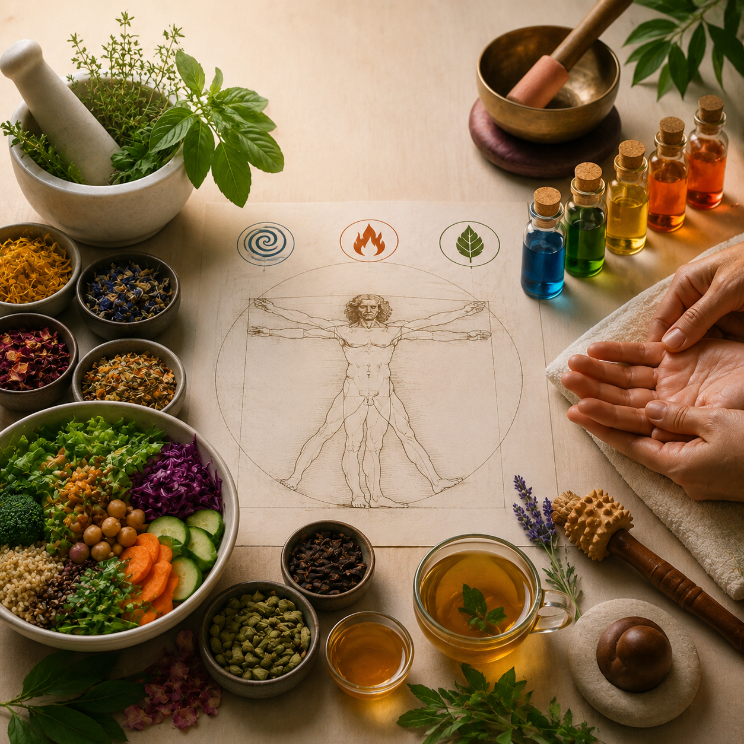
Another aspect that broadens the Ayurveda Course is the variety of methods presented. Nutrition adapted to constitutional characteristics is combined with the informed use of medicinal plants, color therapy, music therapy, acupressure, simple self-massage techniques, and other accessible methods of harmonization.

Traditional Ayurvedic methods of revitalization, rejuvenation, supporting energy, and natural bodily purification are presented, including plants with regenerative properties. Participants gradually discover that Ayurveda offers a system in which nutrition, plants, daily activities, and various natural harmonization methods can be understood as complementary parts of one vision of human balance.

A relevant feature of studying Ayurveda in Romania is the attention given both to medicinal and aromatic plants from Indian tradition and to species from Romania’s flora.

The Ayurveda Course presents the beneficial effects of native medicinal plants and many concrete examples of their use to maintain vitality and well-being. Universal Ayurvedic principles can thus be related to familiar and accessible botanical resources in our geographical area. This connection between Indian tradition and Romania’s medicinal flora is an important area of study with great practical potential.

The structure Ayurveda Course also supports continuity in education.

The program is organized into annual modules that progressively explore different branches of Ayurveda, allowing students to continue through several sections and chapters. It offers a progressive path in which foundational concepts can be assimilated, applied, and later studied in greater depth.

Each weekly meeting lasts approximately two and a half hours. Periodic seminars and question-and-answer sessions supplement the courses, and participants receive the associated written course materials free of charge.

The opportunity to revisit content through written materials and clarify subjects in interactive meetings strengthens learning, reinforces new concepts, and helps integrate them into a coherent, practical understanding adapted to each participant’s pace of study.
An important advantage of this Ayurveda study program is its accessibility.

Participation is not limited to health-care professionals, The Ayurveda Course but is open to everyone interested in Ayurveda.

This openness preserves the educational nature of the program and allows students to approach traditional Ayurvedic knowledge from its foundations, with no previous specialist training required.

Through its progressive nature, focus on self-knowledge and practical application, range of methods, and simultaneous attention to Ayurvedic tradition and the realities of modern life, the 2026–2027 Ayurveda Course offers a distinctive educational path.

Studying Ayurveda in this way makes it possible to develop a precise approach to observing life, understanding individual characteristics, and consciously using natural resources and Ayurvedic principles to cultivate balance, vitality, and personal harmony.

Enrollment – Ayurveda Course 2026–2027:
ayushcell.ro/cursayurveda2627
Contents

2

Contents of the current issue of the digital magazine Ayurveda Agenda

Ayurveda Course

pp. 01–03

The 2026–2027 Ayurveda Course – a path to understanding and applying the Science of Life

Contents

p. 03

Educational resources

pp. 04–06

Ayurveda – Level 01

p. 04

▶ Svasthya-Darshana

C22 (N)

▶ Prakriti-Nikasha

C16 (R)

Current updates

pp. 05–06

A new HTML format for reading the Ayurveda Agenda digital magazine

Educational resources

Ayurveda – Study Level 1 – AY01

3

One course new from the Svasthya-Darshana chapter on awakening resonance centers within the five sheaths of the being

Course 22 presents the application of the third principle of healing, awakening resonance centers, within the five sheaths.

Course 22 is included in Study Level 1 (AY01), the Dosha-Prakriti section (A01), Chapter 2, Svasthya-Darshana (A2), and is available as an easy-to-read A4 PDF and a foldable A5 PDF. This Ayurveda course has the code: AY01-A01-A2-C22.

Course titles and their place in the Basic Ayurveda Course curriculum

📁 AY01
 ├─ 📁 A01: Dosha-Prakriti
  │   ├─📁 A1: Ayurveda-Padartha
  │   ├─📁 A2: Svasthya-Darshana
  │   │   └─ 📄 Dosha-Prakriti_Svasthya-Darshana_C22
  │   └─📁 A3: Prakriti-Nikasha
 ├─ 📁 B01: Amnaya
 └─ 📁 S01: Ayurveda-Parichaya

Awakening inner centers enables the integration of healing energies

Explanatory notes

Title: Dosha-Prakriti_Svasthya-Darshana_C22

4

One course revised from the Prakriti-Nikasha chapter on appetite in vata and pitta constitutional types

Course 16 analyzes appetite as a regulatory function and constitutional criterion, highlighting its specific manifestations in vata and pitta types.

Course 16 is part of Study Level 1 (AY01), the Dosha-Prakriti section (A01), the Prakriti-Nikasha chapter (A3), and is available as an easy-to-read A4 PDF and a foldable A5 PDF, under code: AY01-A01-A3-C16.

Course titles and their place in the Basic Ayurveda Course curriculum

📁 AY01
 ├─ 📁 A01: Dosha-Prakriti
  │   ├─📁 A1: Ayurveda-Padartha
  │   ├─📁 A2: Svasthya-Darshana
  │   └─📁 A3: Prakriti-Nikasha
  │         └─ 📄 Dosha-Prakriti_Prakriti-Nikasha_C16
 ├─ 📁 B01: Amnaya
 └─ 📁 S01: Ayurveda-Parichaya

Appetite reflects constitutional characteristics and the ability to make use of food

Explanatory notes

Title: Dosha-Prakriti_Prakriti-Nikasha_C16

Access: ayushcell.ro/suport_scris

Current updates

5

A new HTML format for reading the Ayurveda Agenda digital magazine

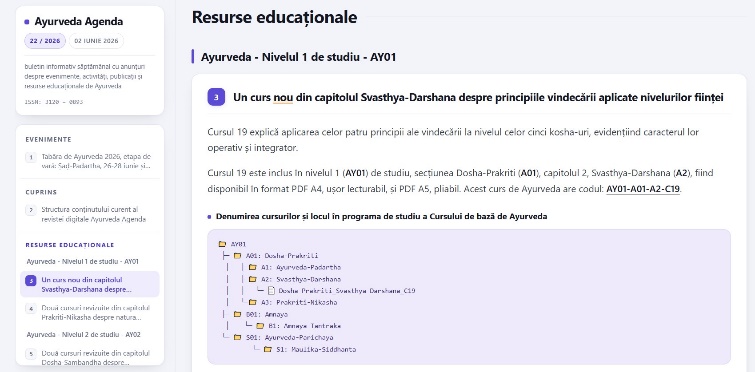
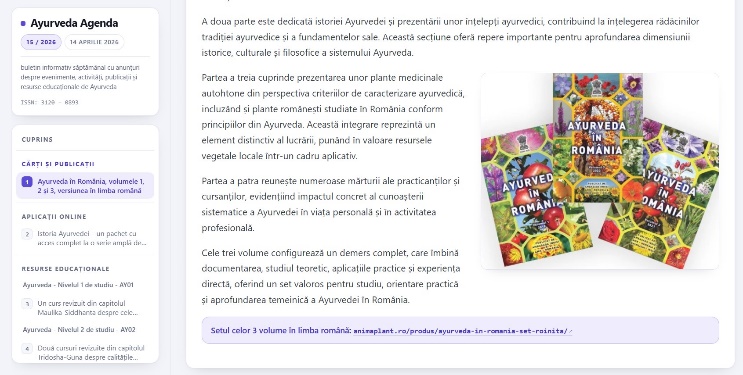
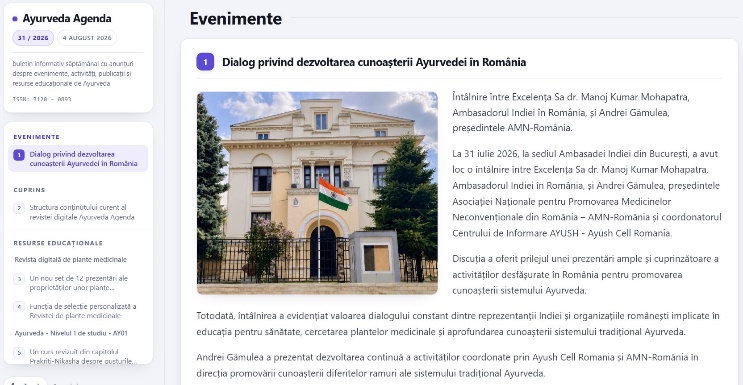
The Ayurveda Agenda digital magazine’s new online presentation turns every issue into an easy-to-navigate webpage, with a navigation menu, quick access to sections, an internal structure, and the option to use modern browser features, including automatic translation into other languages.

The digital magazine Ayurveda Agenda now benefits from a modern HTML format, designed for quick consultation, efficient navigation, and more direct access to weekly information. This presentation complements the magazine’s PDF edition and meets a natural need: informative, editorial, and educational materials should be available not only as documents to archive, but also as dynamic webpages accessible from a computer, tablet, or phone.

With the introduction of the HTML edition, Ayurveda Agenda the publication becomes better aligned with how digital magazines are read today.

Readers can access sections of interest directly, quickly return to the table of contents, follow internal and external links, and use the search and translation tools available in their browsers.

This transformation enriches the magazine’s identity and extends it into a much more flexible, practical format adapted to current information needs.

An important feature of the new format is the navigation menus on the left side of the page.

Navigation menus make it easy to find the main sections and articles in each issue. Rather than searching manually for a particular section, readers have an internal map of the edition.

This makes sections such as Events, Books and Publications, Online Applications, Educational Resources, and Current Updates much easier to access. The structure enhances the magazine’s practical value, especially for readers who use it regularly for reference, checking information, or planning activities related to Ayush Cell România.

The interactive table of contents is another important feature. Each issue is structured so titles, sections, and subsections serve as navigation points, giving the magazine a much clearer internal architecture.

Readers can move quickly from the contents to a desired article, consult a category of information, and return to the issue overview. This is especially useful for longer editions with several study levels, revised courses, current articles, editorial presentations, and links to platform applications.

The new HTML format further highlights the magazine’s value as a reference resource. Ayurveda Agenda.

The publication helps readers track and navigate available educational materials. They can regularly check which courses have been announced, their study levels, sections and chapters, and their exact names in the curriculum. In this way, the magazine becomes a stable reference for organizing personal study, verifying available materials, and matching published information to actual access to written course resources on the platform.

A key technical advantage of HTML is that text is displayed as real webpage text. This enables standard browser functions: searching within the page, selectively copying passages, zooming in or out, adjusting to screen size, and, where available, automatic translation into other languages. Unlike a static document, an HTML page can be processed more easily by everyday digital tools. Readers using a browser configured in another language or activating translation features may be able to access the magazine’s content in other languages, depending on their browser capabilities.

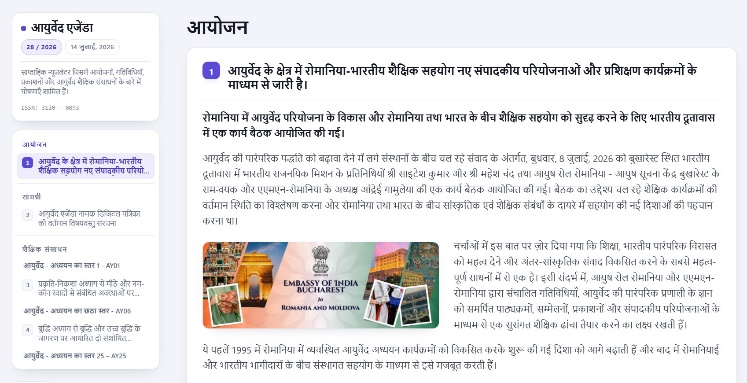
This matters particularly as Ayurveda Agenda increasingly documents intercultural, publishing, and educational developments, including Romanian–Indian dialogue, Romanian- and English-language publications, training programs, and resources for systematic Ayurveda study. HTML can thus make the magazine more accessible to readers outside Romania or those who wish to understand content quickly through automatic translation.

The new online presentation naturally fits into the functional improvements recently made to the ayushcell.ro. Following the introduction of tools for organizing written materials—including personal download reports, PDF report generation, side navigation on small screens, and educational-material sorting and filtering—the magazine’s HTML edition Ayurveda Agenda completes this improvement in digital accessibility.

The magazine now serves two complementary purposes. The PDF remains useful for printing and archiving in a traditional format, while HTML is better suited to quick reading, navigation, searching, and direct access to information. Together, the two versions give readers freedom to choose the format that suits them.

With clear menus, an interactive table of contents, an internal structure, improved accessibility, and compatibility with modern browser tools, the magazine becomes easier to use as a regular source of information, reference, and orientation in Ayurveda study.

Access: ayushcell.ro/ayurveda-agenda/2026-32