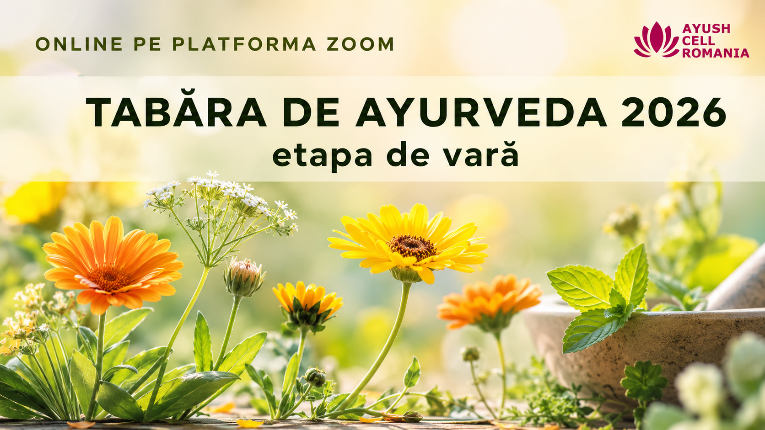
Ayurveda Summer Camp 2026: Ṣaḍ-Padārtha, June 26–28, and Sapta-Samaya, July 24–26
Ṣaḍ-Padārtha and Sapta-Samaya: Two fundamental directions in Ayurvedic knowledge
The 2026 Ayurveda Camp offers an intensive learning environment devoted to major subjects within the esoteric Ayurvedic tradition.
The program is organized into two complementary parts, each consisting of three days of presentations and activities designed to develop a practical understanding of essential Ayurvedic principles. The first part will take place online on June 26, 27, and 28, 2026, and the second on July 24, 25, and 26, 2026.
This year’s Ayurveda Camp adopts a complementary approach. Part 1 introduces the universal principles of Ayurvedic knowledge expressed through the Ṣaḍ-Padārtha system, while Part 2 turns toward the inner and existential orientation of the human being described by the esoteric Ayurvedic Sapta-Samaya system.
The two directions support one another. The first provides foundational ways of understanding reality and analyzing substances, qualities, actions, and relationships between phenomena. The second applies this understanding to self-knowledge, harmonious integration, and gradual existential transformation.
Ṣaḍ-Padārtha — The six principles of Ayurvedic knowledge
Explanatory notes
Part 2: July 24, 25, and 26, 2026
Sapta-Samaya — The Ayurvedic system of seven stages of harmonious existential integration
Explanatory notesExplanatory notes
Registration and participation
The 2026 Ayurveda Camp is open to all who wish to deepen their understanding of the Ayurvedic tradition, including students, lecturers, and practitioners seeking to integrate knowledge in a clear, practical way.
The two parts of the program create a natural continuity between understanding universal principles and applying them in the inner processes of self-knowledge, balance, and transformation.
The 2026 Ayurveda Camp provides a rigorous learning environment and a valuable opportunity to consciously renew the fruitful relationship between knowledge, practice, discernment, and a healthy direction in life.
The program maintains an accessible digital format, with online participation via Zoom and access to video materials.
Registration is completed through the dedicated 2026 Ayurveda Camp page, and access to sessions is granted after participation is confirmed.
The 2026 online Ayurveda Camp program is organized into two thematic parts, each spanning three days with two sessions per day, morning and afternoon, in June and July.
Contents of the current issue of the digital magazine Ayurveda Agenda
The table of contents of Ayurveda Agenda digital magazine includes details of the chapters of educational resources at each included study level.
Events
pp. 01–02
Contents
p. 03
Educational resources
pp. 03–06
Ayurveda – Level 01
pp. 03–04
▶ Svasthya-Darshana
p. 03
▶ Prakriti-Nikasha
p. 04
Ayurveda – Level 02
p. 04
▶ Dosha-Sambandha
p. 04
Ayurveda – Level 03
p. 05
▶ Rasa
p. 05
Ayurveda – Level 04
p. 05
▶ Sapta-Dhatu
p. 05
Ayurveda – Level 06
p. 06
▶ Ahamkara
p. 06
Ayurveda – Level 07
p. 06
▶ Cetas-Pravritti
p. 06
Current updates
pp. 07–08
Educational resources
Ayurveda – Study Level 1 – AY01
3
One course new from the Svasthya-Darshana chapter on healing principles applied to the levels of the human being
Lesson 19 explains how the four healing principles apply to the five koshas, emphasizing their practical and integrative nature.
Lesson 19 is included in Level 1 (AY01) of study, the Dosha-Prakriti section (A01), Chapter 2, Svasthya-Darshana (A2), and is available as an easy-to-read A4 PDF and foldable A5 PDF. This Ayurveda lesson has the code: AY01-A01-A2-C19.
Course titles and their place in the Basic Ayurveda Course curriculum
Differentiated application of healing principles at the level of the koshas
Explanatory noteExplanatory notes
Title: Dosha-Prakriti_Svasthya-Darshana_C19
4
Two courses revised from the Prakriti-Nikasha chapter on personal nature and natural tendencies
Lessons 1 and 2 describe innate personal nature and show how predominant constitutional tendencies can be identified.
Lessons 1 and 2 are included in Level 1 (AY01) of study, the Dosha-Prakriti section (A01), Chapter 3, Prakriti-Nikasha (A3), and are available as easy-to-read A4 PDFs and foldable A5 PDFs, with the codes: AY01-A01-A3-C01 and AY01-A01-A3-C02.
Course titles and their place in the Basic Ayurveda Course curriculum
Constitutional type and innate natural tendencies in Ayurveda
Explanatory notes
Title: Dosha-Prakriti_Prakriti-Nikasha_C01&C02
Ayurveda – Study Level 2 – AY02
5
Two courses revised from the Dosha-Sambandha chapter on relational awareness and Ayurvedic interconstitutional patterns
Lessons 5 and 6 explain how interpersonal interactions can be understood through the kritya-sambandha, trikritya-dosha-prakriti, and sammita-sambandha patterns.
Lessons 5 and 6 are part of Level 2 (AY02) of study, the main Svasthavritta section (A02), the Dosha-Sambandha (A4), and are available both as PDF A4, easy to read, and as PDF A5, foldable. These two lessons have the codes: AY02-A02-A4-C05 and AY02-A02-A4-C06.
Course titles and their place in the Basic Ayurveda Course curriculum
Relational awareness and interconstitutional patterns in Dosha-Sambandha
Explanatory notes
Title: Svasthavritta_Dosha-Sambandha_C05&C06
Ayurveda – Study Level 3 – AY03
6
Two courses revised from the Rasa chapter on salty (lavana) and sour (amla) tastes in Dravyaguna
Lessons 5 and 6 describe salty and sour tastes through their natural sources, subtle structure, therapeutic actions, effects of excessive use, and representative examples.
Lessons 5 and 6 are part of Level 3 (AY03), the Dravyaguna section (A03), the Rasa chapter (A2), and are available as easy-to-read A4 PDFs and foldable A5 PDFs. These two lessons have the codes: AY03-A03-A2-C05 and AY03-A03-A2-C06.
Course titles and their place in the Basic Ayurveda Course curriculum
Salty and sour tastes in the Ayurvedic Dravyaguna system
Explanatory notes
Title: Dravyaguna_Rasa_C05&C06
Ayurveda – Study Level 4 – AY04
7
Two courses revised from the Sapta-Dhatu chapter on rasa-dhatu deficiency and defining characteristics of rakta-dhatu
Lessons 9 and 10 describe rasa-dhatu and rakta-dhatu through their vital functions, subtle composition, signs of imbalance, and bodily characteristics.
Lessons 9 and 10 are part of Level 4 (AY04), the Sharira-Jnana section (A04), the Sapta-Dhatu chapter (A2), and are available as easy-to-read A4 PDFs and foldable A5 PDFs. These lessons have the codes: AY04-A04-A2-C09 and AY04-A04-A2-C10.
Course titles and their place in the Basic Ayurveda Course curriculum
Rasa-dhatu and rakta-dhatu in the Ayurvedic understanding of the body
Explanatory notes
Title: Sharira-Jnana_Sapta-Dhatu_C09&C10
Ayurveda – Study Level 6 – AY06
8
Two courses new from the Ahamkara chapter on ahamkara, adhyasa, mamanta, and viveka
Lessons 4 and 5 describe how identity consciousness (ahamkara) produces identification, possession, and separation, while discernment (viveka) makes it possible to withdraw attributions and clarify consciousness.
Lessons 4 and 5 are part of Level 6 (AY06), the Manasa-Jnana section (A06), the Ahamkara chapter (A5), and are available as easy-to-read A4 PDFs and foldable A5 PDFs. These lessons have the codes: AY06-A06-A5-C04 and AY06-A06-A5-C05.
Course titles and their place in the Basic Ayurveda Course curriculum
Ahamkara, identity attribution, and overcoming ego-related limitations
Explanatory notes
Title: Manasa-Jnana_Ahamkara_C04&C05
Ayurveda — Study Level 7 — AY07
9
One course new from the Cetas-Pravritti chapter on the dynamics of the subtle systems of instrumental consciousness
Lesson 3 explains the dynamics of mano-vaha-srota, buddhi-vaha-srota, and citta-vaha-srota in orienting, discerning, and integrating experiences of instrumental consciousness.
Lesson 3 is part of Level 7 (AY07), the Pravritti-Jnana section (A07), the Cetas-Pravritti chapter (A1), and is available as an easy-to-read A4 PDF and a foldable A5 PDF, with the code: AY07-A07-A1-C03.
Course titles and their place in the Basic Ayurveda Course curriculum
The dynamics of the three subtle systems of instrumental consciousness
Explanatory notes
Title: Pravritti-Jnana_Cetas-Pravritti_C03
“Written Support” application features
10
New sorting and filtering features for organizing materials on the personal “Written Support” page
Three new columns — study level, section, and chapter — provide clear navigation through educational archives, while filtering lets users quickly select sections or chapters of interest..
The “Written Support” page on the ayushcell.ro platform continues to evolve through new features that make access to written course materials more orderly, verifiable, and structured.
Following the introduction of a personal download report, with options for on-screen display and PDF export, and intuitive sideways navigation for smaller screens, another improvement has now been implemented: expanded sorting and filtering for available archives.
This feature meets the practical need to easily locate materials from a particular study level, section, or chapter. As the number of archives grows and resources are grouped into separate themes, navigation becomes much more efficient when users can filter and sort information using clear criteria.
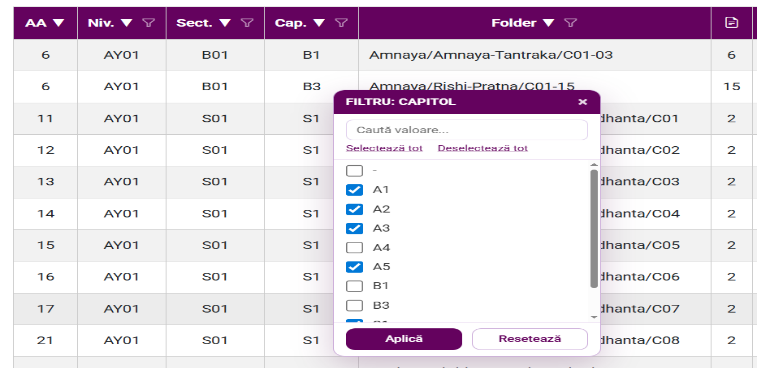
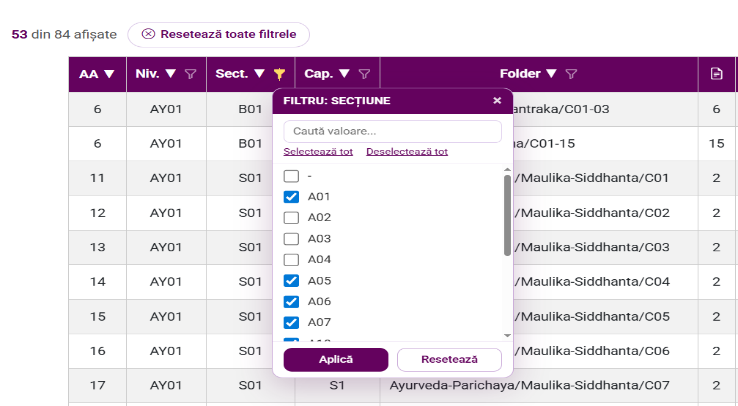
Three new columns have been added to the main “Written Support” table: “Lvl.”, “Sect.”, and “Chap.” They indicate the study level, section, and major chapter associated with each archive.
These references allow users to locate materials precisely within the curriculum and connect available resources to the organization published in the digital “Ayurveda Agenda” magazine under its educational resources section.
With these three columns, each archive is easier to position within the wider course. Users can see not just the folder name but also its place in the structure: study level, thematic section, and chapter. This is particularly useful for students following the course in sequence and for graduates or lecturers who need to find a particular subject quickly.
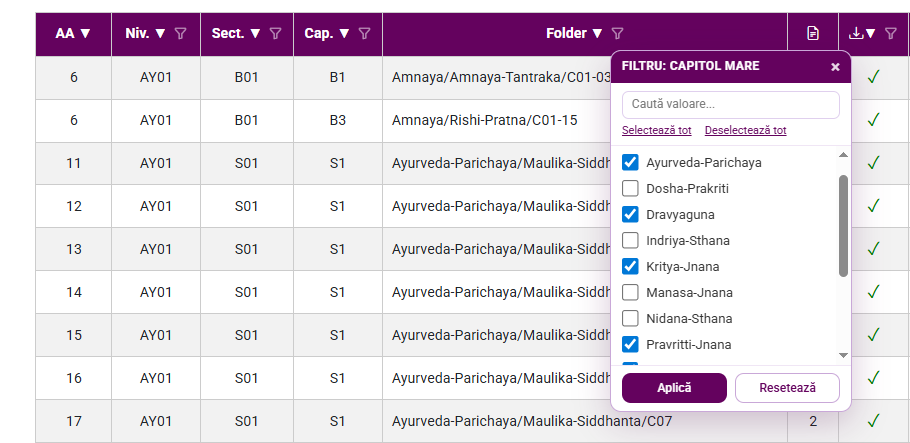
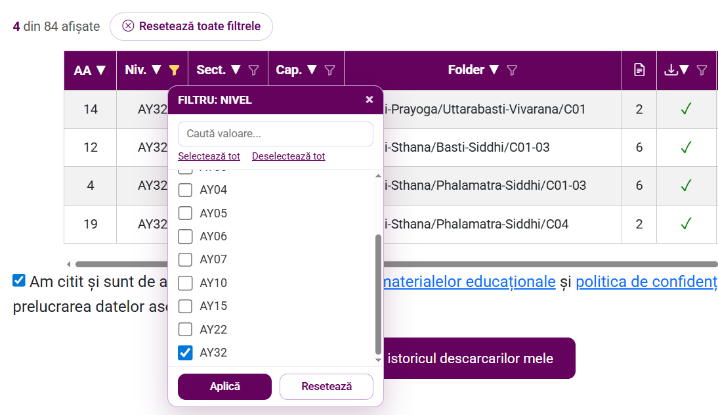
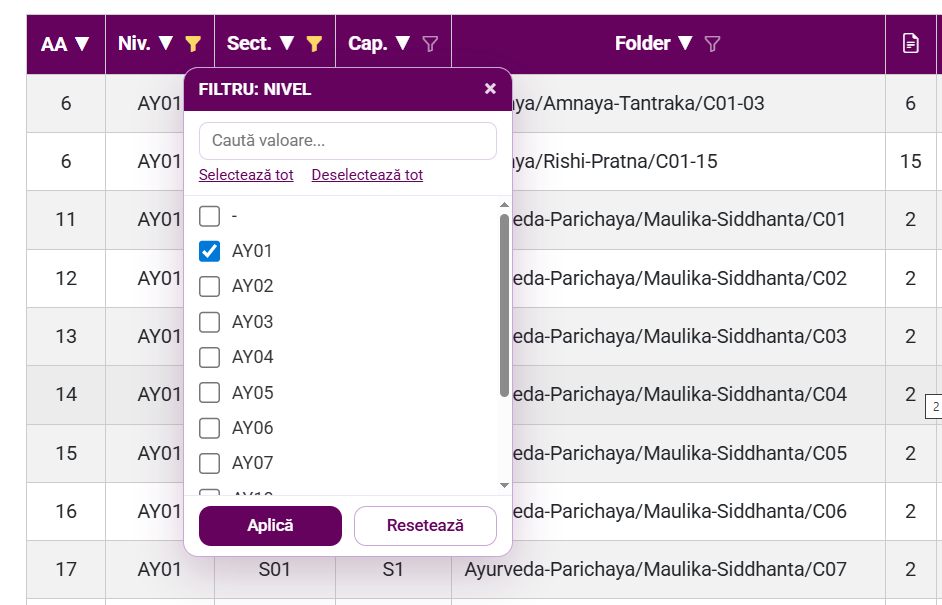
Another important addition is filtering. Users can quickly select relevant sections or chapters by checking items from a list in a separate window.
Users can select one or several topics, select all options, clear them all, search for a value, and apply a filter to show only relevant archives. This makes the displayed list much easier to manage.
For example, users who wish to see only materials from Ayurveda-Parichaya, Dosha-Prakriti, Dravyaguna, Indriya-Sthana, Kriya-Jnana, Manasa-Jnana, or Nidana-Sthana no longer need to scroll through the entire list.
The filter immediately limits the display to the selected area. This is especially useful when the table contains many accessible archives and manual searching would take extra time.
Sorting complements filtering. Columns can be ordered so that materials appear in a sequence that is easier to follow by level, section, chapter, or folder.
Together, sorting and filtering turn the “Written Support” page into a clear, flexible working tool aligned with the needs of systematic study.
This organization fits naturally into the improvements introduced earlier. The personal download report records materials already accessed and can be saved as a PDF.
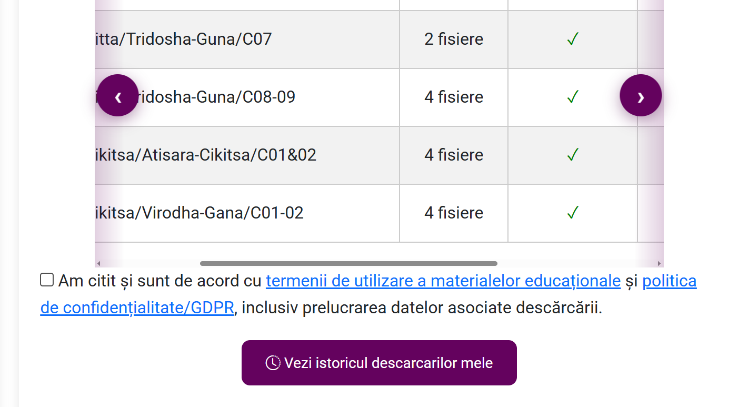
Sideways navigation helps users find important information on small screens or when not all columns fit. New sorting and filtering options make it possible to quickly restrict the visible list to the desired section or chapter.
Through these successive improvements, the “Written Support” page becomes more than a place to download archives: it also helps track, navigate, and organize study. Users can check which materials are available, which they have already downloaded, where these materials belong in the course structure, and how to select them by subject.
This feature supports rigorous use of written educational resources in keeping with individual study pace and the progressive structure of Ayurveda courses. Sorting by level, section, and chapter, together with folder filtering, makes navigation practical and precise and helps users clearly manage the materials available in their personal accounts.