| 1 | An exceptional Romanian–Indian cultural event at India House |
Vasudhaiva Kutumbakam – India’s vision of a peaceful world as one family
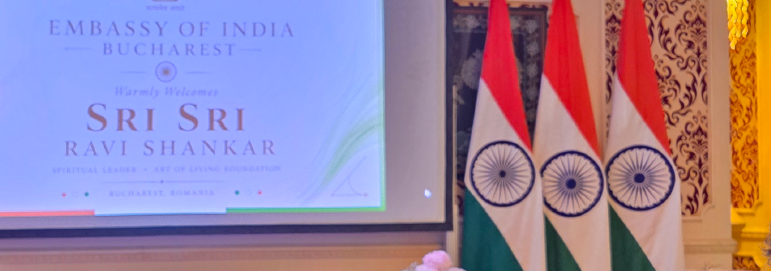
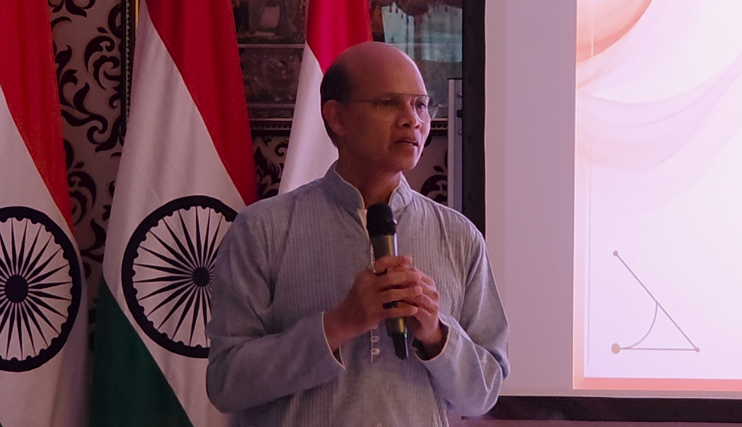
During the reception held on Friday, June 12, 2026, at India House, the residence of the Ambassador of India in Bucharest, His Excellency Dr. Manoj Kumar Mohapatra, Ambassador of India to Romania, offered participants a broad perspective on how contemporary India understands its role in the world: through dialogue, solidarity, education, international responsibility, and peaceful cooperation.
Addressing guests directly and warmly, His Excellency placed one of the fundamental expressions of Indian thought, Vasudhaiva Kutumbakam, at the heart of his remarks, explaining it in a simple yet profound statement: “The whole world is one family”.
This idea, with ancient roots in Indian spirituality and philosophy, expresses the conviction that humanity cannot be understood solely through geopolitical, economic, or cultural divisions; rather, it should be seen as an extended community in which responsibility and mutual understanding are essential values.
His Excellency recalled that this vision had also been emphasized during India’s G20 presidency, when India proposed a message of unity and convergence to the world: “One Earth, One Family, One Future”. This idea was invoked as the expression of an enduring philosophy that integrates economic development, technological progress, and international action into a broader vision of peace and cooperation.
An important point in his remarks concerned the pandemic, recalled as a time of great hardship worldwide but also an opportunity to demonstrate solidarity in concrete ways. His Excellency stressed India’s major role in producing and distributing medical resources, stating that Indian assistance reached “more than one hundred countries”. Beyond the figure itself, his remarks emphasized that a nation’s substantial capacity becomes truly valuable when directed toward the common good of all people on the planet.
From this perspective, India was presented as a civilization seeking to express its rise peacefully, cooperatively, and responsibly. “This is our philosophy”, His Excellency emphasized, referring to how India seeks to share its experience, knowledge, and resources with friends, partners, communities, and countries facing hardship or need.
A moment of particular significance for the Romanian audience came when the Ambassador of India described the closeness between India and Romania in warm, inclusive terms: “We consider Romanians members of our community”.
This statement goes beyond strict diplomatic protocol and expresses a genuine willingness for cultural engagement, institutional dialogue, and stronger relations between India and Romania. In the context of the cultural event, these words demonstrated not only diplomatic courtesy but also a remarkable sense of cultural and human affinity capable of inspiring and sustaining valuable long-term joint projects.
For the weekly Ayurveda Agenda, this perspective has special resonance. Ayurveda, as a traditional science of life, has always formed part of a wider vision of balance, responsibility, and harmony among the human being, community, and nature. Vasudhaiva Kutumbakam may therefore also be understood as a civilizational extension of a view of collective health: the world becomes more balanced when peoples, institutions, and communities relate to one another through respect, mutual support, and caring, clear-minded cooperation.
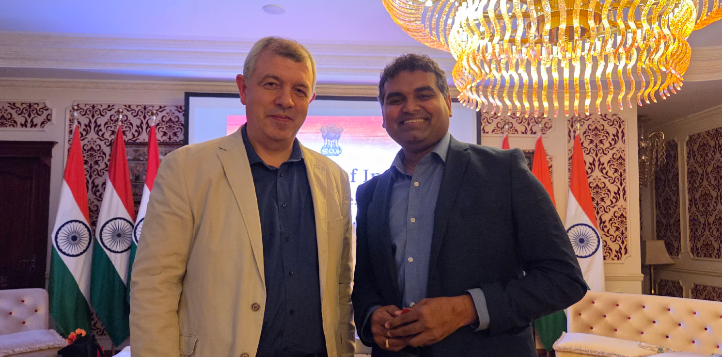
His Excellency’s address highlighted that relations between India and Romania can be strengthened not only through economic or diplomatic exchanges but also through shared values: education, culture, health, social responsibility, and openness to authentic traditions of knowledge and spirituality. In this sense, the presence of AMN-România representatives confirmed their interest in deepening Romanian–Indian dialogue and promoting fruitful forms of cooperation that bring India’s spiritual and scientific heritage together with Romania’s cultural and educational interests.
At the close of his remarks, His Excellency expressed gratitude and warmth using “Dhanyavad” – “Thank you” – and the greeting “Jai Hind.” These words concluded an address that naturally brought together philosophical reflection, diplomatic experience, international solidarity, and friendship toward Romania. His message presented contemporary India as a place of continuity between tradition and modernity, spiritual vision and concrete action, and national identity and global responsibility.
Sri Sri Ravi Shankar at India House – a presence of peace, simplicity, and dialogue
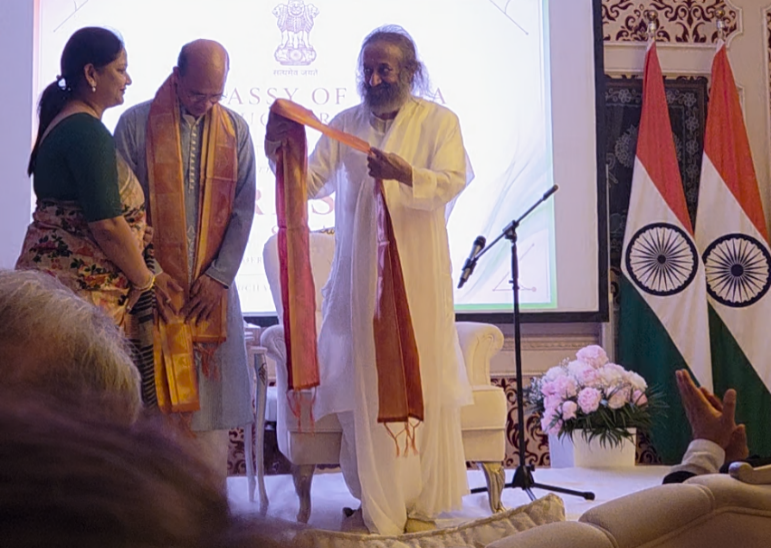
At the evening event at India House, the residence of the Ambassador of India in Bucharest, Gurudev Sri Sri Ravi Shankar brought participants the warmth of a direct, simple, deeply human encounter. The event was distinctive precisely because dialogue created a space for questions, answers, and reflection.
In the opening part of his remarks, Sri Sri Ravi Shankar addressed one of the most sensitive issues of the modern world: anxiety. He observed that humanity has faced increasingly intense forms of unease, tension, and insecurity in recent decades, yet also noted a subtle phenomenon: when a certain problem becomes very pervasive, people gradually grow accustomed to it and become less sensitive to it. In his words, when we spend too long inside a problem, it may no longer seem so large, even though the challenges and anxiety remain.
Sri Sri Ravi Shankar offered an inner, practical response. To overcome anxiety, a person must “turn inward, go within”. This simple phrase captured one of the evening’s central ideas: peace cannot be built solely through external solutions, however necessary they may be, but also requires inner transformation and reconnection with the deepest spiritual center of the being.
In the same context, Sri Sri Ravi Shankar emphasized that “at this time we need peacemakers”. The statement resonated strongly in an era of conflicts and collective tensions.
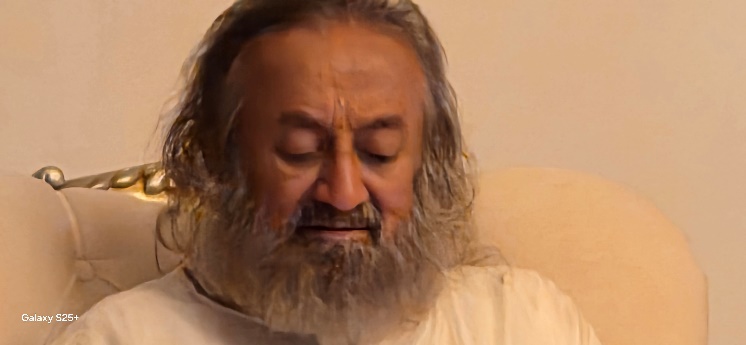
Sri Sri Ravi Shankar explained that when divisions arise, communication breaks down from within. Restoring peace begins with restoring communication, rebuilding trust, and overcoming reactions driven by fear or misunderstanding.
To highlight the historical continuity of conflict, Gurudev recalled that periods without conflict have been very rare in recorded human history. This observation was a call for clear-mindedness: the present world needs peace precisely because history has seen too much violence, suffering, and division among communities, peoples, and individuals.
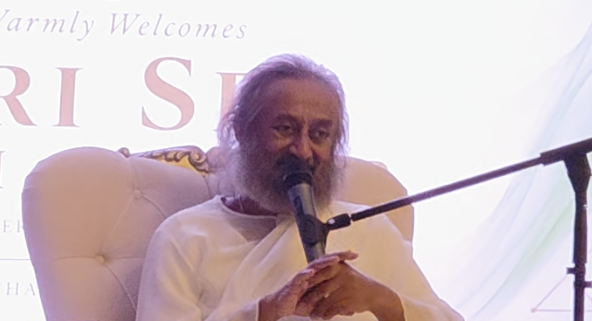
What was particularly striking was how Sri Sri Ravi Shankar combined these serious themes with a calm, serene, approachable presence. He answered participants’ questions naturally, attentively, and gently, turning the meeting into a profound dialogue. His answers often had the simplicity of essential advice, but behind that simplicity was the experience of a life dedicated to deep meditation, inner peace, and bringing people closer together.
For participants, the dialogue was especially valuable because their questions raised concrete concerns: contemporary anxiety, the need for balance, human communication, the difficulty of maintaining inner peace in a tense environment, and how everyone can contribute, however modestly, to reducing conflict around them. Sri Sri Ravi Shankar addressed these concerns warmly and vividly, repeatedly guiding attention toward introspection, clarity, affection, calm, and responsibility.
For Ayurveda Agenda, such a meeting holds special significance. Ayurveda, as a traditional science of life, views health not merely as the absence of disease but as harmony among body, energy, consciousness, community, and the broader rhythms of existence. From this perspective, Sri Sri Ravi Shankar’s message about turning inward, peace, and overcoming anxiety fits naturally into a holistic vision of the human being.
The event at India House was a remarkable moment of human connection and reflection, where Indian spirituality was expressed through a warm, open, deeply communicative presence.
In his replies, Sri Sri Ravi Shankar also explained meditation’s role as a profound form of conscious rest. Gurudev noted that ordinary sleep gives body and consciousness rest, but deep meditation creates a different state: the body rests profoundly while consciousness remains awake, present, and gently alert. In this sense, meditation is a means of inner recovery through which a person can experience deep calm and regeneration in a short time.
Through his answers, Gurudev Sri Sri Ravi Shankar showed that inner peace is a living practice, beginning within each individual and then spreading into family and society.
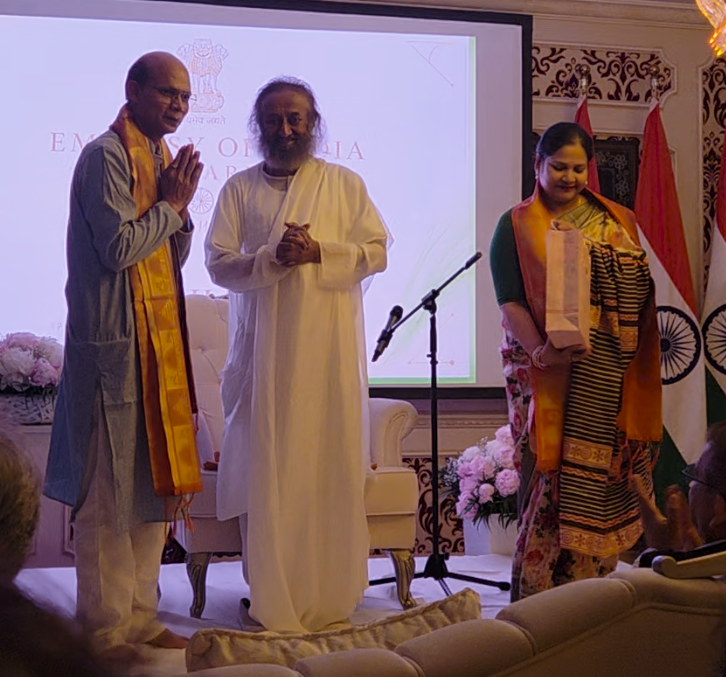
His message remains clear and timely: people need to find their way back to themselves so that they, in turn, can become “bearers of peace”.