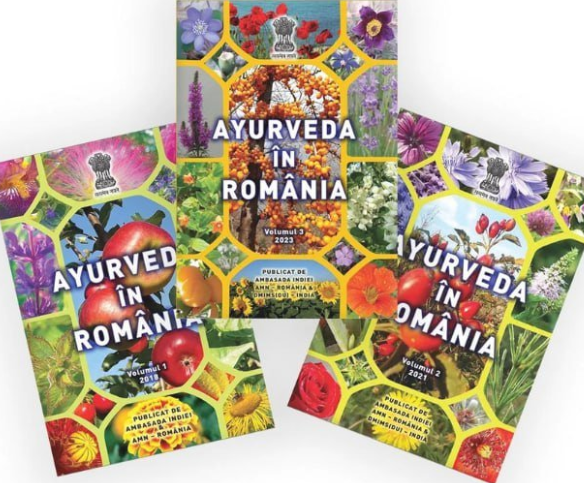
Ayurveda in Romania, Volumes 1, 2, and 3, Romanian Edition
A three-volume editorial collection devoted to the study of Ayurveda in Romania, integrating history, practice, phytotherapy, testimonials, and experiences into a unified, practical structure.
The Romanian-language set Ayurveda in Romania – Volumes 1, 2, and 3 is an extensive editorial synthesis devoted to introducing, developing, and consolidating the study of Ayurveda in Romania through a structured, coherent approach.
Each volume has 200 pages, includes numerous color illustrations, and is consistently organized into four distinct sections of 50 pages each. This gives the series a clear, balanced structure that is easy to navigate. It allows readers either to work progressively through the complete set or to consult selected subjects according to their interests.
The first part of each volume covers landmark events in promoting Ayurveda in Romania and illustrates the extensive history of collaboration between AMN-România and representatives of India in promoting Ayurveda.
These sections provide valuable documentary context and highlight the actual development of this field of knowledge in Romania.
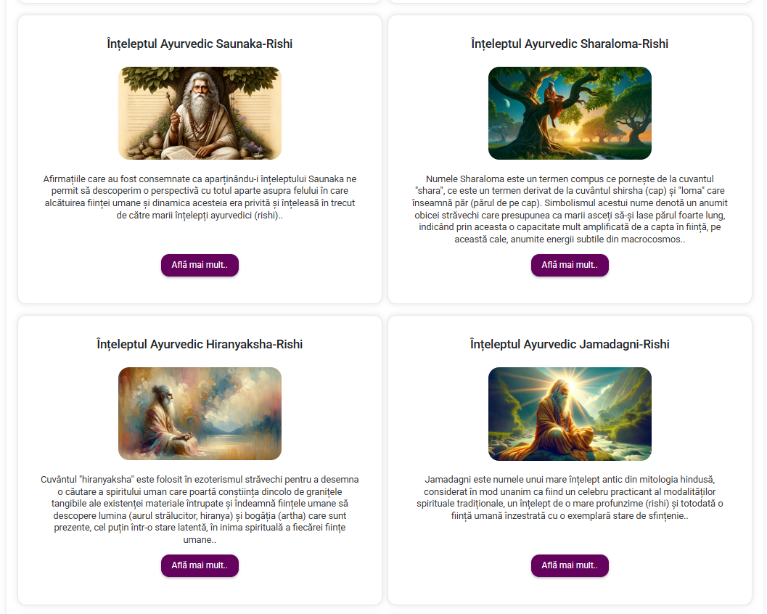
The second part is devoted to Ayurvedic history and presentations of Ayurvedic sages, helping readers understand the tradition's roots and foundations. It provides important reference points for studying the historical, cultural, and philosophical dimensions of Ayurveda in greater depth.
The third part introduces local medicinal plants through Ayurvedic characterization criteria, including Romanian plants studied in Romania according to Ayurvedic principles. This integration is a distinctive feature of the work, bringing local botanical resources into a practical framework.
The fourth part gathers numerous accounts from practitioners and students, illustrating the tangible impact of systematic Ayurvedic knowledge on their personal and professional lives.
Together, the three volumes offer a comprehensive approach combining documentation, theoretical study, practical applications, and direct experience, creating a valuable resource for studying and exploring Ayurveda in Romania more deeply.
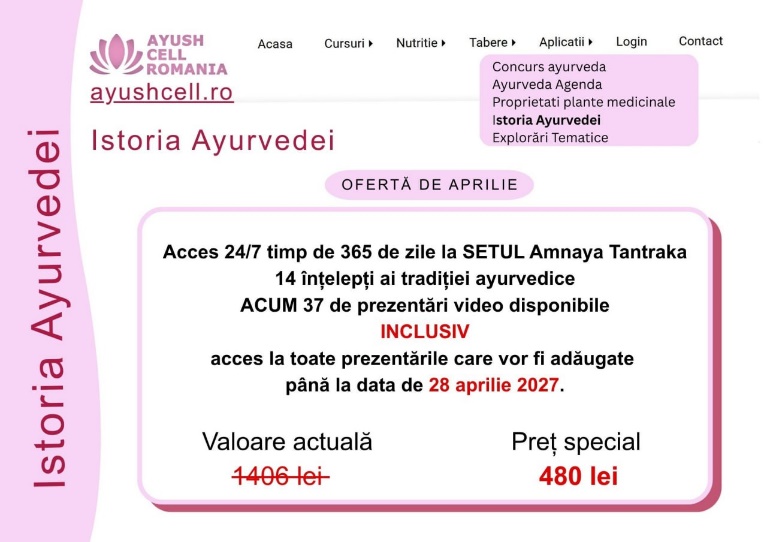
History of Ayurveda – A Complete-Access Package Featuring an Extensive Series of Presentations on Ayurvedic Sages
A video educational package supporting flexible, in-depth study of Ayurvedic tradition through extended 365-day access, thematic organization, and the ability to revisit content.
The Spring 2026 offer provides access to a distinctive educational package designed for those who wish to deepen their Ayurveda studies in a clear, precise, well-documented, flexible, and structured way. Amnaya Tantraka brings together an extensive collection of video recordings that support both introductory learning and, above all, a profound understanding of Ayurvedic tradition.
The educational value of the package lies in how it supports independent study, revisiting important subjects, and gradually integrating essential Ayurvedic concepts. The materials are organized to support personalized progress, encourage reflection, and enable thoughtful exploration at each user's own pace.
With extended access for 365 days, users are not confined to a one-time viewing; they receive a study resource that can be revisited, compared, and put to use progressively.
Amnaya Tantraka is more than a video package: it offers concrete support for consolidating knowledge, organizing information, and cultivating a living, illuminating connection with Ayurvedic wisdom.
The video package provides valuable reference points for studying the tradition of Ayurvedic sages and their contributions to the development of Ayurveda:
One course revised from the Maulika-Siddhanta chapter on the four essential laws of Nature
Lesson 5 presents Ayurvedic principles in relation to the essential laws of Nature and highlights their integrated ecological and therapeutic dimensions.
Lesson 5 belongs to study level 1 (AY01), supplementary Ayurveda-Parichaya section (S01), chapter 1, Maulika-Siddhanta (S1), and is available as easy-to-read A4 and foldable A5 PDFs. Its code is AY01-S01-S1-C05.
Course titles and their place in the Basic Ayurveda Course curriculum
Two courses revised from the Tridosha-Guna chapter on the qualities of the dosha and how this knowledge helps assess interactions
Lessons 3 and 4 explain the qualitative nature of the dosha and their dynamic relationship with the seasons, Ayurvedic constitution, and personal balance.
Lessons 3 and 4 belong to study level 2 (AY02), main Svasthavritta section (A02), chapter Tridosha-Guna (A1), and are available as easy-to-read A4 PDFsand foldable A5 PDFs. Their course codes are: AY02-A02-A1-C03 and AY02-A02-A1-C04.
Course titles and their place in the Basic Ayurveda Course curriculum
Qualitative Characterization of the Dosha and Dynamic Balance of the Tridosha System
Explanatory notes
Title: Svasthavritta_Tridosha-Guna_C03&C04
Ayurveda – Study Level 3 – AY03
5
Two courses updated from the Dravya chapter on elementary substances
Lessons 2 and 3 present the structure of elementary substances and describe Ayurvedic knowledge concerning their properties, classification, and use in remedies.
Lessons 2 and 3 belong to study level 3 (AY03), Dravyaguna section (A03), Dravya chapter (A1), and are available as easy-to-read A4 and foldable A5 PDFs. Their course codes are: AY03-A03-A1-C02 and AY03-A03-A1-C03.
The Dravyaguna (A03) section presents the traditional Ayurvedic system for characterizing natural therapeutic substances and the classification criteria used in Ayurveda.
Course titles and their place in the Basic Ayurveda Course curriculum
Elementary Substances and Ayurvedic Understanding of Therapeutic Properties
Explanatory notes
Title: Dravyaguna_Dravya_C02&C03
Ayurveda – Study Level 4 – AY04
6
One course revised from the Avastha-Dhatu chapter on tissue nourishment and the differences among the processes involved
Lesson 8 introduces three Ayurvedic laws of tissue nourishment and the mechanisms by which nutrients are distributed and transformed.
Lesson 8 belongs to study level 4 (AY04), Sharira-Jnana section (A04), Avastha-Dhatu chapter (A1), and is available as easy-to-read A4 and foldable A5 PDFs, under code AY04-A04-A1-C08.
Course titles and their place in the Basic Ayurveda Course curriculum
Laws of Tissue Nourishment and Mechanisms of Nutritional Supply
Explanatory notes
Title: Sharira-Jnana_Avastha-Dhatu_C08
Ayurveda – Study Level 5 – AY05
7
Two courses revised from the Srota chapter on the nature and classification of channel systems (srota)
The lessons explain the nature, classification, and functions of Ayurvedic channel systems, highlighting how they support vital processes.
Lessons 2 and 3 belong to study level 5 (AY05), Kritya-Jnana section (A05), Srota chapter (A1), and are available as easy-to-read A4 and foldable A5 PDFs. Their course codes are: AY05-A05-A1-C02 and AY05-A05-A1-C03.
The Kritya-Jnana presents the human being's bodily and energetic dynamics by describing functions and processes of circulation, transformation, and coordination that sustain the living organism.
Course titles and their place in the Basic Ayurveda Course curriculum
Nature, Classification, and Functions of Channel Systems (srota) in Ayurveda
Explanatory notes
Title: Kritya-Jnana_Srota_C02&C03
Ayurveda – Study Level 6 – AY06
8
Two courses revised in the Manasa-Jnana series, Buddhi chapter, on the role of intelligence
Lessons 1 and 2 define intelligence as a discriminative, spiritual, and practical power, highlighting its many forms and transformative role.
Lessons 1 and 2 belong to study level 6 (AY06), Manasa-Jnana section (A06), Buddhi chapter (A06A3), and are available as easy-to-read A4 and foldable A5 PDFs. Their course codes are: AY06-A06-A3-C01 and AY06-A06-A3-C02.
The Buddhi (A3) chapter presents the traditional Ayurvedic understanding of human intelligence and the capacity for discernment.
Course titles and their place in the Basic Ayurveda Course curriculum
Discriminative Intelligence and Its Forms of Expression
Explanatory notes
Title: Manasa-Jnana_Buddhi_C01&C02
Current updates
9
A New Video Presentation in the “Thematic Explorations” Series: “Healing Plants in Christian Tradition”
A presentation exploring the role of medicinal plants in Christian tradition as expressions of divine compassion and means of supporting physical and spiritual balance.
The Written Support Dialog Makes It Easy to Report Situations Requiring Verification
A Practical Tool for Submitting Requests About Access to Written Materials Appropriate to One's Study Level
This dialog helps users submit precise requests after personally reviewing information already published in the “Educational Resources” section of Ayurveda Agenda, so that inquiries concern concrete, identifiable matters relevant to the situation reported. It can help avoid confusion and ensure that administrative verification of materials displayed on the personal “Written Support” page is carried out appropriately. For situations requiring additional clarification, users may be contacted by telephone at the number provided in the form.