Ayurveda Agenda 26 / 2026 Contents

Events

1

Meeting of AMN-România Ayurveda lecturers – July 5, 2026

Thematic presentation of the Ayurveda course curriculum, updates to the written study materials application, and the organization of educational and hands-on activities during the summer.

On Sunday, July 5, 2026, beginning at 11:00 a.m., another online meeting of AMN-România Ayurveda lecturers will take place. It will focus on presenting the Pravritti-Jnana section and updating the main study directions for the current stages of Ayurveda training.

The meeting aims to deepen understanding of the structure of the Ayurveda course curriculum, particularly how the Pravritti-Jnana section contributes to understanding the inner dynamics of instrumental consciousness, active tendencies, and orientations involved in shaping inner experience.

A central part of the presentation will continue the discussion of Pravritti-Jnana, clarifying the methodological and teaching reference points needed to integrate this subject into the educational progression of Ayurveda courses.

The meeting will also introduce new written materials in the Svasthya-Darshana chapter, intended to deepen the Ayurvedic view of health, inner balance, and self-observation. These materials seek to support a clearer understanding of how Ayurvedic healing principles can be integrated into appropriate, progressive, and applicable personal practice.

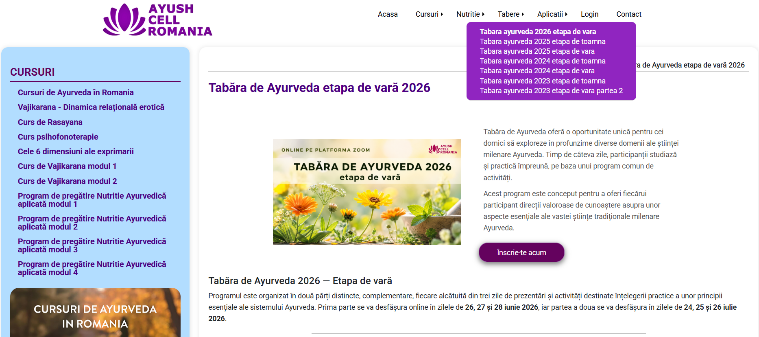
The general topics of the second part of the Summer 2026 Ayurveda Retreat will also be reviewed, including its main study areas, thematic structure, and place within personal training. This part of the lecturers’ meeting will clarify the overall direction and specific aspects of the retreat’s second summer session, as well as how it will be conducted.

The meeting will include an organizational presentation on registration for applied and practical activities scheduled for August. It will cover the principal activities, the participation framework, registration procedures, and the preparations needed by those wishing to attend.

There will also be an update on the use of the online Ayurveda course platform, focusing on the written materials section, access to new educational resources, and platform functions for lecturers’ ongoing work. Access to available documents, use of digital resources, and procedures for updating information necessary for current teaching and organizational activities will be explained.

The meeting is intended to strengthen lecturers’ educational preparation, provide information about the Ayurveda curriculum, and facilitate better coordination regarding written course materials, the Summer Ayurveda Retreat program, and the applied and practical activities scheduled for August.
Books and publications

2

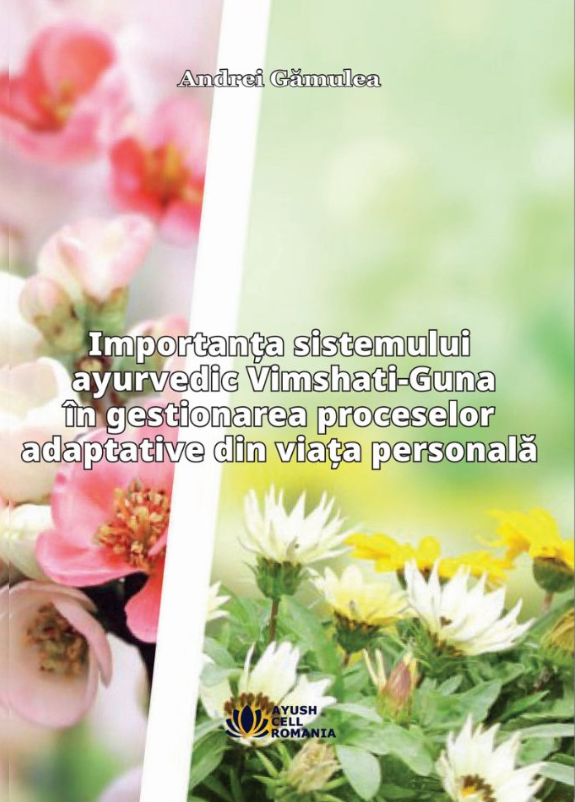
The importance of the Ayurvedic Vimshati-Guna system in managing adaptive processes

A work dedicated to using the system of twenty general qualities as a modern tool for self-knowledge, assessment, and optimizing adaptive capacity.

The work offers a broad, well-reasoned approach to one of Ayurveda’s foundational systems, Vimshati-Guna. It highlights the role of the twenty general qualities in understanding biological, psychological, and behavioral processes that support human balance. It develops an interpretive model of adaptive mechanisms, consistently relating Ayurvedic principles to modern research in physiology, psychology, and medicine.

A distinctive feature is its detailed analysis of each of the ten pairs of complementary qualities – Guru/Laghu, Ushna/Shita, Ruksha/Snigdha, Tikshna/Manda, Chala/Sthira, Sandra/Drava, Khara/Slakshna, Vishada/Picchila, Kathina/Mridu, and Sukshma/Sthula. Each is explained from the standpoint of Ayurvedic tradition through analogies and correlations with physiological and functional processes described by contemporary science.

The book develops the concept of adaptation as a central process of life in an original way. It examines mechanisms involved in adaptive responses, the relationship between stress and resilience, homeostasis, autonomic nervous system function, and the roles of the endocrine and immune systems in maintaining health.

A valuable contribution is its presentation of accessible methods for assessing the effectiveness of adaptive processes. Vimshati-Guna is presented as a practical tool for observing one’s own physiological, emotional, and behavioral reactions, facilitating early recognition of imbalance tendencies and a move toward appropriate self-regulation.

The volume devotes particular attention to the educational dimension of this traditional system and its role in developing discernment.

Numerous practical examples illustrate how the twenty general qualities can guide choices about nutrition, rest, activity, emotion management, and interaction with the environment.

The book also includes directions for further study and educational resources on Vimshati-Guna within Ayurveda programs offered in Romania.

The volume serves as a contemporary methodological guide to the practical integration of Ayurvedic principles into modern life. Its interdisciplinary character and consistent focus on practical application provide a framework for understanding the dynamic relationship between adaptation, balance, and conscious personal development.

The book is available on the website: animaplant.ro/produs/importanta-sistemului-ayurvedic-vimshati-guna-in-gestionarea-proceselor-adaptative-din-viata-personala/

Contents

3

Contents of the current issue of the digital magazine Ayurveda Agenda

The table of contents of the digital magazine Ayurveda Agenda includes details about the chapters of the educational resources for each study level covered.

Events

p. 01

Books and publications

p. 02

Contents

p. 03

Educational resources

pp. 03–04

Ayurveda – Level 01

p. 03

▶ Prakriti-Nikasha

C05 (R)

Ayurveda – Level 02

p. 04

▶ Dosha-Samya

C02 (A)

Ayurveda – Level 32

p. 04

▶ Phalamatra-Siddhi

C05&06 (N)

Educational resources

Ayurveda – Study Level 1 – AY01

4

One course revised from the Prakriti-Nikasha chapter on physical assessment criteria

Course 5 explains how to identify constitutional type using physical constitutional criteria (nikasha) relating to the skin, sweating, nails, hair, mouth, and teeth.

Course 5 is included in Study Level 1 (AY01) of study, in the Dosha-Prakriti section (A01), Chapter 3, Prakriti-Nikasha (A3), and is available as an easy-to-read A4 PDF and a foldable A5 PDF. This course has the code: AY01-A01-A3-C05.

Course titles and their place in the Basic Ayurveda Course curriculum

📁 AY01
 ├─ 📁 A01: Dosha-Prakriti
  │   ├─📁 A1: Ayurveda-Padartha
  │   ├─📁 A2: Svasthya-Darshana
  │   └─📁 A3: Prakriti-Nikasha
  │         └─ 📄 Dosha-Prakriti_Prakriti-Nikasha_C05
 ├─ 📁 B01: Amnaya
 └─ 📁 S01: Ayurveda-Parichaya

Observable constitutional criteria: skin, sweating, nails, hair, and teeth

Explanatory notes

Title: Dosha-Prakriti_Prakriti-Nikasha_C05

Ayurveda – Study Level 2 – AY02

4

One course updated from the Dosha-Samya chapter on inner reordering and the main areas of balancing intervention

Course 2 explains the reordering of consciousness and the practical areas through which Dosha-Samya supports balancing the vital forces.

Course 2 belongs to Study Level 2 (AY02) of study, in the main Svasthavritta section (A02), chapter Dosha-Samya (A3), and is available in both PDF A4, easy-to-read, and PDF A5, foldable, with code: AY02-A02-A3-C02.

Course titles and their place in the Basic Ayurveda Course curriculum

📁 AY02
└─ 📁 A02: Svasthavritta
   ├─ 📁 A1: Tridosha-Guna
   ├─ 📁 A2: Dosha-Vaisamya
   ├─ 📁 A3: Dosha-Samya
   │     └─ 📄 Svasthavritta_Dosha-Samya_C02
   └─ 📁 A4: Dosha-Sambandha

Inner reordering and the areas of dosha balance

Explanatory notes

Title: Svasthavritta_Dosha-Samya_C02

Ayurveda – Study Level 32 – AY32

5

Two courses new from the Phalamātrā-Siddhi chapter on saṅga-vighaṭa and the psychological implications of functional regulation through basti

Courses 5 and 6 explain the dual concept of saṅga-vighaṭa as a principle of connection and separation leading to physiological regulation, psychological balance, and appropriate, controlled therapeutic application.

Courses 5 and 6 belong to Study Level 32 (AY32), the Siddhi-Sthāna section (A32), the Phalamātrā-Siddhi chapter (A3), and are available as easy-to-read A4 PDFs and foldable A5 PDFs, with the codes: AY32-A32-A3-C05 and AY32-A32-A3-C06.

Course titles and their place in the Basic Ayurveda Course curriculum

📁 AY32
└─ 📁 A32: Siddhi-Sthāna
   └─ 📁 A3: Phalamātrā-Siddhi
          └─ 📄 Siddhi-Sthāna_Phalamātrā-Siddhi_C05&C06

Saṅga-vighaṭa and the regulatory function of vāta-doṣa

Explanatory notes

Title: Siddhi-Sthana_Phalamatra-Siddhi_C05&C06

Access: ayushcell.ro/suport_scris