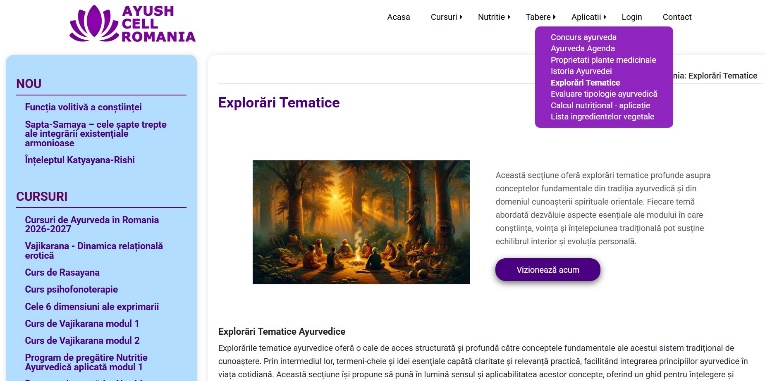
| 1 | The collection of thematic explorations on ayushcell.ro offers a dedicated space for interdisciplinary learning |
A section dedicated to exploring current topics through a wide range of subjects from Ayurveda, alongside illustrative perspectives from the traditional Yoga, Unani, and Siddha systems.
The “Thematic Explorations” section of the Ayush Cell România website offers a distinctive study space in which foundational ideas from Eastern traditions are presented in a structured, accessible manner that connects with the concerns of contemporary life.

The diversity of subjects is one of the section’s greatest strengths. Health, constitutional balance, consciousness, willpower, adaptation, medicinal plants, cognitive processes, and spiritual practice are brought together in a broad field of exploration. The “Thematic Explorations” page provides access to recorded presentations and descriptions of the topics covered.
Ayurveda is at the heart of these presentations. Its concepts are also connected with the ancient system of Yoga, psychology, neuroscience, phytotherapy, the history of healing, and the systems grouped under the acronym AYUSH: Ayurveda, Yoga and Naturopathy, Unani, Siddha, and Homeopathy.
This openness reflects the integrative mission of the AYUSH field, in which distinct traditions can highlight their individual characteristics, values, and areas of convergence.
India’s Ministry of AYUSH presents all these systems as separate disciplines united by a shared interest in health, well-being, prevention, and the use of traditional care resources.
The topics available on ayushcell.ro illustrate the richness of this perspective. The presentation dedicated to the Sapta-Samaya system describes the seven stages of harmonious existential integration, while the topic on the twenty general qualities in Ayurveda (Vimshati-guna) seeks to explain physiological, emotional, psychological, and behavioral responses. Prakriti-Nikasha highlights the value of constitutional assessment when choosing medicinal plants, while the topic devoted to the science of Gupta-Cikitsa opens a line of inquiry into the subtle causes of imbalance. Other explorations address herbal medicine, focusing consciousness, the practice of withdrawal of the senses (pratyahara), volitional therapy, cognitronics, and the significance of healing plants in the Christian tradition. Together, these form a growing collection that brings traditional heritage into dialogue with questions relevant to modern life.


One representative area is the interdisciplinary examination of the volitional function of consciousness.
The Ayurvedic perspective on willpower is linked with explanations from psychology and neuroscience to investigate how a clear intention gradually becomes action. Defining a goal, determining whether it is beneficial, committing to an intention, mobilizing energy, and maintaining continuity become stages of a process that can be understood from both traditional and modern perspectives. Ayurveda provides a framework for the inner organization of the individual; Yoga contributes methods of concentration and disciplined attention; and modern research explains the roles of executive functions, motivation, and self-regulation.
Equally revealing is the exploration of connections between Ayurvedic constitutions and synergology, the study of body language. Posture, attitudes, gestures, and micro-movements can be examined in relation to the dynamics of the three doshas. This subject shows how Ayurvedic constitutional indicators can inspire a nuanced observation of constitutional expressiveness, supplemented by findings from behavioral psychology and nonverbal communication.

The illustrative approach plays an important role. Concepts are clarified through concrete situations, analogies, comparisons, and applied examples, making relationships between traditions easier to follow. An exploration of digestion, for example, might begin with agni in Ayurveda, move to digestion and metabolic transformation in Unani, and include the Siddha perspective on the balance of elements, food, and internal organization. Similarly, topics on breathing may bring together the role of prana in Ayurveda and Yoga, pranayama exercises, Unani ideas about regulating vital faculties, and respiratory practices preserved in the Siddha tradition.
Medicinal plants offer an especially rich field for comparison. The same plant may be examined through its rasa, virya, and vipaka properties in Ayurveda, through the temperamental qualities used in Unani, and through the elemental and energetic criteria of Siddha. Each illustrative example thus becomes a means of comparative understanding, highlighting both the common ground and the distinct contribution of each tradition.
Through this diversity, the “Thematic Explorations” section goes beyond a collection of recordings and creates a genuine laboratory of valuable ideas and perspectives. Ayurveda, the traditional Science of Life, remains its central axis; Yoga broadens its practical dimension; and Unani, Siddha, and other AYUSH disciplines expand its horizon. The result is a distinctive form of integrative education that can turn traditional concepts into meaningful reference points for understanding and balance.
Access: ayushcell.ro/explorari_tematice