Meeting of AMN-România Ayurveda Instructors – May 17, 2026
A New Thematic Presentation on Organizing the Ayurveda Course Curriculum and Online Access to Study Resources for Different Ayurveda Training Levels
On May 17, 2026, starting at 11:00 a.m., another online meeting of Ayurveda instructors within AMN-România will take place, devoted to the structure of education at Level 7 of the Ayurveda course organized by AMN-România, with emphasis on updating and exploring in greater depth the areas of study appropriate to this stage of training.
The meeting will present the general Level 7 course curriculum, organized as a thematic section divided into specialized chapters, to clarify methodological orientation and integrate new study subjects into this educational level.
A central topic will be the introduction of the Pravritti-Jnana (A07) section, devoted to the dynamics, active tendencies, and functional orientations of instrumental consciousness within the human being's inner experience. The section examines how inner processes contribute to forming reactions, orientations, and behavioral responses.
The meeting will also introduce a new first chapter in the Pravritti-Jnana section, entitled Cetas-Pravritti (A1), added to the Level 7 curriculum. It explores how instrumental consciousness is activated and oriented in perception, thought, inner reactions, and action, examining the internal field of consciousness's participation in experience and the formation of active tendencies.
The meeting will also examine how these subjects fit within teaching at AyurvedaLevel 7 and their relationship to other foundational sections of the Ayurveda curriculum, particularly the Level 6 course structure.
Organizational matters concerning access to written course materials and updates to educational resources available on the platform devoted to Ayurveda courses.
An updated presentation of the online platform for Ayurveda instructors will be given, emphasizing its principal administrative and educational functions. It will explain access to the volunteer-activities section, use of digital documents and forms, and procedures for entering and updating online information required for ongoing teaching and organizational work.
Books and publications
2
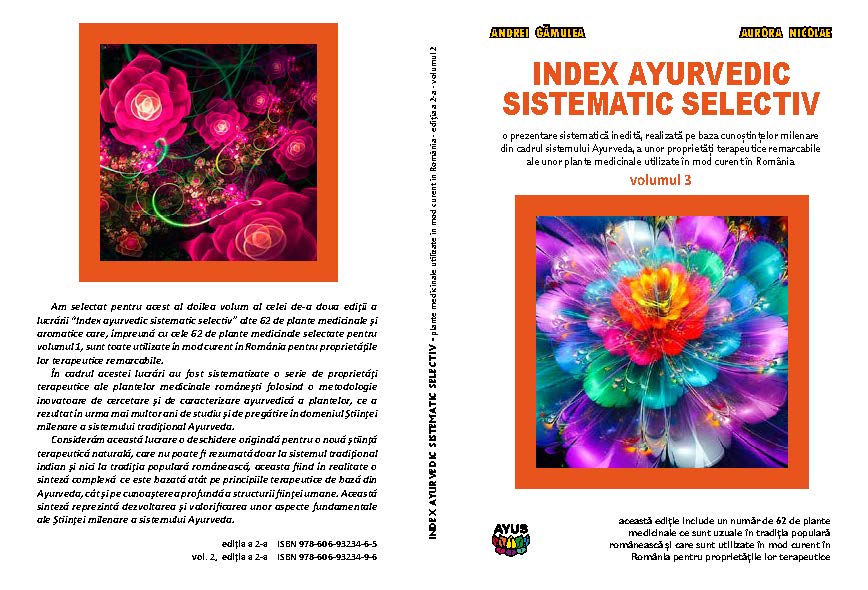
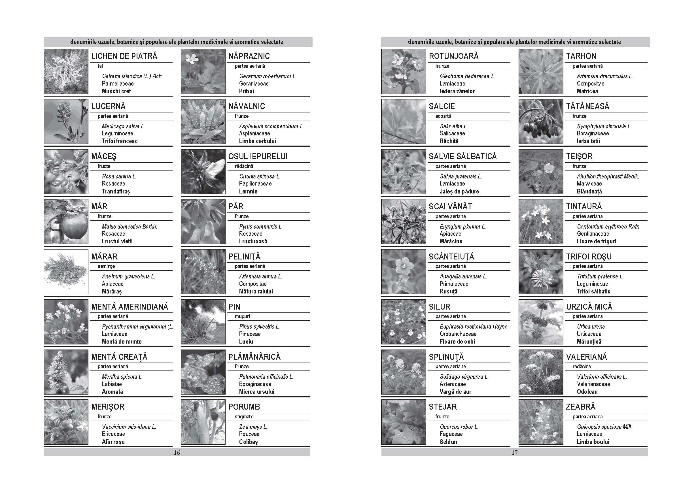
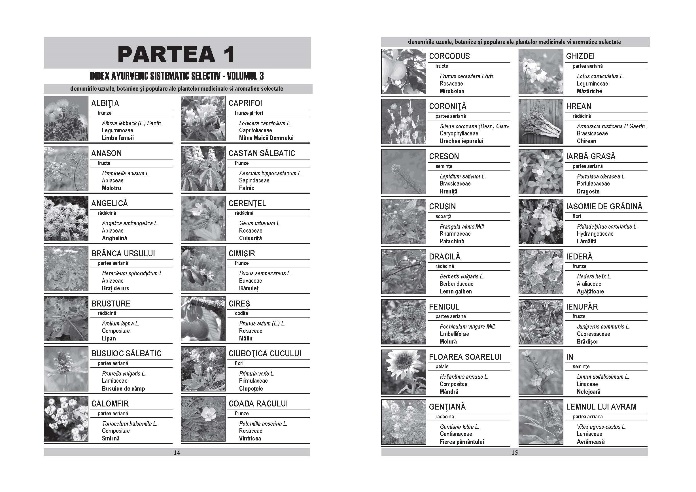
Selective Systematic Ayurvedic Index – Medicinal Plants from Romania – Volume 3
A Practical Approach to the Ayurvedic System for Characterizing Medicinal Plants Traditionally Used in Romania and Europe
Selective Systematic Ayurvedic Index – Volume 3 continues the presentation of Ayurvedic characterization of medicinal plants used in Romania and Europe. It builds on earlier volumes with a new group of medicinal and aromatic plants analyzed systematically according to traditional Ayurvedic criteria, with a practical orientation.
The volume belongs to the series developed by Andrei Gămulea and Aurora Nicolae and contributes to a new framework for integrating European phytotherapy into the Ayurvedic perspective.
The work highlights how medicinal plants can be assessed through fundamental properties, relationships with vital factors, and effects on different functional structures of the human being. Criteria include plants' qualitative nature, direction of action, and characteristic therapeutic effects.
The volume includes plants familiar in Romania, incorporated into a system of interpretation inspired by traditional Ayurvedic principles.
This approach interprets native plants through a unified therapeutic language compatible with the Ayurvedic conceptual framework.
The work emphasizes practical application, providing useful reference points for selecting plants according to individual circumstances and needs for harmonization. Phytotherapy is thus presented as a differentiated intervention tailored to personal characteristics.
Through its systematic structure and practical orientation, Selective Systematic Ayurvedic Index – Volume 3 is a valuable tool for studying phytotherapy and exploring the relationship between medicinal plants and Ayurvedic principles in greater depth.
Two courses revised from the Svasthya-Darshana chapter on inner orientation and the subtle energetic foundation of healing
Lessons 5 and 6 present healing as a process of inner harmonization, focused consciousness, and beneficial influence on the relationship between physical structure and the human being's subtle energetic substratum.
Lessons 5 and 6 belong to study level 1 (AY01), Dosha-Prakriti section (A01), chapter 2, Svasthya-Darshana (A2), and are available as easy-to-read A4 and foldable A5 PDFs. Their course codes are: AY01-A01-A2-C05 and AY01-A01-A2-C06.
Course titles and their place in the Basic Ayurveda Course curriculum
Beneficial Inner Orientation and the Quantum Level of Healing in Ayurveda
Explanatory notes
Title: Dosha-Prakriti_Svasthya-Darshana_C05&C06
Ayurveda – Study Level 4 – AY04
4
Two courses revised from the Sapta-Dhatu chapter on rasa-dhatu, nourishment, and its specific function called prinana
Lessons 4 and 5 explain nourishment of rasa-dhatu and the meaning of its general function, prinana, at nutritional, emotional, subtle, and spiritual levels.
Lessons 4 and 5 belong to study level 4 (AY04), Sharira-Jnana section (A04), Sapta-Dhatu chapter (A2), and are available as easy-to-read A4 and foldable A5 PDFs. Their course codes are AY04-A04-A2-C04 and AY04-A04-A2-C05.
Course titles and their place in the Basic Ayurveda Course curriculum
Nourishment of Rasa-Dhatu and the Deeper Meaning of Its Specific Function, Prinana
Explanatory notes
Title: Sharira-Jnana_Sapta-Dhatu_C04&C05
Ayurveda – Study Level 7 – AY07
5
One course new from the Cetas-Pravritti chapter, Pravritti-Jnana section, on the subtle levels of instrumental consciousness
Lesson 2 describes the functional orientation of instrumental consciousness and highlights the roles of subtle levels of reception, interpretation, integration, and identity attribution.
Lesson 2 belongs to study level 7 (AY07), Pravritti-Jnana section (A07), Cetas-Pravritti chapter (A1), and is available as easy-to-read A4 and foldable A5 PDFs, under code: AY07-A07-A1-C02.
Course titles and their place in the Basic Ayurveda Course curriculum
Functional Orientation of Instrumental Consciousness and Subtle Levels of Information Processing
Explanatory notes
Title: Pravritti-Jnana_Cetas-Pravritti_C02
6
Two courses revised from the Raksha-Viddhi chapter, Pravritti-Jnana section, on the formation and overcoming of defensive patterns
Lessons 2 and 3 explain the development, adaptive role, and transcendence of defense mechanisms through awakening clarity, sound judgment, and beneficial orientation.
Lessons 2 and 3 belong to study level 7 (AY07), Pravritti-Jnana section (A07), Raksha-Viddhi chapter (A2), and are available as easy-to-read A4 and foldable A5 PDFs. Their course codes are AY07-A07-A2-C02 and AY07-A07-A2-C03.
Course titles and their place in the Basic Ayurveda Course curriculum
Formation, Adaptation, and Overcoming of Ego Defense Mechanisms
Explanatory notes
Title: Pravritti-Jnana_Raksha-Viddhi_C02&C03
Ayurveda – Study Level 22 – AY22
7
Two courses revised from the Varnasvariya chapter on anticipatory signs of existential transitions in Ayurveda
Lessons 2 and 3 explain signs anticipating existential transformations and the role of audiovisual assessment in Indriya-Sthana.
Lessons 2 and 3 belong to study level 22 (AY22), Indriya-Sthana section (A22), Varnasvariya chapter (A1), and are available as easy-to-read A4 and foldable A5 PDFs, under codes AY22-A22-A1-C02 and AY22-A22-A1-C03.
Course titles and their place in the Basic Ayurveda Course curriculum
Anticipatory Signs of Existential Transitions in Indriya-Sthana
Explanatory notes
Title: Indriya-Sthana_Varnasvariya_C02&C03
Ayurveda – Study Level 32 – AY32
8
One course new from the Siddhi-Sthāna section, Phalamātrā-Siddhi chapter, on the systemic action of enema therapy (basti) and the role of vāyu
Lesson 4 explains the systemic action of enema therapy (basti) and highlights vāyu's profound regulatory role in harmonizing processes of functional separation and association.
Lesson 4 belongs to study level 32 (AY32), Siddhi-Sthāna section (A32), Phalamātrā-Siddhi chapter (A3), and is available as easy-to-read A4 and foldable A5 PDFs. Its new course code is: AY32-A32-A3-C04.
Course titles and their place in the Basic Ayurveda Course curriculum