A New Learning Path Establishing the Foundations of Narratotherapy According to the Principles of Sattvavajaya-Cikitsa, Supporting the Restructuring of Narrative Consciousness and Personal Harmonization
The specialized course in Narratotherapy begins with Module 1, “Biocompatible Narrative Psychoprogramming.” This first module introduces a framework for understanding and applying Narratotherapy. Narratotherapy is a method of working with consciousness that seeks to identify, reorganize, and rewrite personal narrative structures so that experiences can be perceived and integrated in a coherent, balanced manner conducive to self-regulation and harmonious development.
Based on the principles of sattvavajaya-cikitsa in Ayurveda and linked to contemporary research on narrative consciousness, the Narratotherapy course proposes an integrative approach to personal identity, directly related to inner balance and harmonious bodily functioning.
The educational path in Module 1 of Narratotherapy—“Biocompatible Narrative Psychoprogramming”—aims to identify limiting narrative patterns and dysfunctional structures that may adversely affect personal development, while providing practical tools for rewriting and reconfiguring them biocompatibly within personal consciousness.
The course explores operative concepts such as the narrative threshold, the relationship between narrative and non-narrative experience, and criteria for harmonizing narrative construction in consciousness with one's own biological and constitutional principles.
Through practical exercises and methods of conscious integration, Narratotherapy supports a clear, stable inner perspective, fostering self-regulation, regeneration, and emotional balance.
The fully recorded format allows students to work at their own pace and revisit essential concepts whenever necessary, helping integrate them gradually and effectively into daily life through personal practice.
Narratotherapy Course, Module 2: “Narrative Reordering of Consciousness”
A Practical Module Exploring Narratotherapy Through Methods of Reorganizing Consciousness and Harmonizing the Interpretation and Integration of Life Experiences
Module 2 of the Narratotherapy course, devoted to narrative reordering of consciousness, systematically develops the approaches introduced in Module 1, focusing transformation on a profound reorganization of how experiences are integrated into personal consciousness.
The emphasis is on stabilizing a comprehensive inner perspective capable of sustaining clarity, continuity, and balance amid the changing dynamics of everyday life.
The second module proposes a regulatory approach in which narrative structures are analyzed and reconfigured to enable natural connections among lived experiences while reducing fragmentation and inconsistencies in perception.
It introduces practical methods for training consciousness to organize its interpretive processes, including when facing difficult experiences, thereby facilitating more stable, adaptive integration.
Through adapted practical exercises and clear reference points, Module 2 supports the ability to return to stable inner reference points, helping consolidate a functional, flexible narrative structure in consciousness.
The recording-based digital format enables participants to study at their own pace and revisit essential stages so that reordering can be integrated gradually and effectively. Additional resources related to the exercises are available to support practice.
The Development of Narratotherapy Study – From Narrative Psychoprogramming to Reordering Consciousness
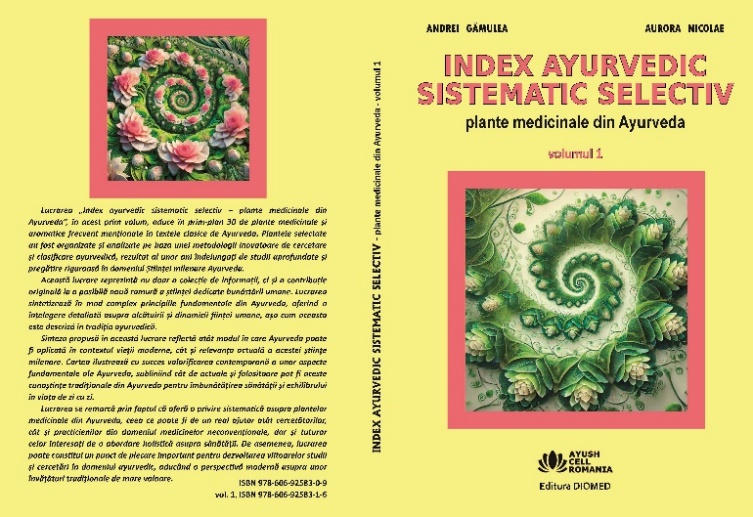
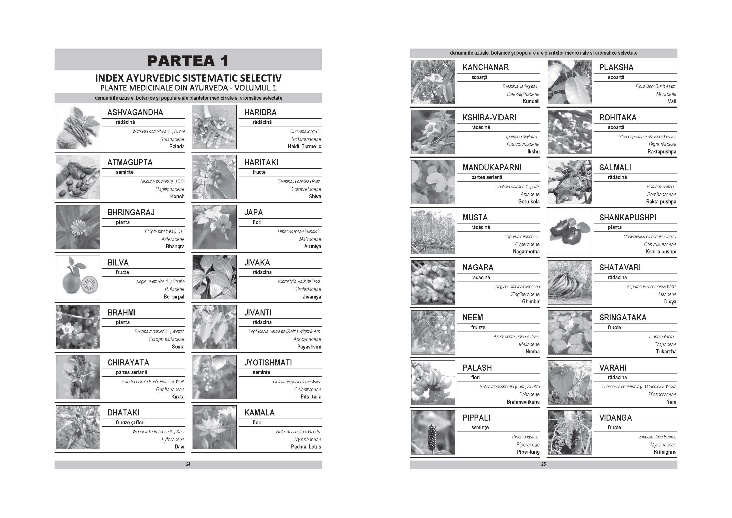
Selective Systematic Ayurvedic Index – Medicinal Plants Used in Ayurveda – Volume 1
An Original Work That Systematizes Ayurvedic Plants Through a Practical Methodology, Facilitating Their Direct Use in Therapeutic Contexts and Applied Ayurvedic Study
Volume 1 of the Selective Systematic Ayurvedic Index devoted to plants used in Ayurveda offers an innovative approach to presenting Ayurvedic medicinal plants, moving beyond conventional description toward practical application and systematic correlation.
The work's originality lies in organizing plants according to a distinctive Ayurvedic characterization method integrating botanical, functional, and therapeutic criteria into an accessible framework.
Each plant is presented concisely, with its common, botanical, and traditional names, plant part used, and relevant details for identification and application.
This organization makes information easy to find, turning the work into a practical tool for both study and use in therapeutic settings.
Through its selection and organization, the book provides a clear, applicable perspective on Ayurvedic phytotherapy.
The volume helps readers move from theoretical knowledge to the structured use of medicinal plants in supporting well-being and balance.
It brings together representative Ayurvedic plants such as Ashvagandha (root), Atmagupta (seeds), Bhringaraj (the whole plant), Bilva (fruit), Brahmi (the whole plant), Chirayata (aerial parts), Haridra (root), Haritaki (fruit), Japa (flowers), Jyotishmati (seeds), Neem (leaves), and Shatavari (root), each illustrating a particular direction of use in Ayurvedic practice.
The synthesis offered in this work reflects both how Ayurveda can be applied to modern life and the continuing relevance of this ancient science. Its systematic overview of Ayurvedic medicinal plants can be useful to researchers, practitioners of non-conventional medicines, and anyone interested in a holistic approach to human well-being and health.
We recommend watching the recording: https://youtu.be/4FHSwQDq5mg , which includes practical examples illustrating how the information in the book can be applied.
Educational resources
Ayurveda – Study Level 1 – AY01
4
Three lessons revised from the Svasthya-Darshana chapter on the subtle structure and spiritual foundations of the human being
Lessons 2, 3, and 4 present a view of health as a balance among body, consciousness, and spirit, describing manifestations of auric protection within the human being's subtle structure.
Lessons 2, 3, and 4 belong to study level 1 (AY01), Dosha-Prakriti section (A01), chapter 2, Svasthya-Darshana (A2), and are available as easy-to-read A4 and foldable A5 PDFs. Their course codes are AY01-A01-A2-C02, AY01-A01-A2-C03 and AY01-A01-A2-C04.
Course titles and their place in the Basic Ayurveda Course curriculum
Health, the Human Being's Subtle Structure, and the Spiritual Foundations of Ayurveda
Explanatory note
Title: Dosha-Prakriti_Svasthya-Darshana_C02-C04
Ayurveda – Study Level 4 – AY04
5
Two courses revised from the Sapta-Dhatu chapter on organic water and the nourishing functions of rasa-dhatu in the human organism
Lessons 2 and 3 explain organic water's role in the composition of rasa-dhatu and highlight its nourishing, structuring, dynamic, and informational functions in the human body.
Lessons 2 and 3 belong to study level 4 (AY04), Sharira-Jnana section (A04), Sapta-Dhatu chapter (A2), and are available as easy-to-read A4 and foldable A5 PDFs. Their course codes are AY04-A04-A2-C02 and AY04-A04-A2-C03.
Course titles and their place in the Basic Ayurveda Course curriculum
Organic Water and the Nourishing Dynamics of the First Bodily Constituent (rasa-dhatu)
Explanatory notes
Title: Sharira-Jnana_Sapta-Dhatu_C02&C03
Ayurveda – Study Level 7 – AY07
6
One course new from the Cetas-Pravriti chapter, Pravritti-Jnana section, on the dynamics, orientation, and shaping of instrumental consciousness
Lesson 1 explains the dynamics of instrumental consciousness, the distinction between vritti and pravritti, and the roles of subtle components shaping inner life's orientation, reactions, and tendencies.
Lesson 1 belongs to study level 7 (AY07), Pravritti-Jnana section (A07), Cetas-Pravritti chapter (A1), and is available as easy-to-read A4 and foldable A5 PDFs, under code: AY07-A07-A1-C01.
The Pravritti-Jnana (A07) section addresses the study of dynamics, active tendencies, and functional orientations of instrumental consciousness within the human being's inner experience.
The Cetas-Pravritti (A1) chapter is new to the Level 7 curriculum. It concerns how instrumental consciousness is activated, oriented, and functionally engaged in relation to perception, thinking, inner reactions, and action. This first chapter examines the involvement of the internal field of consciousness in experience, the formation of tendencies, and organization of inner and behavioral responses.
Course titles and their place in the Basic Ayurveda Course curriculum
Dynamics of Instrumental Consciousness and Its Pathways of Functional Engagement
Explanatory notes
Title: Pravritti-Jnana_Cetas-Pravritti_C01
7
One course revised from the Raksha-Viddhi chapter, Pravritti-Jnana section, on ego defense mechanisms and their limiting effects on the human being
Lesson 1 describes ego defense mechanisms as limiting automatic reactions and highlights how becoming aware of them contributes to inner transformation and health.
Lesson 1 belongs to study level 7 (AY07), Pravritti-Jnana section (A07), Raksha-Viddhi chapter (A2), and is available as easy-to-read A4 and foldable A5 PDFs, under code: AY07-A07-A2-C01.
The Raksha-Viddhi (A2) addresses the description and classification of ego (ahamkara) defense mechanisms, presented as automatic protective reactions of identity-based consciousness. It explains how these mechanisms (raksha-viddhi) arise within instrumental consciousness, how they manifest, and how they influence awareness, behavior, relationships, psycho-mental health, and the possibility of genuine inner transformation.
Course titles and their place in the Basic Ayurveda Course curriculum
Ego Defense Mechanisms and Their Limiting Effects on Consciousness
Explanatory notes
Title: Pravritti-Jnana_Raksha-Viddhi_C01
Ayurveda – Study Level 22 – AY22
8
One course revised from the Indriya-Sthana section on predictive indicators of existential turning points in Ayurveda
Lesson 1 explains the meaning of Indriya-Sthana and highlights the role of anticipatory indicators in recognizing profound transformations and existential turning points.
Lesson 1 belongs to study level 22 (AY22), Indriya-Sthana section (A22), Varnasvariya chapter (A1), and is available as easy-to-read A4 and foldable A5 PDFs, under code: AY22-A22-A1-C01.
The Indriya-Sthana refers to knowledge of anticipatory signs through which decisive moments of existential transition can be recognized.
The Varnasvariya concerns basic audiovisual indicators through which significant existential transitions may be observed.
Course titles and their place in the Basic Ayurveda Course curriculum