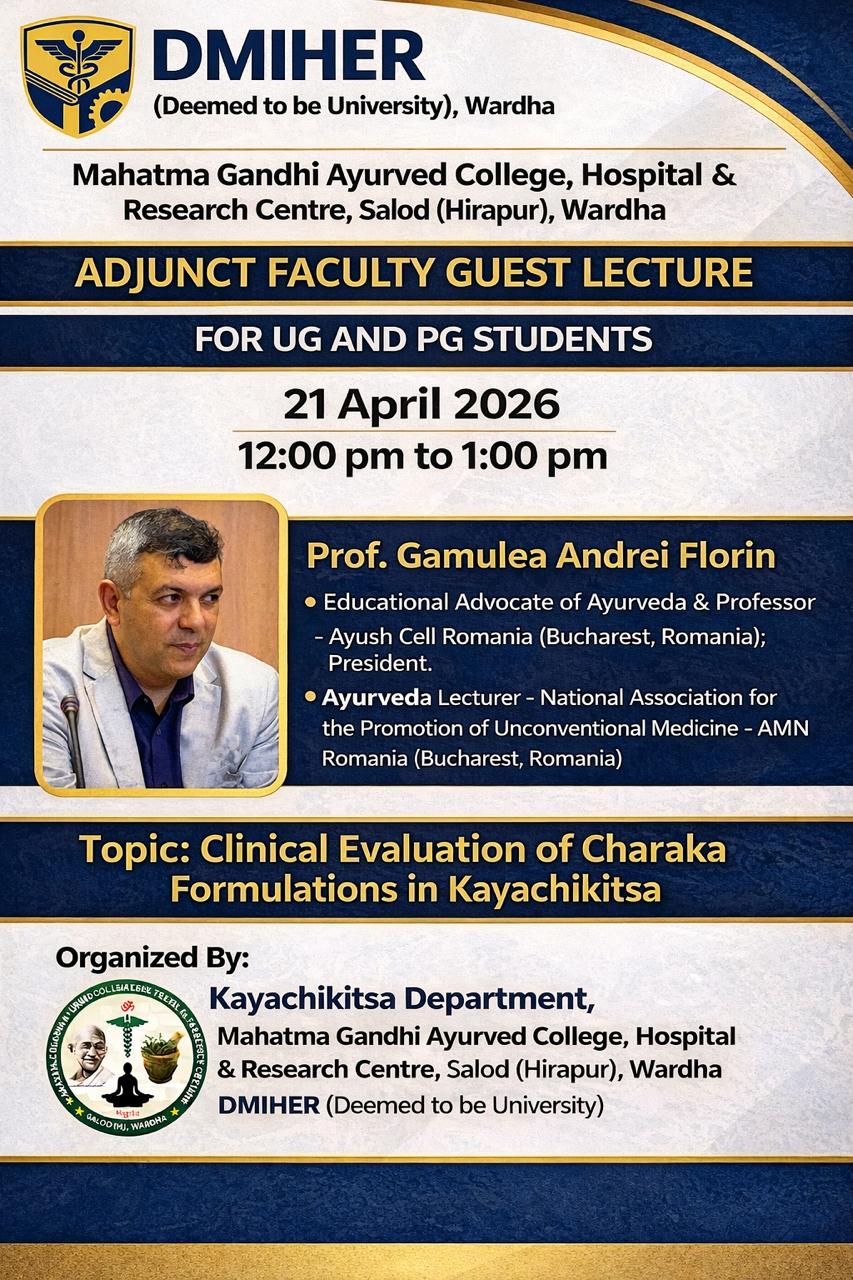
DMIHER Wardha Hosts an Online Lecture on Evaluating Formulations from Charaka Samhita
The event organized by the Department of Kayachikitsa brings together undergraduate and postgraduate students under the coordination of MGACH&RC Salod and DMIHER University.
The topic of the online meeting is “Clinical Evaluation of Charaka Formulations in Kayachikitsa,” and the event is coordinated by the Department of Kayachikitsa at MGACH&RC.
The event introduces future Ayurvedic practitioners to a subject of major importance in the clinical study of classical Ayurvedic texts, creating an educational connection between Ayurvedic tradition and contemporary approaches to Kayachikitsa within an international university setting.
The lecture highlights that evaluating the formulations described in the chapters of Chikitsa Sthana in the Ayurvedic work Charaka Samhita has its methodological foundation in Vimana-Sthana, considered one of the most reliable ways to understand the transition from diagnosis to treatment.
Through the ten parameters of accurate Ayurvedic diagnosis, the twelve factors preparing for appropriate Ayurvedic treatment, and the relationship between rasa (taste) and the dosha (vital forces), the presentation seeks to demonstrate how orderly, applicable clinical reasoning is developed.
The presentation also emphasizes inhibitory and enhancing factors, the importance of the recipient's condition, the value of post-digestive effect (vipaka), and the role of the Ayurvedic principle of predominance (pradhanya) when assessing formulations appropriate to the dynamics of pathological processes.
Online Applications
2
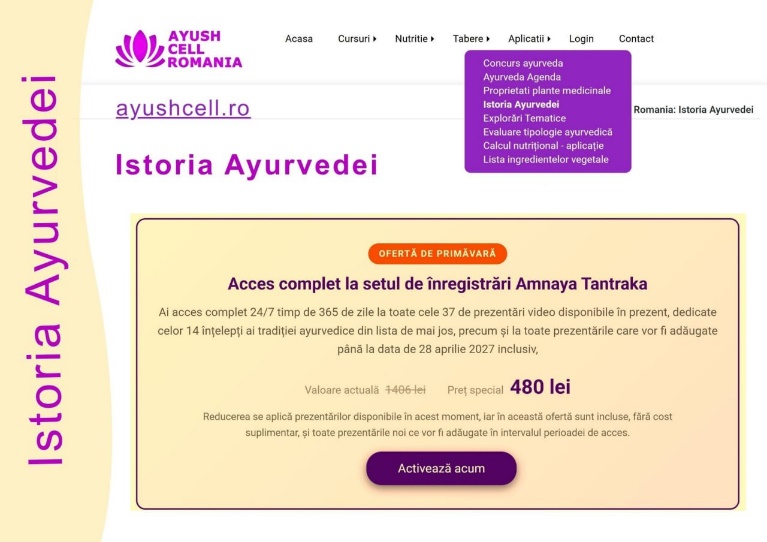
The “History of Ayurveda” Application – Full Access to Presentations on Sages of Ayurvedic Tradition
An online educational tool for advanced study, coherent thematic organization, and extended access to structured video content about Amnaya tradition and key figures in Ayurveda.
The “History of Ayurveda” application is designed as a digital educational tool for in-depth personal study of Ayurvedic tradition.
Grounded in Ayurvedic tradition (Amnaya), it draws on the living lineage of knowledge transmission and enables Ayurveda to be understood as an integrative system of knowledge, practice, and reflection.
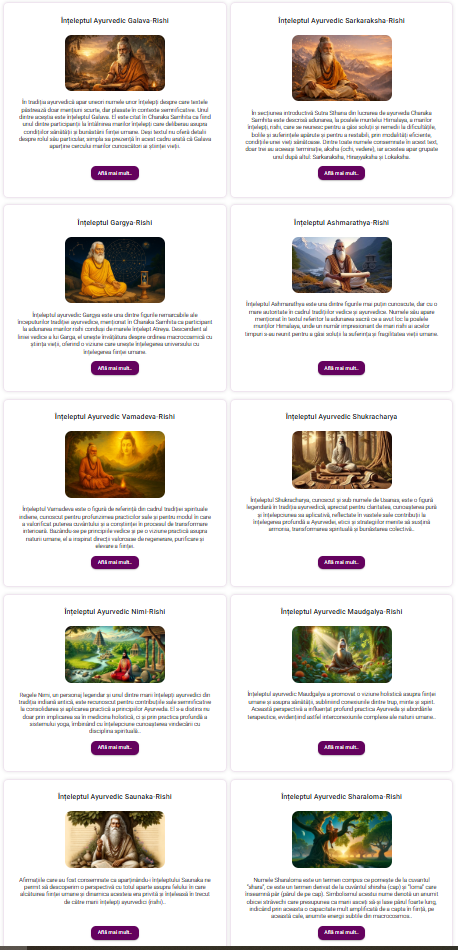
The Amnaya Tantraka package brings together 38 video recordings devoted to 14 Ayurvedic sages, organized by theme to support coherent, progressive learning.
Extended 365-day access makes it a flexible study resource, enabling users to revisit content, compare ideas, and gradually deepen their understanding of fundamental concepts.
Throughout the annual subscription period, all new recordings subsequently added are also included at no additional cost, so users benefit from both the current content and the gradual expansion of the application's educational resources.
The application's educational value lies in how it organizes and integrates information, enabling users to develop a systematic perspective on the contributions of great sages to the development of Ayurveda.
The “History of Ayurveda” application is a comprehensive, modern study resource providing access to relevant information and integrating it into an inspiring view of Ayurvedic tradition.
The video package offers valuable reference points for studying the tradition of Ayurvedic sages and their contributions to the development of the ancient Science of Ayurveda.
One course revised from the Maulika-Siddhanta chapter on the role of self-knowledge in Ayurveda
Lesson 6 presents Ayurveda as an applied science of life through self-knowledge, identification of constitutional type, and somatometric assessment.
Lesson 6 belongs to study level 1 (AY01), supplementary Ayurveda-Parichaya section (S01), chapter 1, Maulika-Siddhanta (S1), and is available as easy-to-read A4 and foldable A5 PDFs. Its course code is AY01-S01-S1-C06.
Course titles and their place in the Basic Ayurveda Course curriculum
Ayurveda as a Genuine Science of Life and Applied Knowledge of Oneself
Explanatory notes
Title: Ayurveda-Parichaya_Maulika-Siddhanta_C06
Ayurveda – Study Level 2 – AY02
4
Two courses revised from the Tridosha-Guna chapter on qualitative dosha assessment within a unified view of the tridosha system
Lessons 5 and 6 address the assessment of dosha states as a unifying reference for self-knowledge, prevention, and practical guidance.
Lessons 5 and 6 belong to study level 2 (AY02), main Svasthavritta section (A02), chapter Tridosha-Guna (A1), and are available as easy-to-read A4 PDFsand foldable A5 PDFs. Their course codes are: AY02-A02-A1-C05 and AY02-A02-A1-C06.
Course titles and their place in the Basic Ayurveda Course curriculum
Assessment of Imbalances in the Three Dosha Through a Unified Perspective on the Tridosha System
Explanatory notes
Title: Svasthavritta_Tridosha-Guna_C05&C06
Ayurveda – Study Level 3 – AY03
5
Two courses updated from the Dravya chapter on the preparation and therapeutic use of natural substances (dravya)
Lessons 4 and 5 present methods of preparation and administration of natural substances in Ayurveda, highlighting their therapeutic value according to their properties and context.
Lessons 4 and 5 belong to study level 3 (AY03), Dravyaguna section (A03), Dravya chapter (A1), and are available as easy-to-read A4 and foldable A5 PDFs. Their course codes are: AY03-A03-A1-C04 and AY03-A03-A1-C05.
Course titles and their place in the Basic Ayurveda Course curriculum
Preparation, Administration, and Uses of Natural Substances in Dravyaguna
Explanatory notes
Title: Dravyaguna_Dravya_C04&C05
Ayurveda – Study Level 4 – AY04
6
One course new from the Avastha-Dhatu chapter on tissue nourishment and the functional state of the dhatu
Lesson 9 describes the nourishment of bodily tissues (dhatu), interactions among dhatu, and the relevance of the traditional Ayurvedic concept of avastha-dhatu for an integrative physiology of life.
Lesson 9 belongs to study level 4 (AY04), Sharira-Jnana section (A04), Avastha-Dhatu chapter (A1), and is available as easy-to-read A4 and foldable A5 PDFs, under code AY04-A04-A1-C09.
Course titles and their place in the Basic Ayurveda Course curriculum
Nourishment of Bodily Tissues (dhatu) and the Functional State of Bodily Constituents
Explanatory notes
Title: Sharira-Jnana_Avastha-Dhatu_C09
Ayurveda – Study Level 5 – AY05
7
Two courses revised from the Srota chapter on types of srota and their discriminative functions
Lessons 4 and 5 describe types of srota and their selective, metabolic, and eliminative roles in maintaining communication and self-regulation within the body.
Lessons 4 and 5 belong to study level 5 (AY05), Kritya-Jnana section (A05), Srota chapter (A1), and are available as easy-to-read A4 and foldable A5 PDFs. Their course codes are: AY05-A05-A1-C04 and AY05-A05-A1-C05.
Course titles and their place in the Basic Ayurveda Course curriculum
Classes of Channel Systems (srota) and Their Functional Intelligence
Explanatory notes
Title: Kritya-Jnana_Srota_C04&C05
Ayurveda – Study Level 6 – AY06
8
Two courses revised from the Buddhi chapter on discriminative, ethical, and spiritual intelligence
Lessons 3 and 4 define intelligence as a discriminative, ethical, and spiritual force capable of guiding genuine spiritual transformation.
Lessons 3 and 4 belong to study level 6 (AY06), Manasa-Jnana section (A06), Buddhi chapter (A06A3), and are available as easy-to-read A4 and foldable A5 PDFs. Their course codes are: AY06-A06-A3-C03 and AY06-A06-A3-C04.
Course titles and their place in the Basic Ayurveda Course curriculum