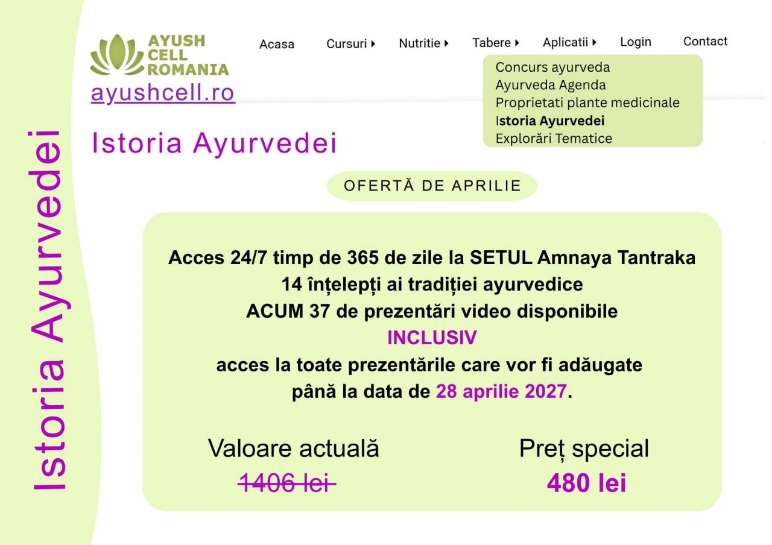
Spring Offer: Full Access to the Amnaya-Tantraka Application
A novel educational tool for advanced personal study of Ayurvedic tradition.
The spring offer provides full access to the Amnaya Tantraka recording collection, prepared as an online educational application for structured personal study. It currently includes 38 video recordings organized by topic and devoted to 14 sages of Ayurvedic tradition, providing a distinctive framework for deepening knowledge of Ayurveda's history and fundamental principles.
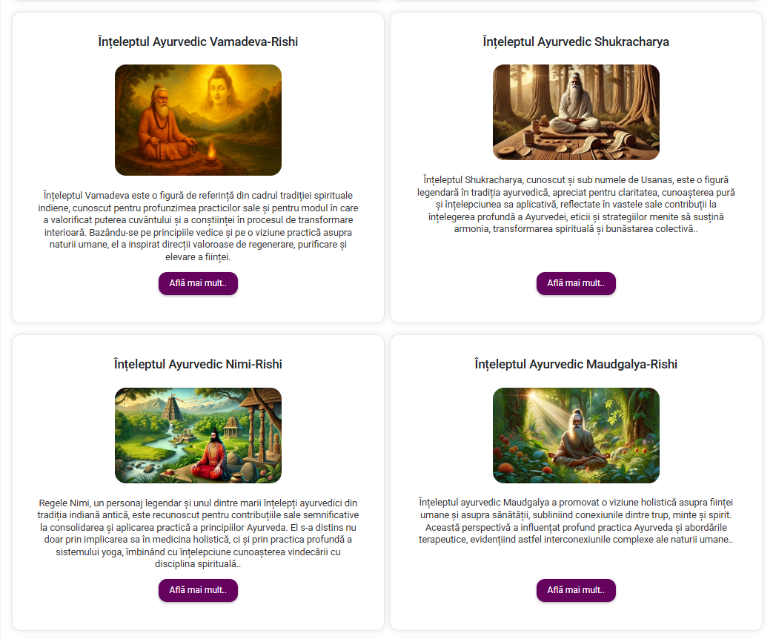
Extended series feature major figures such as Nimi-Rishi, Maudgalya-Rishi and Hiranyaksha-Rishi (five presentations each), alongside modules devoted to important figures including Shukracharya (four video recordings), Jivaka-Rishi, Jamadagni-Rishi and Vamadeva-Rishi (three video recordings each). Other essential contributions are presented in materials devoted to the Ayurvedic sages Galava-Rishi, Saunaka-Rishi and Sharaloma-Rishi (two video recordings each), supplemented by presentations focusing on other noteworthy figures in Ayurvedic tradition, such as Asita-Rishi, Gargya-Rishi, Ashmarathya-Rishi and Sharkaraksha-Rishi (one recording each).
The value of this video package lies in its role as an independent study resource, enabling not only access to information but also integration of knowledge through review, correlation, and progressively deeper exploration.
Its format supports a flexible approach adapted to each user's needs.
With its original structure, the Amnaya-Tantraka application offers a modern learning system designed to develop a thorough, profound understanding of the Ayurvedic wisdom tradition.
One course revised from the Maulika-Siddhanta chapter on longevity and the orientation of consciousness
Lesson 4 examines relationships among body weight, nutrition, and longevity, bringing together the Ayurvedic perspective and modern discoveries about neural orientation and how consciousness works.
Lesson 4 belongs to study level 1 (AY01), supplementary Ayurveda-Parichaya section (S01), chapter 1, Maulika-Siddhanta (S1), and is available as easy-to-read A4 and foldable A5 PDFs. Its course code is AY01-S01-S1-C04.
Course titles and their place in the Basic Ayurveda Course curriculum
Body Weight, Nutrition, and the Orientation of Consciousness in Ayurveda
Explanatory notes
Title: Ayurveda-Parichaya_Maulika-Siddhanta_C04
Ayurveda – Study Level 2 – AY02
3
One course revised from the Tridosha-Guna chapter on the relationship between general qualities and the dosha
The lesson explains the system of twenty general qualities (vimshati-guna) and their relationship to the dosha, highlighting their role in assessing and maintaining balance.
Lesson 2 belongs to study level 2 (AY02), main Svasthavritta section (A02), chapter Tridosha-Guna (A1), and is available as an easy-to-read A4 PDFand as a foldable A5 PDF. Its course code is AY02-A02-A1-C02.
Course titles and their place in the Basic Ayurveda Course curriculum
Vimshati-Guna and Tridosha – The Qualitative Foundation of Ayurvedic Balance
Explanatory notes
Title: Svasthavritta_Tridosha-Guna_C02
3
A supplementary course new from the Tridosha-Vaisamya chapter on Ayurvedic classification of diseases
The text presents the Ayurvedic classification of tridosha imbalances and their relevance to diagnosis, prognosis, and therapy for a deeper understanding of disease.
Lesson 1 belongs to study level 2 (AY02) of Ayurveda, supplementary Svasthavritta-Prayoga section (S02), supplementary chapter Tridosha-Vaisamya (S02S1), and is available as an easy-to-read A4 PDFand as a foldable A5 PDF. Its course code is AY02-S02-S1-C01.
The Svasthavritta-Prayoga section concerns the practical application of Ayurvedic teaching on maintaining health, seeking to put principles of assessment and harmonization into practice.
The Tridosha-Vaisamya chapter deals with imbalances in the three-dosha system and disturbances in the functional relationships among vata, pitta, and kapha in the human being.
Course titles and their place in the Basic Ayurveda Course curriculum
Ayurvedic Classification of Imbalances in the Tridosha System
Explanatory note
Title: Svasthavritta-Prayoga_Tridosha-Visamya_C01
Ayurveda – Study Level 3 – AY03
4
One course updated in the Dravyaguna section, Dravya chapter, on universal substantiality
The lesson introduces the concept of substance (dravya), explaining the nature of substantiality, its fundamental role, and the elemental structure of reality according to traditional Ayurveda.
Lesson 1 belongs to study level 3 (AY03), Dravyaguna section (A03), Dravya chapter (A1), and is available as easy-to-read A4 and foldable A5 PDFs. Its course code is AY03-A03-A1-C01.
The Dravyaguna (A03) presents the traditional Ayurvedic system for characterizing natural therapeutic substances. The Dravya (A03A1) chapter presents the Ayurvedic perspective on substantiality.
Course titles and their place in the Basic Ayurveda Course curriculum
Dravya – The Principle of Substantiality in Traditional Ayurveda
Explanatory notes
Title: Dravyaguna_Dravya_C01
Ayurveda – Study Level 4 – AY04
5
One course revised from the Avastha-Dhatu chapter on nourishing bodily constituents (dhatu)
The lesson describes how food is transformed into the living substance of the body and presents three Ayurvedic laws governing nourishment and regeneration of bodily constituents (dhatu-poshana-nyaya).
Lesson 7 belongs to study level 4 (AY04), Sharira-Jnana section (A04), Avastha-Dhatu chapter (A1), and is available as easy-to-read A4 and foldable A5 PDFs, under course code AY04-A04-A1-C07.
Course titles and their place in the Basic Ayurveda Course curriculum
The Three Main Types of Processes for Nourishing Bodily Tissues (dhatu-poshana-nyaya)
Explanatory notes
Title: Sharira-Jnana_Avastha-Dhatu_C07
Ayurveda – Study Level 5 – AY05
6
One course revised from the Srota chapter on the human being's channel systems (srota)
The lesson explains the nature of Ayurvedic channel systems (srota) and their roles in transporting, transforming, and balancing constituent substances and circulating energies.
Lesson 1 belongs to study level 5 (AY05), Kritya-Jnana section (A05), Srota chapter (A1), and is available as easy-to-read A4 and foldable A5 PDFs. Its course code is AY05-A05-A1-C01.
The Kritya-Jnana presents the body's physical and energetic dynamics by describing the functions and processes of circulation, transformation, and coordination that sustain the organism's living activity.
Course titles and their place in the Basic Ayurveda Course curriculum
Channel Systems (srota) That Support the Human Being's Bodily and Energetic Dynamics
Explanatory notes
Title: Kritya-Jnana_Srota_C01
Ayurveda – Study Level 32 – AY32
7
One course new from the supplementary Siddhi-Prayoga section on stimulating procedures
The lesson explains three external stimulating Ayurvedic procedures and their role in reducing circumstances that favor kapha accumulation.
Lesson 1 belongs to study level 32 (AY32) of Ayurveda, in the supplementary Siddhi-Prayoga (S32), supplementary chapter Uttarabasti-Vivarana (S4), and is available as an easy-to-read A4 PDFand as a foldable A5 PDF. Its course code is AY32-S32-S4-C01.
The supplementary section Siddhi-Prayoga deals with refining the specialized application of Ayurvedic therapeutic procedures and seeks to develop a practical understanding of their correct use, adaptation, and validation in a therapeutic context.
The Uttarabasti-Vivarana deals with explanatory details and a series of practical applications relating to procedures presented in the Uttarabasti chapter (chapter 12 of the Siddhi-Sthana section), with an emphasis on their technical and procedural meanings, specific indications, and proper integration into Ayurvedic treatment.
Course titles and their place in the Basic Ayurveda Course curriculum
A New Feature in the Written Course Materials Application: The “Contact Written Support” Form
A Practical Guide to Submitting Requests to Verify Access to Written Course Materials Appropriate to One's Study Level
The “Contact Written Support” section of the dedicated written-materials page on the ayushcell.ro website provides an orderly, effective way to report potential discrepancies or uncertainties concerning materials available on a user's personal page. This form is designed as a practical tool through which users can submit a verification request, allowing the reported situation to be examined accurately on the basis of relevant information.
The primary purpose of this platform feature ayushcell.ro is to help users submit complete verification requests.
Rather than sending a general or potentially incomplete message, users are guided to provide precisely the information needed to identify their study context and the materials concerned. This makes verification more accurate and substantially reduces misunderstandings or irrelevant inquiries.
The form on the Written Support page is intended particularly for cases in which a material is not displayed as expected, there are differences between what is shown in Ayurveda Agenda and what was expected, questions arise about assigning a material to a specific study year or group, or clarification is needed concerning the relationship between published materials and a user's educational progress.
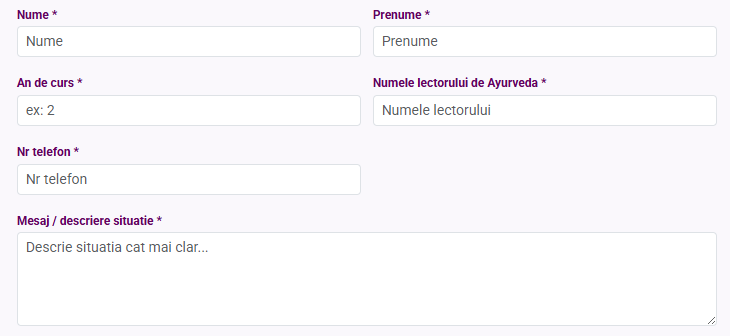
The form's first function is to identify the person making the request. The email, first-name, and last-name fields link the inquiry to its sender so the response reaches the correct person and the case can be followed up individually. Entering these details accurately is important for processing the request correctly.
A second important function is identifying the educational context precisely. Fields for the Ayurvedic Practitioner Code (CPA), course year, and Ayurveda instructor's name make it possible to place the request within the relevant study structure. This information is essential when the issue depends on training level, group organization, or group coordination. The “I don't have a CPA” checkbox also serves a useful practical purpose, allowing those who have not yet been assigned this administrative identifier to complete the form.
The telephone-number field serves a supplementary function and can help staff contact the requester if additional clarification is needed, especially when a written message reports a problem requiring specific checks. This field therefore helps make the resolution process more efficient.
The central element of the form is the “Message / Description of the Situation” field. Users can describe their issue as clearly as possible here. In practice, it is where they should specify the relevant material, where it should have appeared, what discrepancy they noticed compared with information in Ayurveda Agenda, which study level or group is concerned, and any other helpful details. The more concrete the description, the faster and more accurately the request can be evaluated.
The final confirmation checkbox serves a verification purpose. By selecting it, users confirm that they have consulted the relevant information in Ayurveda Agenda and that their request accords with the information available there. This step helps prevent reports being submitted before existing published sources have been checked and helps filter requests that genuinely require intervention.
The “Submit Request” button is the final step. Clicking it sends all the information entered in an organized format.
The “Contact Written Support” section helps users submit clear, complete requests concerning educational materials shown on their personal pages. This dialog form is a practical communication and verification tool for managing issues requiring clarification about written course support.