1Psychophonotherapy Course: Module 1 – Fundamentals of Psychophonotherapy and Applications
An introductory course on understanding speech and sound as instruments for purification, regulation, and transformation of consciousness.
The specialized psychophonotherapy program offers a structured approach to vak-shuddhi practices within the Ayurvedic methods of sattvavajaya, treating speech as a direct expression of consciousness and a means of inner harmonization.
The course entitled “Fundamentals of Psychophonotherapy” provides a clear framework for understanding the relationship among thought, intention, sound, and subtle structure, approaching psychophonotherapy as a conscious process of refining expression and restoring psycho-emotional balance.
This program introduces the fundamental principles of psychophonotherapy as derived from the traditional teachings of the Ayurvedic sage Vamadeva, emphasizing the role of spoken words, consciously experienced silence, and inner verbalization in the overall dynamics of operative consciousness.
The content is organized to support both theoretical learning and the practical integration of psychophonotherapy as a discipline for personally working with consciousness.
2Psychophonotherapy Course: Module 2 – The Six Emotional Dimensions of Expression
A module exploring emotional expression as a means of self-knowledge by relating language to the Ayurvedic principles of taste.
This module in the psychophonotherapy series offers an original approach to human expressiveness, starting with common spoken expressions—such as “sweet words,” “speaking about one's bitterness,” or “sour remarks”—and relating them to the six fundamental tastes of Ayurveda: sweet, salty, sour, pungent, bitter, and astringent.
Each taste is examined as conveying a distinct emotional dimension recognizable in vocal tone, rhythm, and modulation.
Organized into two lessons, the module provides a symbolic and practical map of these emotional dimensions, described through psychological and neurophysiological characteristics. It shows how verbal expression can support nervous-system balance or, conversely, reflect tension and imbalance. The expression of particular emotions is approached as a conscious process of observation and transformation.
3The Importance of the Ayurvedic Vimshati-Guna System in Managing Adaptive Processes
An introductory and practical book explaining the twenty general Ayurvedic qualities as essential reference points for adaptation, balance, and self-regulation in everyday life.
The book presents the Ayurvedic system of twenty general qualities (Vimshati-Guna) in a concise, coherent form. This fundamental framework of Ayurvedic thought helps explain human biological, psychological, and behavioral processes.
The work highlights how these general qualities affect the dynamics of vital forces, the doshas, and the body's ability to adapt to internal and external factors.
By continually referring to the twenty general qualities, practitioners gain clear reference points for adjusting everyday choices and managing their personal adaptive processes more consciously. Vimshati-Guna is presented not only as a descriptive tool, but as an operational model for recognizing signs of imbalance and practical approaches to restoring inner harmony.
The book emphasizes that these Ayurvedic qualities are organized into ten polar pairs, providing a common language for interpreting the phenomena of life, from stability and transformation to coherence and flexibility. This approach supports a dynamic understanding of how human beings interact with their environment and maintain homeostasis.
By explicitly connecting the system to modern concepts in physiology, self-regulation, and adaptive psychology, the book bridges Ayurvedic tradition and contemporary needs, offering an accessible, practical framework for optimizing adaptive processes and cultivating a balanced lifestyle.
4The Ayurvedic System of 20 Qualities (Vimshati-Guna) and Human Adaptive Processes
A concise video presentation explaining the twenty general Ayurvedic qualities as a tool for analyzing and guiding adaptive processes in personal life.
This video recording provides a clear, structured introduction to the Ayurvedic Vimshati-Guna system, emphasizing the role of the twenty general qualities in maintaining inner balance and regulating responses to internal and external factors. It offers accessible conceptual reference points for understanding how these qualities influence self-regulation. Vimshati-Guna is approached as an operational model for interpreting lived experience. The presentation is intended for those wishing to deepen their understanding of Ayurveda's theoretical foundations and those seeking clear tools for understanding and managing adaptive processes in everyday life.
5Five Revised Courses for Year 1: The Ayurvedic View of Health (Svasthya-Darśana)
Lessons 09–13 in the Svasthya-Darśana chapter, Doṣa-Prakṛti section, provide a systematic explanation of how Ayurveda traditionally defines health.
These courses introduce essential criteria for understanding human structure, the relationship between Ayurvedic constitution and the subtle levels of existence, and the active role of consciousness in maintaining balance.
This series of five revised courses for Ayurveda Study Year 1 (Doṣa-Prakṛti section, Svasthya-Darśana chapter) covers lessons 09–13 (2026 edition), available in easy-to-read A4 and foldable A5 PDF formats. These five revised lessons replace their counterparts from the 2005, 2019, 2022, and 2023 editions. Graduates of Ayurveda Study Year 1 who have completed the Svasthya-Darśana chapter may request them.
Pañca-kośa – Human Structure and the State of Health (Lessons 09–13)
Explanatory notes
6One New Course for Year 1: The Ayurvedic View of Health (Svasthya-Darśana)
Lesson 14 of the Svasthya-Darśana chapter, Doṣa-Prakṛti section, describes the role of the sheath of bliss (ananda-maya-kośa) in maintaining health.
This course is part of the Ayurveda Study Year 1 curriculum (Doṣa-Prakṛti section, Svasthya-Darśana chapter), and is available as an easy-to-read A4 PDF and a foldable A5 PDF. Participants studying or having completed this chapter may request it.
Ananda-maya-kośa – States of Happiness as the Foundation of Holistic Health in Ayurveda (Lesson 14)
Explanatory notes
Current updates
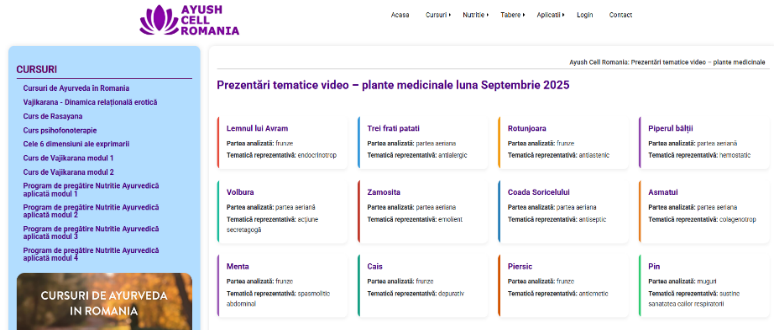
7Digital Medicinal Plants Magazine: September 2025 Presentations
8Video Presentations on the History of Ayurveda: Amnaya-Tantraka
The page entitled “History of Ayurveda” on the website https://ayushcell.ro is dedicated to presenting the traditional Ayurvedic perspective, Amnaya.
Amnaya is the lineage of knowledge expressing the continuity and living transmission of Ayurvedic teachings, preserved without interruption through the centuries. The page offers videos and presentations supporting Ayurvedic education, emphasizing that Amnaya denotes essential knowledge revealed through great spiritual figures and exceptional beings—great sages.
The videos also introduce the specific framework of Amnaya Tantraka, described as a structured system of knowledge and practices transmitted within initiatory traditions of Ayurveda.
The presentations in the History of Ayurveda series explore aspects of Ayurvedic tradition recorded in classical works such as Charaka-Samhita, Sushruta-Samhita, Ashtanga-Hridaya, Kashyapa-Samhita, and Sharangadhara-Samhita, or in related traditional writings. These works refer to events and features representative of Ayurvedic tradition (Ayurveda-Amnaya).
The recordings and presentations on this page allow viewers to study and review material at their own pace. The structured video archive links to presentations on exemplary figures in Ayurvedic tradition, including Saunaka, Gargya, Ashmarathya, Vamadeva, Hiranyaksha, Nimi, Maudgalya, Jamadagni, Sharaloma, Asita, and Jivaka—valuable for those continually deepening their knowledge of Ayurveda's history.
The most recent video recordings available on this page concern the Ayurvedic sages Sarkaraksha and Shukracharya, providing updated insights into their role in the Amnaya tradition and the transmission of Ayurvedic knowledge.
9The Ayurvedic Sage Sarkaraksha – Advocate of an Original View of the Granularity of Perception
Granularity of perception is the ability to distinguish fine differences, make clear distinctions, and integrate information coherently without getting lost in either excessive detail or overly broad generalization.