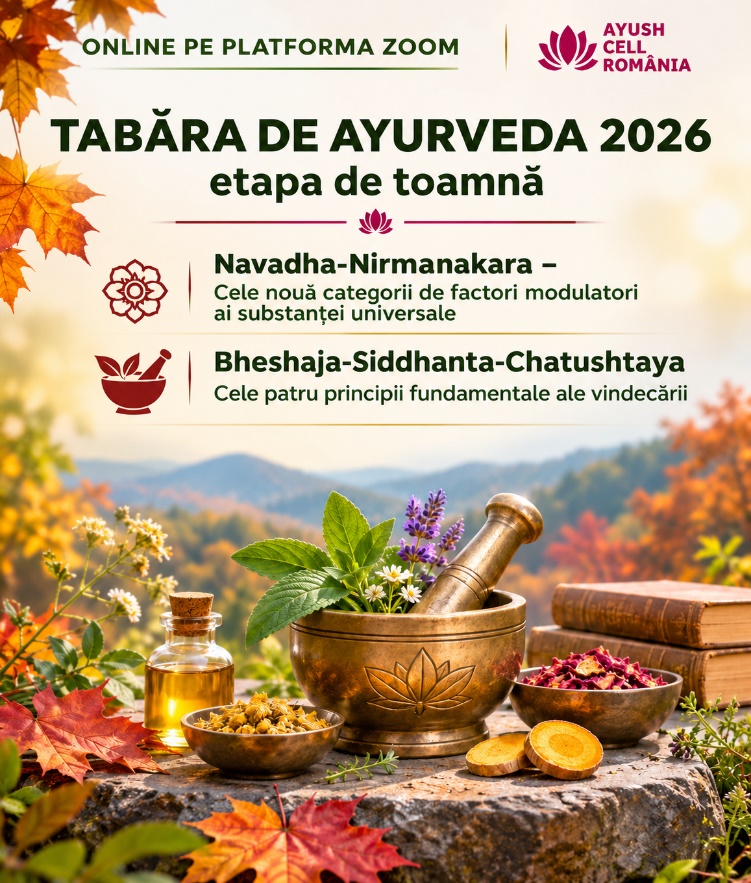
| 1 | 2026 Ayurveda Camp, autumn session – Part 1 on 26, 27, 28 and 29 November 2026, and Part 2 on 11, 12 and 13 December 2026 |

Two subjects for an in-depth exploration of traditional Ayurvedic knowledge: Navadha-Nirmanakara and Bheshaja-Siddhanta-Chatushtaya
The autumn session of the 2026 Ayurveda Camp offers an in-depth study of two fundamental subjects in traditional Ayurvedic knowledge, devoted to understanding universal processes of transformation and the operative principles of healing in Ayurveda.
The first part of the autumn Ayurveda Camp will focus on the Navadha-Nirmanakara system, which describes the nine categories of modulating factors of universal substance.
The second part will address the Bheshaja-Siddhanta-Chatushtaya system, the set of four fundamental principles of healing in Ayurveda.
The two subjects offer distinct yet complementary perspectives on how the transformative resources of existence can be recognised, understood and consciously used to maintain health, restore balance and support the harmonious development of the human being.
Studying these esoteric systems encourages more precise observation of life's processes, develops discernment in selecting means of harmonisation and allows physical and subtle transformations to be understood within a unified, coherent and profound perspective applicable to everyday experience and integrative Ayurvedic practice.
Navadha-Nirmanakara – The nine categories of modulating factors of universal substance: 26–29 November 2026
The first part of the Ayurveda Camp will explore the nine categories of modulating factors of universal substance (Navadha-Nirmanakara), a subject belonging to the esoteric Ayurvedic tradition and associated with the teachings of the great Vedic sage Angira.
This perspective highlights the idea that all manifested existence is characterised by continuous transformative dynamism, sustained by the action of the universal transformative principle (Agni).
The nine categories of modulating factors (nirmanakara) represent distinct ways in which this transformative principle acts upon the nine fundamental categories of universal substance (maha-dravya).
The first five categories correspond to the fundamental elements of manifestation: earth (prithivi), water (apas), fire (tejas), air (vayu) and ether (akasha). Four subtle categories are added to these and are particularly important for understanding human experience: instrumental consciousness (manas), space (dis), time (kala) and trans-instrumental consciousness (cit).
An important aspect of this knowledge is the possibility of recognising the action of the modulating factors (nirmanakara) in physical and metabolic processes, sensory experiences, spatial and temporal integration, and the inner transformation of personal consciousness.
Thus, the human capacity to organise and integrate perceptible information can be examined through the instrumental modulating factor manas-nirmanakara.
Our relationship with space, adaptation to environmental changes and the formation of spatial representations within personal consciousness can be examined in relation to dis-nirmanakara.
The way a person experiences the passage of time and integrates temporal experiences can be explored through an understanding of kala-nirmanakara.
At a deeper level, the modulating factor of trans-instrumental consciousness (cit-nirmanakara) offers a perspective on processes of objectification, moral discernment and the human capacity to bring about conscious inner transformations.
The presentations will also highlight the relationships between the nine categories of modulating factors and the six fundamental operative principles of Ayurvedic knowledge (Ṣaḍ-Padārtha), explored during the summer session of the Ayurveda Camp.
This connection offers a deeper understanding of how universal laws of order are reflected in the processes of organisation and transformation specific to different levels of existence.

Participants will be able to discover the value of this integrative perspective for understanding life experience, developing their capacity for observation and deepening their Ayurvedic knowledge of the human being.
The knowledge gained can thus become a source of practical guidance, helping people recognise conditions conducive to beneficial transformations and cultivate a lucid, responsible and harmonious relationship with their own lived experience.
Bheshaja-Siddhanta-Chatushtaya – The four fundamental principles of healing in Ayurveda: 11–13 December 2026
The second part of the Ayurveda Camp will be devoted to presenting and illustrating the four fundamental principles of healing in Ayurveda, collectively known as Bheshaja-Siddhanta-Chatushtaya. This subject highlights the fundamental conditions that make it possible to engage consciously, appropriately and effectively in a healing process, within the integrative perspective offered by the traditional science of Ayurveda.

The first principle, Kshetra-Anurupa-Shakti-Siddhanta, is the principle of energy appropriate to the plane of action. It indicates that the energy involved in a healing process must be qualitatively suited to the level at which transformation is sought.
Choosing a method, remedy or form of intervention therefore requires recognising the nature of the imbalance and identifying resources compatible with the area in which it manifests.
The second principle, Matranurupa-Shakti-Siddhanta, is the principle of energy proportionate to the degree of transformation required. It highlights the importance of proportionality between the energy used and the extent of the intended transformation.
Selecting the right healing means is not sufficient: its appropriate amount, intensity, duration and continuity of action must also be established. Applying this principle provides guidance for understanding the importance of dosage and consistency in processes of restoring balance.
The third principle, Prabodha-Kendra-Shakti-Samvada-Siddhanta, is the principle of activating states of resonance through the awakening of energy centres. It highlights the role of receptivity and the person's active participation in the healing process.
From the traditional Ayurvedic perspective, the use of beneficial subtle energy presupposes a corresponding centre that has been awakened and is capable of resonating with it. Preparing, activating and developing heightened receptivity are therefore important aspects of applying healing methods.
The fourth principle, Shakti-Parinama-Urdhvikarana-Siddhanta, is the principle of the transformation and upward elevation of energy. It opens up a broader perspective on healing by highlighting the possibility of transforming, refining and directing energies already present within the person towards higher purposes. Through processes of transmutation and sublimation, energy resources can be put to beneficial use, supporting not only the restoration of balance but also the development of higher human capacities.
The four principles form a coherent set of operative guidelines in Ayurveda. The first establishes the qualitative correspondence of energy with the intended plane; the second highlights quantitative proportionality; the third introduces receptivity through resonance; and the fourth offers a perspective on transforming energy and directing it towards higher purposes.
An integrative perspective on transformation and healing
The two parts of the autumn 2026 Ayurveda Camp seek to deepen essential areas of Ayurvedic knowledge by combining the presentation of traditional principles with illustrations of their practical implications.
Knowledge of the esoteric Navadha-Nirmanakara system broadens understanding of the transformative processes occurring in manifestation, while Bheshaja-Siddhanta-Chatushtaya offers operative guidelines for the conscious and appropriate use of healing resources.
This session of the 2026 Ayurveda Camp gives participants an opportunity to deepen their understanding of existence from an Ayurvedic perspective, in which knowledge, observation, discernment and conscious action become complementary means of maintaining health, restoring harmony and developing a profound relationship with oneself.
Access: ayushcell.ro/tabere/tayt26