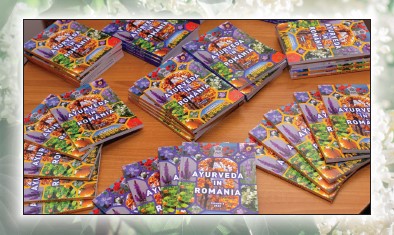
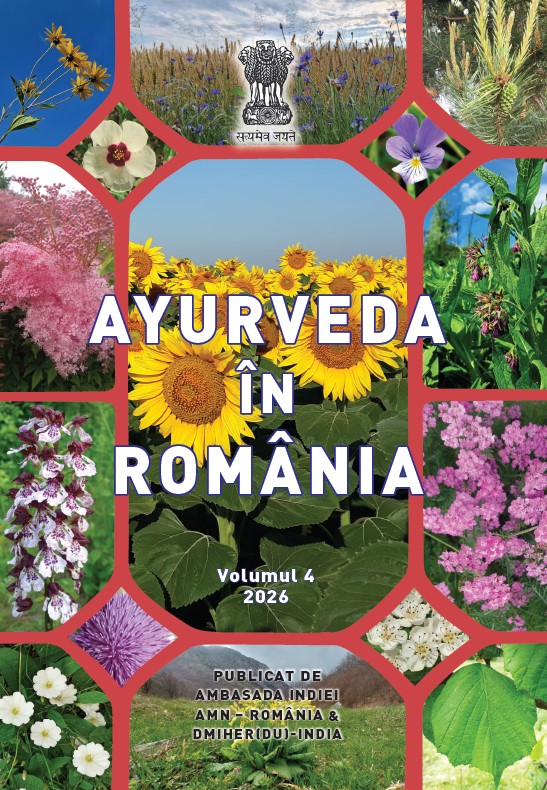
| 1 | Volume 4 of “Ayurveda in Romania”: A Romanian–Indian educational and cultural project |
A new stage in a work documenting Ayurveda’s active presence in Romania, from events and the tradition of great sages to medicinal-plant research and the direct experiences of people studying Ayurveda.
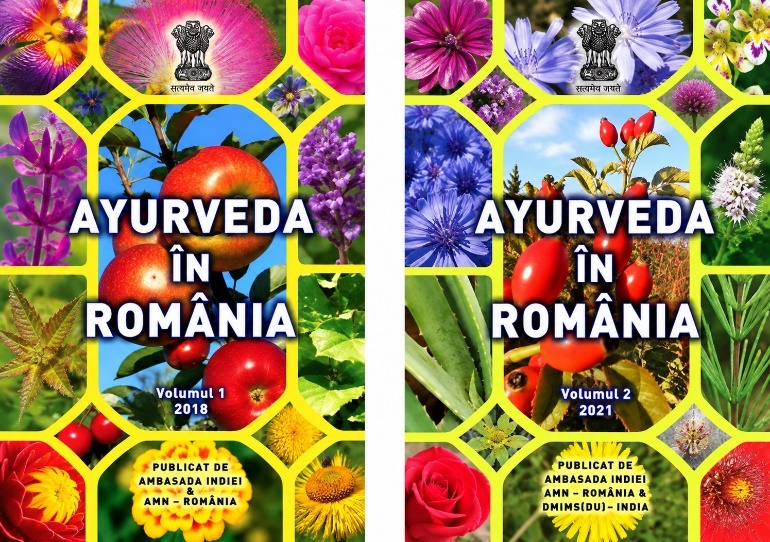
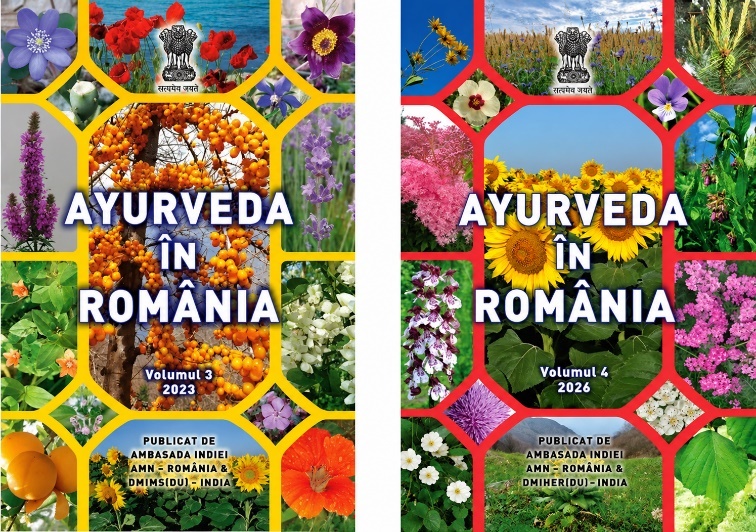
The publication of Volume 4 of “Ayurveda in Romania” marks a new stage in a publishing project launched in 2018 and developed through successive volumes highlighting the presence in Romania of Ayurveda, India’s traditional system of knowledge about life.
In Romania, Ayurveda is studied, explored in depth, practiced, and incorporated into the local cultural context.
“Ayurveda in Romania” was initiated by the Embassy of India in Romania and is published by the Embassy of India in Bucharest in cooperation with the National Association for the Promotion of Non-Conventional Medicines in Romania (AMN-Romania).
Volume 4, coordinated, authored, and edited by Andrei Gămulea, reaffirms the purpose of the entire series: to show how traditional Indian knowledge of life has become an integral part of the interests of many people in Romania. This purpose explains the distinctive character of “Ayurveda in Romania.” Each volume may be viewed both as a modern Ayurveda handbook and as a collection of relevant information about Ayurvedic activities in Romania.
Together, the four volumes published so far gradually form a thematic archive in which current developments, tradition, education, research, practical experience, and personal testimony complement one another.
Volume 4 maintains this editorial identity. Its contents begin with Ayurveda Day and continue with the educational dimension and the history of the publishing project. The book then explores the Ayurvedic tradition through its major figures — Angira, Daksha, Marichi, Bhela, and Kankayana — and includes an extensive section on medicinal and aromatic plants. It presents the curriculum of the Ayurveda course in Romania and the “Ayurveda Agenda” project, concluding with personal testimonies.
The book thus examines several dimensions of one reality: where knowledge originates, who transmitted it, how it is studied today, how it can be researched, how it is communicated publicly, and ultimately what it contributes to people’s lived experience.
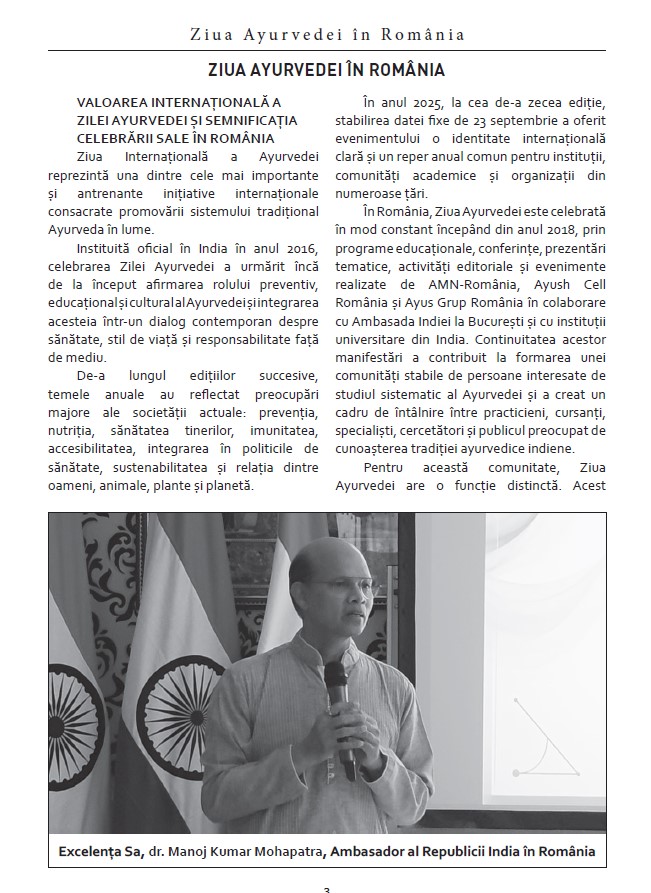
Ayurveda Day in Romania: Continuity of an international celebration
The volume opens with the section “Ayurveda Day in Romania.” Over the years, Ayurveda Day has become a key occasion connecting activities in Romania with contemporary developments in Ayurveda worldwide.
Considerable attention is given to the 2025 edition, organized around “Ayurveda for People and Planet.” Volume 4 also records the significance of setting September 23 as the annual date for Ayurveda Day, allowing international events to be coordinated around a fixed date.
The Romanian program included a retrospective of the 2022, 2023, and 2024 editions, turning an annual celebration into a record of continuity.
Volume 4 also recounts the event in Floreasca Park, where diplomatic messages, presentations of Ayurvedic activities in Romania, and public participation came together in a natural setting. Before this event, a six-day online thematic program included subject-specific presentations, historical reviews of Ayurvedic activities, and contributions from specialists in research, education, and health.
This illustrates a defining feature of Volume 4: events are documented to help trace the emergence of new directions for development.
The contribution on Kayacikitsa is considered in relation to metabolism, prevention, treatment, and regeneration, as well as contemporary interest in preventive, personalized, and integrative medicine.
Another program day focused on publications and research aimed at highlighting remarkable knowledge from the Ayurvedic tradition, bringing together courses, seminars, conferences, congresses, Ayurveda camps, contests, medicinal-plant presentations, and publishing projects undertaken in Romania.
Ayurveda Day thus emerges as an important festive occasion and an annual meeting point between past achievements and future development.
Bridges of knowledge between India and Romania
The book’s second major section, “Bridges of Knowledge between India and Romania Opened by Ayurveda,” broadens the perspective. It examines the human, institutional, and academic relationships that have made Romanian–Indian dialogue possible.
A significant reference is a 2024 speech by Her Excellency Manika Jain, then Ambassador of India to Romania. The volume records her appreciation for educational work in Romania and her explicit reference to the three earlier volumes of “Ayurveda in Romania.”
The book highlights how the publishing project and the Ayush Cell Romania Information Center complement each other: the volumes preserve and organize information, while the center helps share it through courses, conferences, and other programs.
Of particular importance is the openness to interdisciplinary research.
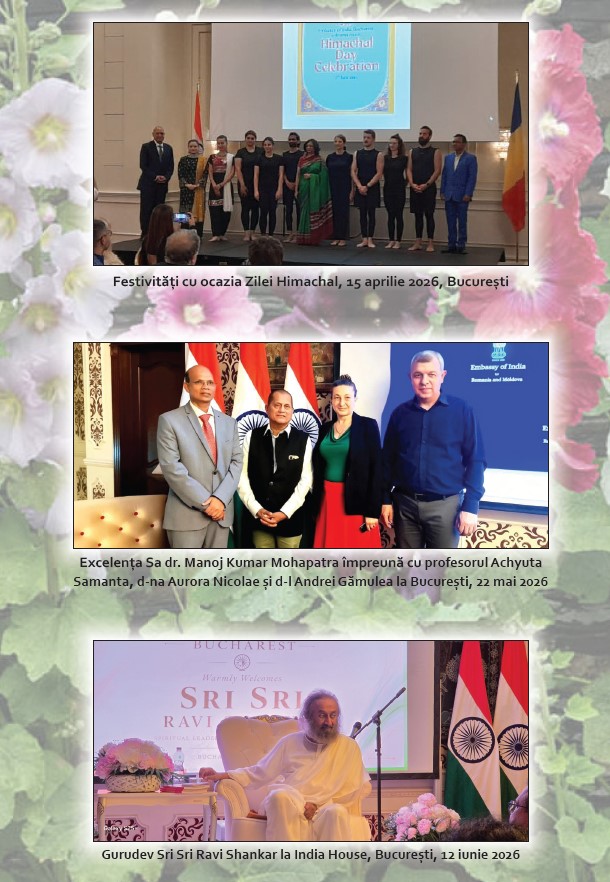
The cooperation between Datta Meghe Institute of Higher Education and Research (DMIHER), Wardha, and AMN-Romania is presented in relation to the assessment of plant resources and the integration of traditional Ayurvedic criteria into a modern research framework. Dialogue with Dr. Manish P. Deshmukh connects Romanian work on Ayurvedic plant characterization with Indian infrastructure for clinical, pharmacological, toxicological, and epidemiological research.
This reveals one of the project’s most promising future directions: correlating traditional Ayurvedic criteria with modern research tools.
Volume 4 makes this complementarity clear. Ayurvedic analysis examines taste, properties, active potency, post-digestive effects, and influence on balance, while modern research can investigate chemical composition, pharmacological activity, bioavailability, and interactions. Both perspectives can generate research directions and clarify conditions for using plant resources.
Education as a form of continuity
“The Educational Dimension of the Ayurveda in Romania Project” is a central theme of the book.
One important milestone is the international academic lecture held online on April 21, 2026, by DMIHER, Wardha, together with Mahatma Gandhi Ayurved College, Hospital & Research Centre, for students in the Kayacikitsa Department. The topic concerned evaluating formulas from the Charaka Samhita and the relationship between the examination methodology described in Vimana-Sthana and therapeutic formulas from Cikitsa-Sthana.
Including this lecture reveals a change of scale. A project launched through educational activities in Romania has grown into exchanges of academic content within an Indian university, including students in undergraduate and postgraduate programs.
The educational method suggested here is also important: Ayurveda is presented through relevant, current information and through the links between assessment and decision, criteria and intervention, classical texts and application.
Volume 3 viewed from within Volume 4
An interesting feature of the new book is that it preserves the memory of its own publishing history. The sections “Launch of Volume 3 of Ayurveda in Romania” and “Responses and Perspectives on Ayurveda in Romania” turn Volume 4 into a document on the series’ development.
Volume 3, published in 2023, covered events and projects from 2020 to 2023, when international cooperation and online activities expanded and the Ayush Cell Romania Information Center opened in Bucharest in June 2021. The launch of Volume 3 at the residence of the Indian Ambassador becomes a reference point in the current volume for how the project was perceived.
In his message, Ambassador Rahul Shrivastava noted the work required to reach the third volume and the decades of experience reflected in testimonies from Romanian practitioners.
His message expressly encouraged the continuation of courses, camps, congresses, and educational activities dedicated to Ayurveda in Romania.
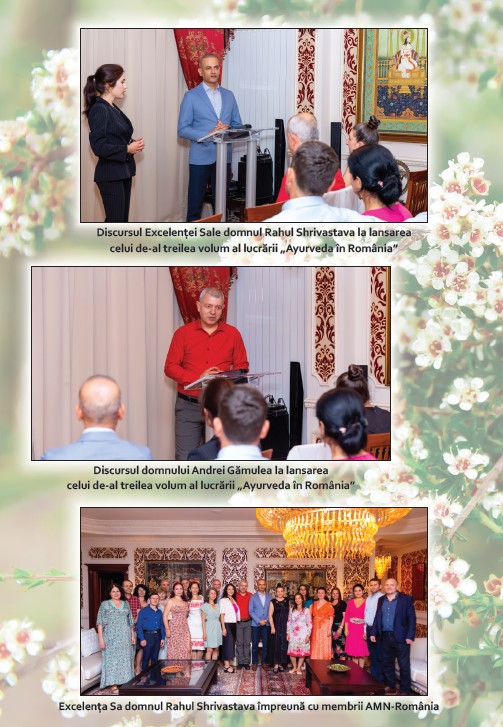
Aurora Nicolae, in turn, presented Ayurveda as a unified vision of life and emphasized the formative value of its principles.
The book then records the presentation of the three volumes at the 2023 Gaudeamus Book Fair. The four-part structure defining the series was explained: the contemporary relevance of Ayurveda and associated events; the history of the system and its great sages; local medicinal plants analyzed using Ayurvedic criteria; and testimonies from people who have studied and practiced Ayurveda in Romania. Volume 4 follows the same structure, enriched by two especially visible components: the educational curriculum and “Ayurveda Agenda.”
The Ayurvedic tradition: Angira and Daksha
The “Ayurvedic Tradition (Amnaya-Tantraka)” section includes two extensive studies: the great sage Angira and the god Daksha.
The presentation of Angira takes readers into Ayurveda’s Vedic background. Angira is described as one of the seven great sages of the earliest spiritual period and as the founder of the lineage that includes Bharadvaja.
The chapter on Daksha broadens this perspective to Vedic cosmology. Daksha is presented as an expression of creative will, and his relationship with Brahma and Aditi introduces readers to the symbolic language through which Vedic tradition conveys the principles of creation.
These chapters are significant to the volume as a whole. They show that Ayurveda cannot be fully understood if detached from the philosophical and spiritual world in which it developed.
Marichi, Bhela, and Kankayana: Three figures in the history of Ayurvedic knowledge
The next section, “Great Sages of the Ayurvedic Tradition,” continues the historical focus while moving closer to classical literature. The first profile concerns the sage Marichi, an authority in Ayurvedic knowledge, and emphasizes his original perspective on the role of the transformative principle (agni).
The sage Bhela introduces another direction. He is presented as one of the six direct disciples of the great sage Atreya and as the author of Bhela-Samhita. The text follows the transmission of Atreya’s teachings and Bhela’s place in later Ayurvedic literature, where he is cited by Vagbhata, Dalhana, Chakrapani, and other commentators.
Kankayana is likewise revisited as one of the classical sages mentioned in Charaka-Samhita. Associated with the Bahlika region and known as Bahlika-Bhishaka, he appears in debates on the origins and causes of disease and in doctrinal discussions that helped establish Ayurvedic interpretive criteria.
The three profiles illustrate the essential role of dialogue in the formation of Ayurvedic knowledge. In classical texts, ideas are often expressed through questions, answers, differing viewpoints, and debates among sages. Knowledge thus emerges as a living tradition.
Vanaspati-Jnana: Plants familiar in Romania examined through Ayurvedic criteria
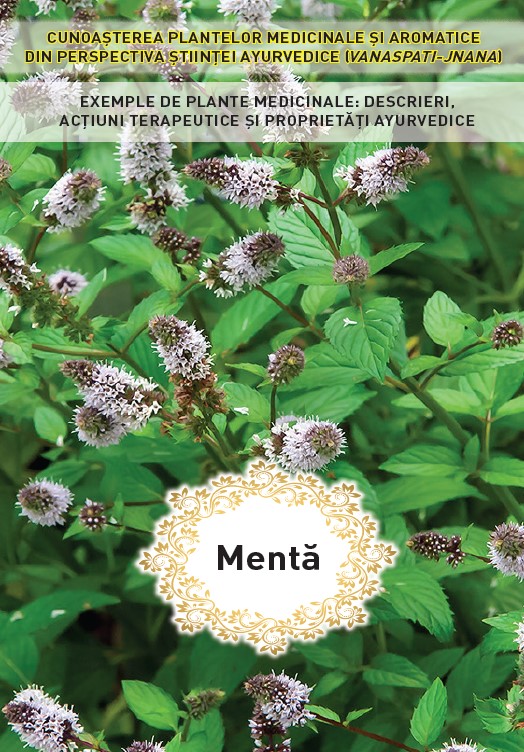
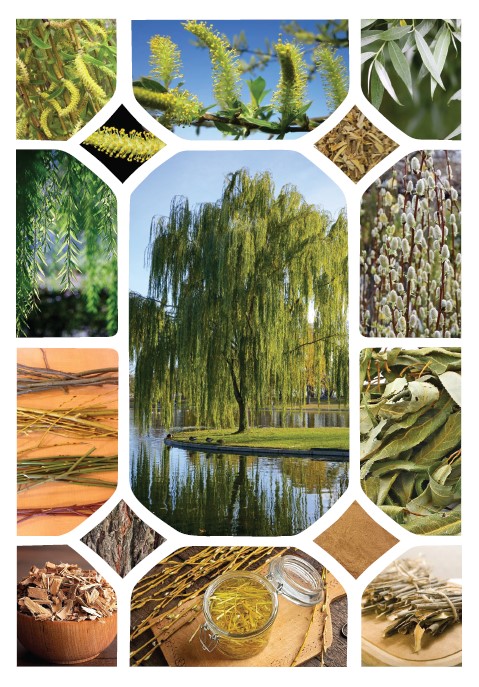
One of the volume’s most practical sections is “Knowledge of Medicinal and Aromatic Plants from the Perspective of Ayurvedic Science (Vanaspati-Jnana).” Volume 4 selects five plants: peppermint, walnut, elder, willow, and quince. The selection illustrates an original direction consistently developed within “Ayurveda in Romania”: plants familiar in Romania are examined through Ayurvedic criteria.
Peppermint: From familiarity to systematic analysis
Explanatory note
Walnut: Exploring a less commonly used plant part
Explanatory note
Elder: A plant associated with comfort and harmonization
Explanatory note
Willow: Between traditional use and phytochemical profile
Explanatory note
Quince: Completing a short monograph on familiar resources
Explanatory note
After exploring tradition and plants, Volume 4 returns to contemporary Romania in the section “Aspects of Ayurvedic Activities in Romania.” Its first chapter outlines the Ayurveda course curriculum.
The figures help convey the project’s scope: the basic course is organized into 32 core sections and more than 170 chapters. The aim is progressively developing an Ayurvedic way of thinking that relates general principles to human structure, bodily functions, processes of consciousness, health assessment, and traditional methods.
The first reference areas are Dosha-Prakriti, Ayurveda-Padartha, Svasthya-Darshana, and Prakriti-Nikasha. These are followed by Svasthavritta, which addresses dosha qualities, states of imbalance and rebalancing, relationships between constitutional predominances, temporal cycles, and the twenty-guna system.
Dravyaguna then introduces a complex methodology for analyzing natural substances: dravya, rasa, virya, vipaka, prabhava, and karman. Vanaspati-Jnana applies this approach to medicinal plants.

The curriculum also includes Sharira-Jnana, Kritya-Jnana, Manasa-Jnana, Pravritti-Jnana, Nidana-Sthana, Indriya-Sthana, and Cikitsa-Sthana, along with Pancha-Karma, Upa-Krama, Rasayana, and Vajikarana. Levels 27–29 include Vimana-Sthana and levels 30–32 include Siddhi-Sthana.
This curriculum explains a recurring point elsewhere in the volume: the continuity of Ayurvedic activity in Romania rests on an educational structure that has been developed progressively for more than three decades.
“Ayurveda Agenda”: A continuing account of current developments
Including “Ayurveda Agenda” in Volume 4 is especially significant because it connects two very different publishing rhythms.
“Ayurveda in Romania” records major stages of long-term development in comprehensive volumes. “Ayurveda Agenda,” by contrast, follows that development week by week. Initiated by Ayush Cell Romania, it is a registered weekly online publication, available in HTML and PDF, with the HTML version also supporting automatic translation tools.
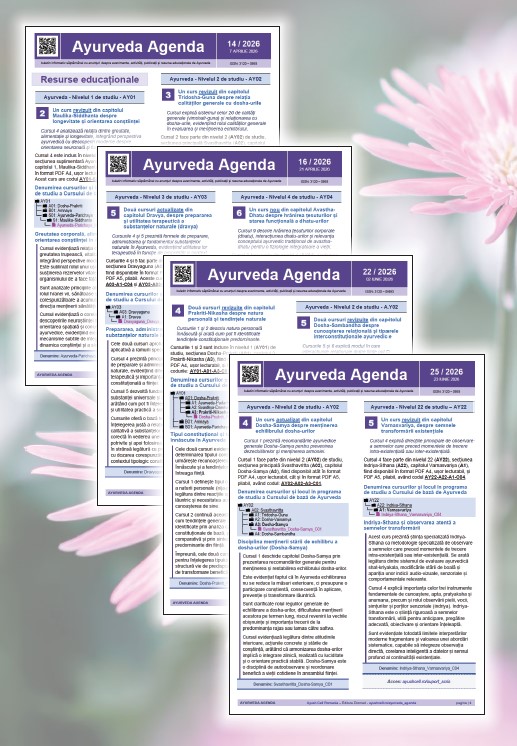
Its content brings together educational programs, publications, study resources, events, and institutional partnerships. Early editions were organized around specialized courses, books and publications, educational resources, and current information.
Including “Ayurveda Agenda” in Volume 4 creates a distinctive publishing relationship: the weekly magazine records the present, while the book selects and integrates that present into a lasting record. The projects complement each other: the magazine captures developments; the book provides perspective.
Testimonies: Where knowledge meets experience
The volume’s final major section is devoted to personal testimonies. This component has existed since the project began and carries special meaning.
At the initiative of the Embassy of India, the experiences of those studying Ayurveda in Romania were included in the series to document Ayurveda’s presence through people’s direct experiences. Volume 4 maintains this approach. Accounts come from people with different professions, backgrounds, and periods of study. Some describe changes in how they understand health; others emphasize self-knowledge, relationships, diet, medicinal plants, education, or the application of Ayurvedic principles in professional life.
The volume closes with perhaps one of the simplest explanations of the practical value participants find in Ayurveda: it offers tools for understanding the interaction between themselves and their environment. Diet, lifestyle, and environmental factors are viewed as parts of an interconnected network.
Four volumes so far: An ongoing publishing endeavor
With four volumes, the “Ayurveda in Romania” project already invites retrospective reading.
Started in 2018, it has aimed to document the development of Ayurveda in Romania, educational and research activities, cooperation with India, the appreciation of local medicinal plants, and the experiences of those studying Ayurveda.
Volume 3 covered 2020–2023, when international cooperation and online activity expanded and Ayush Cell Romania opened. Volume 4 shows what developed from those foundations.
The information center has become a hub for educational and publishing projects. International cooperation has grown into university exchanges. Medicinal-plant research has adopted an interdisciplinary direction. The curriculum is presented as a broad, systematic structure. A weekly digital magazine has emerged with its own bibliographic identity. Ayurveda Day has gained continuity and visibility, and the publishing series itself has become the subject of retrospective review.
This development explains why Volume 4 need not be read only from beginning to end. It also serves as a reference work whose sections can be consulted according to interest. Readers concerned with contemporary Ayurveda can begin with Ayurveda Day and Romanian–Indian cooperation. Those interested in traditional sources can turn to Angira, Daksha, Marichi, Bhela, and Kankayana. Plant-focused readers can explore Vanaspati-Jnana. Those interested in education can examine the curriculum. And those wishing to understand what Ayurveda means to people who have studied it for years or decades can start with the testimonies.
A thread unites all these sections, becoming especially visible with the fourth volume: continuity between India and Romania; between traditional sources and contemporary research; between the great Ayurvedic sages and people studying their texts today; between medicinal plants known for generations and current efforts to understand their properties through precise criteria; between weekly lessons and an Ayurvedic curriculum developed over decades; between events and their documentation; and between weekly “Ayurveda Agenda” issues and the book preserving these milestones for the future.
In this light, Volume 4 may be seen as a meeting point between memory and development. It records what has been achieved while showing the directions still evolving.
This may be among the “Ayurveda in Romania” project’s most important achievements. After four volumes, there is now a body of documentation built over time showing how a traditional system of knowledge originating in India can be studied, understood, researched, and transmitted in another cultural setting without losing touch with its sources.
In Volume 4, cultural diplomacy meets education, history meets current events, botany meets Dravyaguna, classical texts meet academic research, and personal experience meets publishing documentation.
Together, these directions form the vision that “Ayurveda in Romania” has pursued from the outset: Ayurveda is a broad system of knowledge about life, capable of inspiring education, research, intercultural dialogue, reflection, and experience. Volume 4 confirms the continued development of the project launched in 2018.