| 1 | Four Volumes Documenting the Presence and Development of Ayurvedic Studies in Romania |
A New Publication Completes One of the Most Extensive Documentary Series on the Development of Ayurvedic Studies in Romania, Offering an Overview of Educational Progress, Romanian–Indian Cooperation, and Editorial Resources in Recent Years
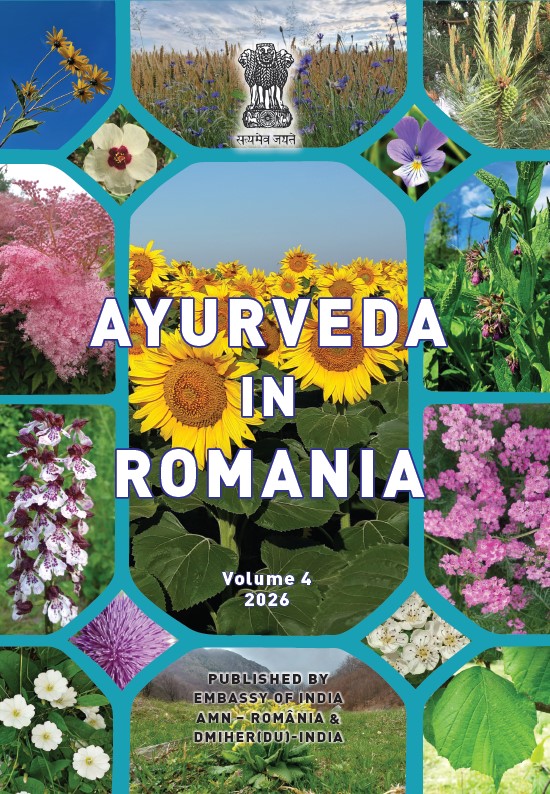
In recent years, the development of Ayurvedic studies in Romania has been accompanied by sustained publishing activity devoted to educational works and resources and to systematically documenting the stages through which this traditional Indian science of life has strengthened its place in Romanian cultural life.
The result is the “Ayurveda in Romania” series, an editorial project consistently tracing the evolution of educational programs, institutional partnerships, research initiatives, and activities undertaken to promote traditional Indian knowledge.
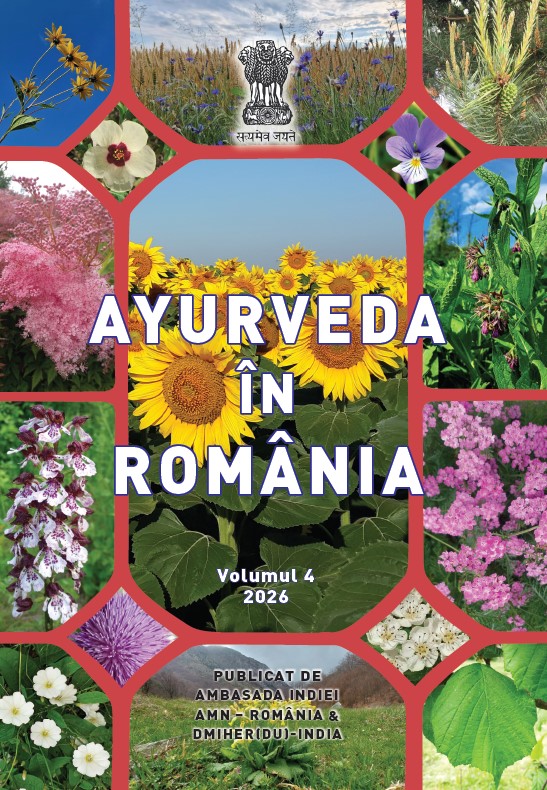
The series now welcomes its fourth volume, which joins the three previously published volumes and continues the same documentary approach, offering a broad picture of recent developments. Like its predecessors, the new work will be available in both Romanian and English, reinforcing the project's international character and making its content accessible to Romanian readers as well as readers and collaborators abroad. The “Ayurveda in Romania” series occupies a distinctive position among Romanian publications devoted to the traditional Indian science of life.
While most existing works describe Ayurveda's fundamental principles, introduce traditional methods, or translate classical texts, this series takes a different approach. It documents how Ayurvedic studies have developed in Romania, capturing the institutional context, educational initiatives, international collaborations, and publishing projects that have enabled this field to expand.
From this perspective, each volume can be read both as an informative work and as a historical document. Events are presented in chronological context, accompanied by details of organizers, participating institutions, educational programs, and results. The series thus goes beyond a collection of articles and becomes a documentary archive tracing, step by step, the formation of a continually developing field.
The new volume faithfully reflects this approach. It brings together material on Romanian–Indian cooperation, the work of Ayush Cell Romania – the AYUSH Information Center in Bucharest, educational projects developed in recent years, activities organized with the support of the Embassy of India in Romania, conferences, academic and diplomatic meetings, and many publishing initiatives that have expanded access to Ayurvedic knowledge.
Each chapter contributes to the picture of sustained activity in which education, research, and international cooperation reinforce one another and converge toward a shared goal: establishing a sound framework for systematic Ayurvedic studies in Romania.
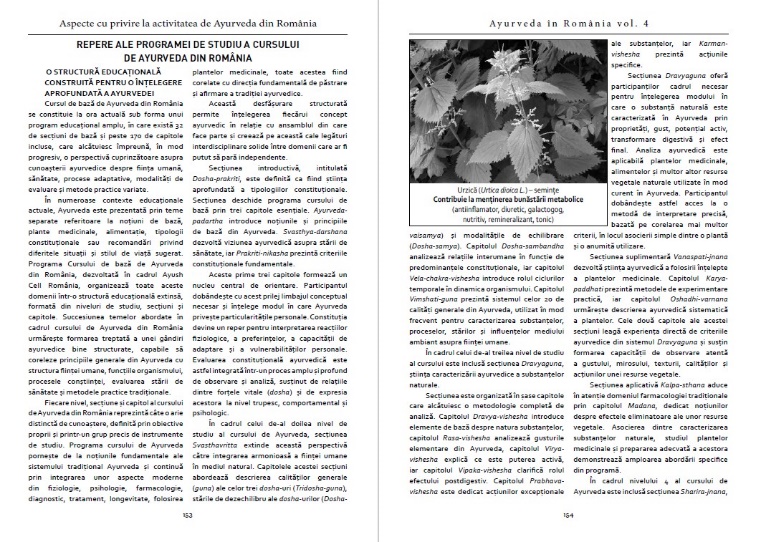
Special attention is given to education. The volume describes the evolution of study programs, the expansion of resources for participants, and the diversification of learning materials. Readers can follow the development of an extensive curriculum organized into successive levels of training, supported by courses, publications, digital materials, videos, and supplementary educational tools.
Beyond listing these resources, the book highlights the teaching philosophy underlying the educational initiatives in Ayurveda: building a gradual, stable, coherent, and rigorous learning process in which each stage of study—each level, section, or chapter—prepares students for deeper exploration in the next.
Publishing activity also occupies an important place in the account, reflected in the numerous books, courses, guides, and periodicals on Ayurveda produced in recent years.
The variety of these materials demonstrates the effort to build a modern Romanian-language bibliography suited to the needs of students, practitioners, and everyone interested in Ayurveda.
At the same time, English-language editions bring these contributions into international dialogue, making the experience gained in Romania known to a much wider audience.
A distinctive feature of the volume is its integrative perspective on the field. Ayurveda is presented through interconnected educational, cultural, publishing, and institutional initiatives that develop together.
This enables readers to discover the relationships among the different components of the educational effort and understand how each project helps consolidate a complex educational ecosystem capable of supporting both theoretical study and practical application of Ayurvedic principles.
This approach gives the entire series lasting documentary value beyond the immediate concerns of the present. Over time, the four volumes will provide an important resource for researchers interested in the history of Ayurveda's reception in Europe and the development of cultural and academic cooperation between Romania and India. The series gathers information usually scattered across press releases, conference programs, periodicals, and institutional archives into a unified, accessible, rigorously organized resource.
The publication of Volume 4 therefore continues a long-term editorial project intended to document the development of Ayurvedic studies in Romania with as much rigor and consistency as possible.
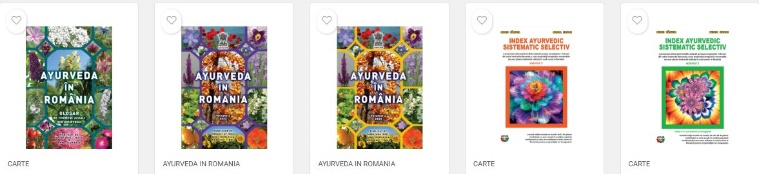
Since its launch in 2018, the “Ayurveda in Romania” series has periodically released volumes in Romanian and English. It has become one of the most extensive documentary collections on Ayurveda's development in a European country, reflecting the growth of a field that invites continuous, deeper study.