Ayurveda Agenda 27 / 2026 Contents

Events

1

Summer 2026 Ayurveda Retreat – Part 2: Sapta-Samaya, the seven stages of harmonious existential integration

In-depth study of Sapta-Samaya during Part 2 of the Summer 2026 Ayurveda Retreat – July 24, 25, and 26, 2026
Part 2 of the Summer 2026 Ayurveda Retreat will take place July 24–26 and will be devoted to Sapta-Samaya, the esoteric Ayurvedic system of seven stages of harmonious existential integration.

This part of the program focuses on self-knowledge and the progressive assessment of beneficial personal transformation. It leads to the fundamental question of the meaning of existence. Sapta-Samaya is a staged framework for inner orientation, enabling Ayurvedic practitioners to recognize where they are, the direction in which they are developing, and how their practice gains depth and transformative effectiveness.

The seven stages of the esoteric Ayurvedic Sapta-Samaya system are prakṛta-samaya, ākāra-samaya, utphala-samaya, vistāra-samaya, siddhi-samaya, prabodha-samaya, and saṃhatatva-samaya. Together they form an ascending sequence of higher states of harmonious existential integration through which a person can better understand their development. Each stage represents a specific form of harmony, growth, and inner maturation.

Sapta-Samaya provides participants with a useful tool for introspection and personal assessment of inner progress, as well as a framework for a deep understanding of personal purpose.

The first day, July 24, 2026, will begin with an overview of Sapta-Samaya and the meaning of the traditional concept of samaya. From this perspective, samaya can be understood as opportunity, beneficial commitment, and an inner promise of transformation.

Participants will discover that a stage of existence is an inner condition in which a person adopts a direction, goal, and deeper orientation. This first stage offers a practical, initiatory framework for understanding the seven levels.

Access: ayushcell.ro/tabere/tayv26

On the same day, participants will evoke the consciousness of the Ayurvedic sage Gālava, associated in Ayurvedic tradition with the appropriate measure in using one’s resources. This invocation opens the Sapta-Samaya study because harmonious existential integration requires proportionate effort, clear management of energy, and a balanced approach to practice.

The second day, July 25, will examine the stages of existential integration in greater depth and explain how Sapta-Samaya can become a tool for self-knowledge. Special emphasis will be placed on prakṛta-samaya, the starting stage, which expresses harmony with one’s constitutional nature and the realization of latent potential. It is the foundation of the entire ascending journey because higher development rests on a clear, stable, conscious relationship with one’s own constitution.

Building on this foundation, the study will follow the stages leading toward formation, flowering, expansion, attainment, awakening, and unified integration. Ayurvedic practice, constitutional harmonization, regeneration through Rasāyana, and inner discipline can be understood as means of ordering one’s inner journey. Sapta-Samaya thus offers an ascending perspective on well-being, viewing a healthy state as the foundation for greater clarity of consciousness and substantially higher existential integration.

The second day will include an invocation of the consciousness of the Ayurvedic sage Pārīkṣi, associated with careful investigation, clear examination, and discernment. In this perspective, Pārīkṣi provides a model for examining the contents and functioning of one’s own consciousness.

In studying Sapta-Samaya, this orientation is essential because progressing through harmonious existential integration requires objective observation, clarification of inner causes, and recognition of mechanisms that support or limit beneficial transformation.

The third day, July 26, will synthesize the Sapta-Samaya system. Participants will see how the seven stages form a complete, unified model for understanding existential meaning. The synthesis will examine motivational origins and existential purpose.

These three reference points provide a clear introspective method and show that personal purpose can be discovered by relating clearly to one’s starting point, intended direction, and current stage of development.

On the final day, participants will evoke the Ayurvedic sage Kātyāyana, associated with correct measure, precision of expression, exact language, ritual order, and appropriate therapeutic action. This invocation emphasizes the importance of clarity and inner order in existential integration. In Sapta-Samaya, beneficial transformation occurs when intention is clearly formulated, practice is orderly, and principles are properly applied.

Part 2 of the Summer 2026 Ayurveda Retreat therefore offers systematic, deeply practical study. The event is open to students, lecturers, practitioners, and anyone wishing to explore Ayurvedic tradition and integrate its knowledge in an authentic, profoundly transformative way.

The program will be held online on Zoom, with morning and afternoon sessions.

Registration is available according to the instructions on the dedicated Summer 2026 Ayurveda Retreat page: ayushcell.ro/tabere/tayv26. A corresponding plant set is available for practical activities in this part.

Set: animaplant.ro/produs/set-pma-sps-26/

By exploring the esoteric Sapta-Samaya system, Part 2 of the Summer 2026 Ayurveda Retreat offers an opportunity for inner growth, a healthy orientation toward life, and a deeper relationship between knowledge and practice in the broad process of harmonious transformation.
Contents

2

Contents of the current issue of the digital magazine Ayurveda Agenda

The digital magazine Ayurveda Agenda table of contents provides details about the chapters of educational resources at each study level covered.

Events

pp. 01–02

Contents

p. 03

Educational resources

pp. 03–06

Medicinal Plants Magazine

pp. 03–05

▶ Issue for June 2026

p. 03

▶ Thematic selection feature

pp. 04–05

Ayurveda – Level 01

p. 06

▶ Prakriti-Nikasha

C06&07 (R)

Ayurveda – Level 25

p. 06

▶ Purusha-Vichaya

C01 (A)

Educational resources

Digital Medicinal Plants Magazine

3

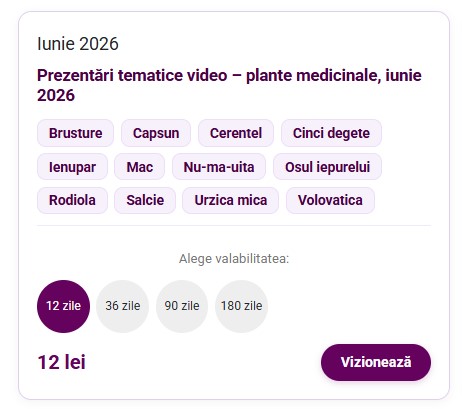
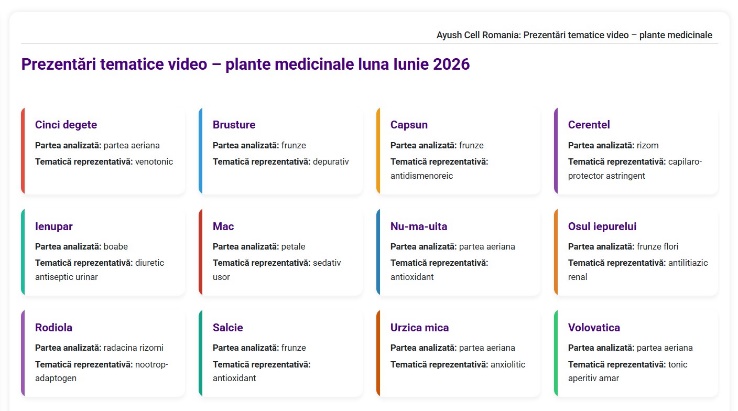
A new set of 12 presentations on the properties of medicinal plants – June 2026

The June 2026 issue of the digital medicinal plants magazine: 12 new video presentations on valuable plants, covering traditional uses, ethnobotany, and modern phytotherapeutic research.

A new issue of the Digital Medicinal Plants Magazine, for June 2026, has been published, expanding the thematic video collection with a new selection of representative medicinal plants examined for their functional properties, traditional uses, special characteristics, and contemporary research findings.

Explanatory note

The materials are presented in a modern, easy-to-consult format designed for quick identification of essential information, offering for each plant a summary of the part used and its representative theme, based on traditional phytotherapy and specialist literature.

Access to the video presentations is integrated into the platform ayushcell.ro and requires signing in. Those interested in new releases can also subscribe to the newsletter, which periodically announces the latest issues and published resources.

Selective access to each monthly issue:
ayushcell.ro/prezentari_plante_medicinale
4

A new feature for creating a personalized thematic issue of the Digital Medicinal Plants Magazine

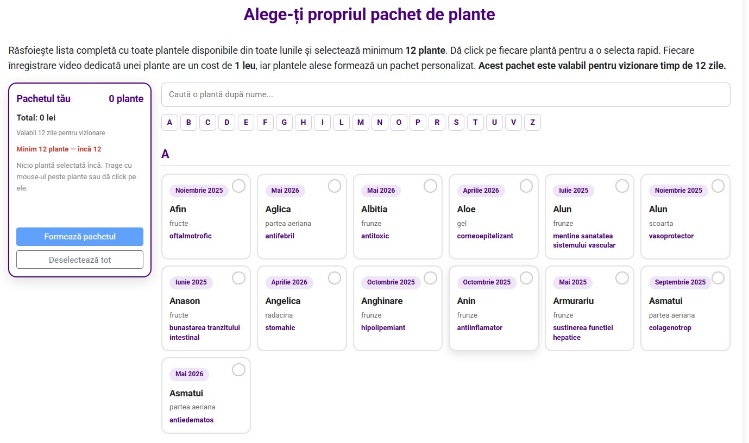
A new feature of the Digital Medicinal Plants Magazine allows users to create a personalized package of at least 12 video presentations, selecting their own issue from the entire existing collection.

Thematic magazines have always offered the advantage of a carefully organized selection of information. The Digital Medicinal Plants Magazine was designed in this spirit, with each monthly issue bringing together twelve medicinal plants in a consistent format emphasizing representative properties, traditional uses, and correlations with modern research.

As the platform has developed ayushcell.ro, this study experience has been complemented by a new feature that significantly expands ways to explore the collection and gives each user the freedom to create their own research pathway.

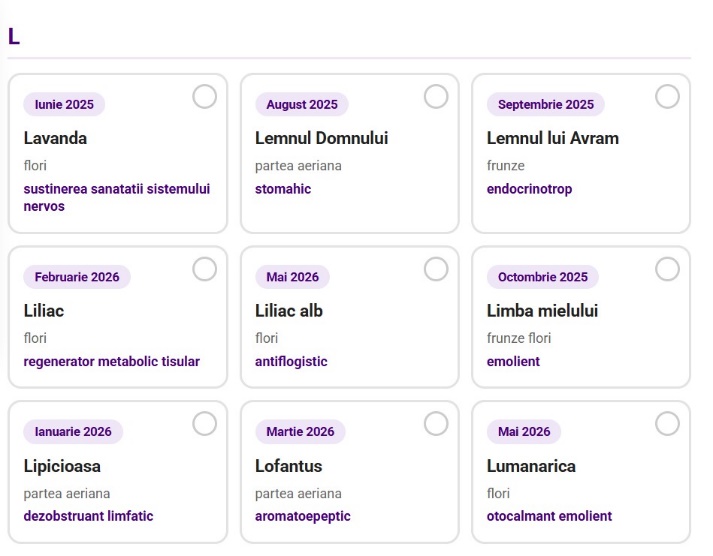
The new section “Choose Your Own Plant Package” turns the entire digital magazine archive into an interactive collection from which each user can choose the plants best suited to their interests. Rather than selecting one monthly issue, users can create a personalized package of at least twelve video presentations drawn from all editions published to date. Each video costs just one leu, and the resulting package remains available for viewing for twelve days, giving users time to study the materials.

One of the greatest benefits of this feature is that users can genuinely build their own issue of the magazine. The new system allows combinations tailored to individual objectives.

Each thematic package becomes a unique collection of presentations based on personal interests and study areas considered relevant.

Selections can follow many criteria. Some users may group plants with similar properties, such as antioxidants, hepatoprotective plants, adaptogens, immunomodulators, capillary protectors, anti-inflammatory plants, depuratives, or neurotropic plants. Others may study plants supporting a particular bodily system, selecting those with applications relating to digestion, cardiovascular health, breathing, the nervous system, endocrine function, urinary health, or the skin. In this way, a personalized package becomes a thematic study tool tailored to a specific interest.

The feature also allows selections of rare or less familiar plants, encouraging exploration of resources seldom discussed in popular literature. Plants from the same botanical family can be compared, grouped by the part used—leaves, flowers, roots, rhizomes, fruits, seeds, bark, or buds—or assembled according to similar representative actions for easier comparison.

Search and the alphabetical index make it quick to find desired plants or systematically explore the whole collection. This flexibility makes research more efficient than consulting monthly issues one by one and enables focused packages.

A thematic selection can support a professional project, educational program, research topic, or simply a personal area of interest.

As the video collection expands with new monthly issues, personalization options continue to grow. Users can return periodically to build new thematic combinations, supplement previous selections, or explore different areas of study. The digital magazine thus develops beyond the concept of a periodic publication into a continually expanding knowledge base.

Through this new feature, the Digital Medicinal Plants Magazine goes beyond the traditional monthly issue model and offers a modern way to access information.

Users can shape their own learning pathway by selecting exactly the plants they wish to study. The result is a personalized magazine issue tailored to individual goals and study pace, drawing on the entire video collection available through Ayush Cell România.

Ayurveda – Study Level 1 – AY01

5

Two courses revised from the Prakriti-Nikasha chapter on constitutional features of the eyes and irises

Courses 6 and 7 explain the Ayurvedic method of observing the eyes, iris color, texture, and brightness as constitutional criteria (nikasha).

Courses 6 and 7 are included in Study Level 1 (AY01), the Dosha-Prakriti section (A01), Chapter 3, Prakriti-Nikasha (A3), and are available as easy-to-read A4 PDFs and foldable A5 PDFs, with codes: AY01-A01-A3-C06 and AY01-A01-A3-C07.

Course titles and their place in the Basic Ayurveda Course curriculum

📁 AY01
 ├─ 📁 A01: Dosha-Prakriti
  │   ├─📁 A1: Ayurveda-Padartha
  │   ├─📁 A2: Svasthya-Darshana
  │   └─📁 A3: Prakriti-Nikasha
  │         └─ 📄 Dosha-Prakriti_Prakriti-Nikasha_C06&C07
 ├─ 📁 B01: Amnaya
 └─ 📁 S01: Ayurveda-Parichaya

Eyes as constitutional criteria in specialized Prakriti-Nikasha analysis

Explanatory notes

Title: Dosha-Prakriti_Prakriti-Nikasha_C06&C07

Ayurveda – Study Level 25 – AY25

6

One course updated from the Purusha-Vichaya chapter on Loka-purusha-samanya

Course 1 examines human beings through the correspondence of Loka-purusha-samanya.

Course 1 is part of Study Level 25 (AY25) of study, in the main Sharirastha-Jiva section (A25), chapter Purusha-Vichaya (A4), and is available in both PDF A4, easy-to-read, and PDF A5, foldable, under code AY25-A25-A4-C01.

The section Sharirastha-Jiva (A25), included in Sharira-Sthana, concerns the living principle within the body and denotes the conscious being participating in embodiment and supporting development, organization, and animation of the bodily structure.

The chapter Purusha-Vichaya (A4) concerns “analysis of the human being” or “investigation of the nature of purusha,” examining how the human being is constituted as a microcosm.

Course titles and their place in the Basic Ayurveda Course curriculum

📁 AY25
└─ 📁 A25: Sharirastha-Jiva
   └─ 📁 A4: Purusha-Vichaya
          └─ 📄 Sharirastha-Jiva_Purusha-Vichaya_C01

Purusha-Vichaya and the Law of Microcosm–Macrocosm Correspondence

Explanatory notes

Title: Sharirastha-Jiva_Purusha-Vichaya_C01

Access: ayushcell.ro/suport_scris