| 1 | Official reception hosted by the Embassy of India in Romania in honor of Professor Achyuta Samanta, founder of “Art of Giving” |
Education, strategic dialogue, and the art of giving in relations between India and Romania.
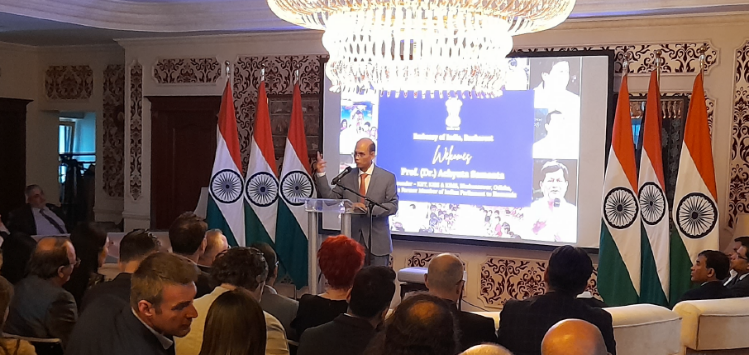
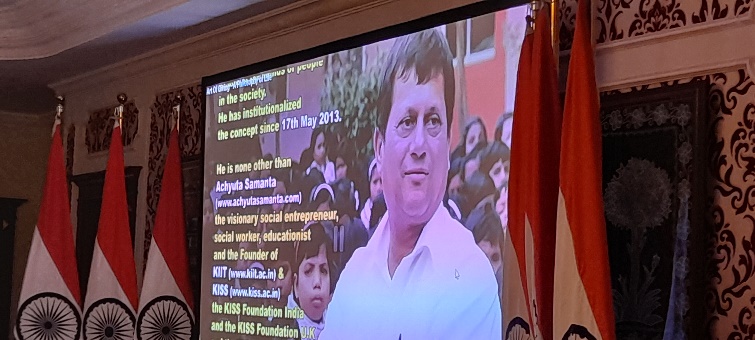
On May 22, 2026, an official reception was held at India House, the residence of the Ambassador of India in Bucharest, in honor of Professor Achyuta Samanta, founder of KIIT (Kalinga Institute of Industrial Technology), KISS (Kalinga Institute of Social Sciences), and the global Art of Giving movement. The event offered an exceptional diplomatic setting for discussing major themes in India–Romania relations: education, philanthropy, academic cooperation, cultural dialogue, international solidarity, and opportunities to deepen the bilateral partnership.
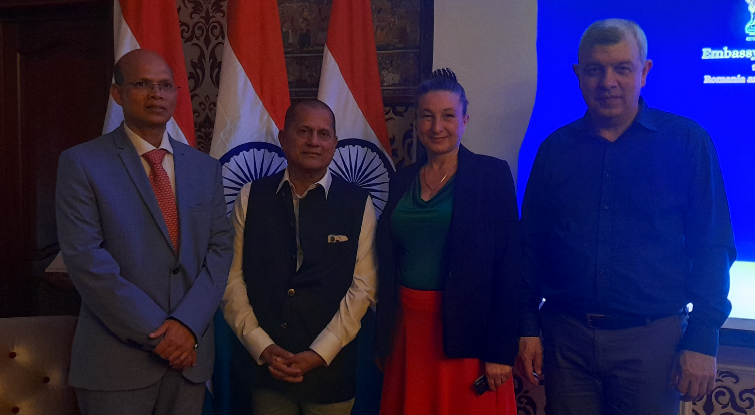
At the invitation of the Embassy of India in Bucharest, AMN-România was represented by its president, Mr. Andrei Gămulea, and its vice president, Ms. Aurora Nicolae.
Participation provided an opportunity for direct and cordial dialogue with both His Excellency the Ambassador of India in Bucharest and the guest of honor, Professor Achyuta Samanta.
During the exchange, AMN-România representatives expressed their deep appreciation for Professor Achyuta Samanta’s contributions to education, social inclusion, and promoting an active culture of giving.
The “Ayurveda in Romania” publishing and educational project was also presented as an expression of an ongoing commitment to bringing India’s heritage of traditional knowledge to Romanian cultural life.
The constructive dialogue highlighted the importance of education as a bridge between cultures, institutions, and communities, confirming AMN-România’s openness to closer cultural and educational cooperation with India.
In his address, His Excellency the Ambassador of India in Bucharest expressed appreciation for Romania’s willingness to increase the level of engagement between India and Romania.
He presented the possibility of a strategic partnership between the two countries as both a future direction and an important diplomatic objective at present.
This vision confirms that Romanian–Indian relations can move beyond occasional exchanges toward wider, structured cooperation with economic, educational, cultural, and institutional implications.
His Excellency also spoke of the dynamism of India’s presence in Romania, mentioning the significant number of Indian companies active across various economic sectors. This observation highlights the existing economic foundation of the India–Romania dialogue, which can support new cooperation initiatives.
From this perspective, the bilateral relationship can be seen as a meeting point for economic potential, educational experience, modern technology, and civilizational values.
A major theme of the speech was the peaceful manner in which India is asserting its rise. His Excellency emphasized that India’s development is not merely economic, but also embodies a vision of international coexistence.
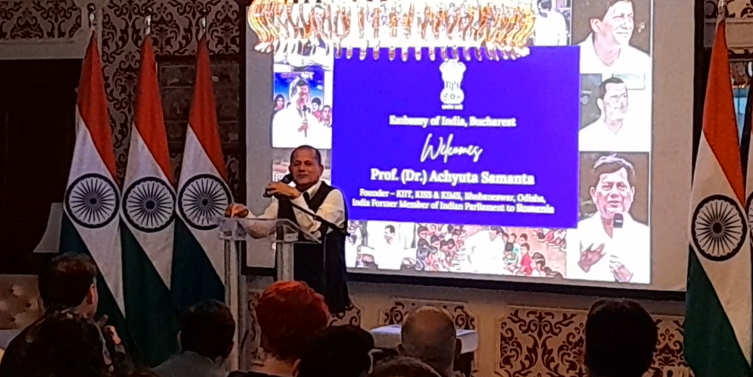
In this context, he invoked the Sanskrit expression Vasudhaiva Kutumbakam, which affirms that the whole world is one family. Deeply rooted in Indian culture, this idea offers a key to understanding how contemporary India can shape its global role through development, education, mutual assistance, and openness to others.
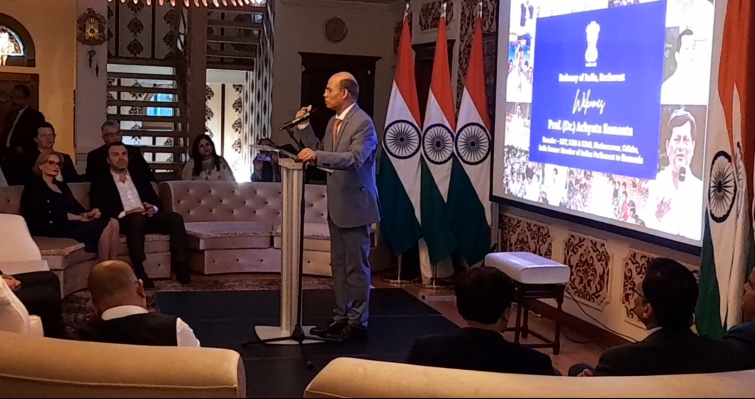
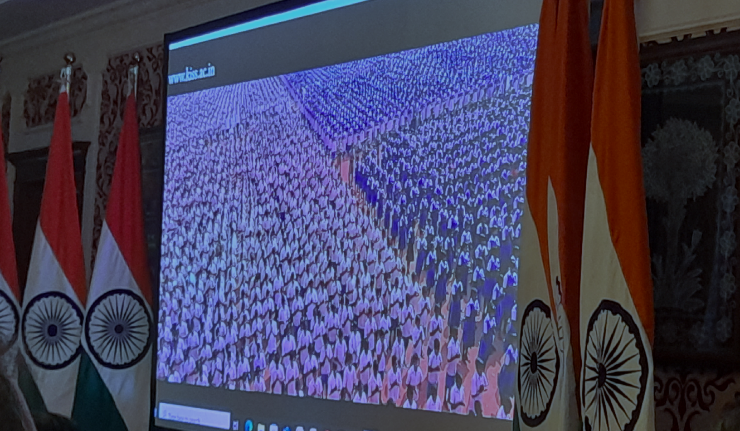
References to education had particular resonance at an event honoring Professor Achyuta Samanta. His Excellency recalled the contributions of Indian civilization to mathematics and the importance of education as a foundation of progress. These ideas resonate naturally with Professor Samanta’s work, which links higher education with social responsibility. KIIT is now a university focused on professional training, research, and development, while KISS is a major educational and social initiative dedicated to children and young people from tribal and indigenous communities.
In the same spirit, the Art of Giving movement expresses the idea that giving, compassion, generosity, and support for others can be cultivated not only by individuals but also by institutions. This orientation is evident in the way Professor Achyuta Samanta has built extensive educational projects capable of transforming lives and communities. Education thus becomes a means of personal advancement, social integration, and affirming human dignity.
His Excellency also referred to India’s role in supporting neighboring countries, recalling aid provided to Sri Lanka during its crisis. He mentioned India’s openness toward the Republic of Moldova in the wider context of regional cooperation and economic engagement. These examples were presented as expressions of international conduct based on solidarity, responsibility, and a willingness to take concrete action.
His Excellency also described India’s major role in the international pharmaceutical sector, noting that India is often called the “pharmacy of the world.” This phrase reflects its extensive production capacity and readiness to respond to the essential needs of other countries during difficult periods. During crises, India has shown that its industrial and scientific development can serve a broader principle of international responsibility through the supply of medicines and solidarity with countries in need. India’s rise was thus presented as an expression of a humane, cooperative vision of relations among nations.
For AMN-România, participation in this event holds special significance. The association’s work is devoted to promoting systematic knowledge, intercultural dialogue, and authentic traditions of health and wisdom, with particular attention to the science of Ayurveda. Meeting an Indian figure who has integrated education, social inclusion, and philanthropy into a major institutional project provided another opportunity to affirm traditional Indian values that can now be expressed through modern forms of cooperation.
The event at India House confirms the active role of the Embassy of India in Bucharest in building bridges between the two cultural spheres.
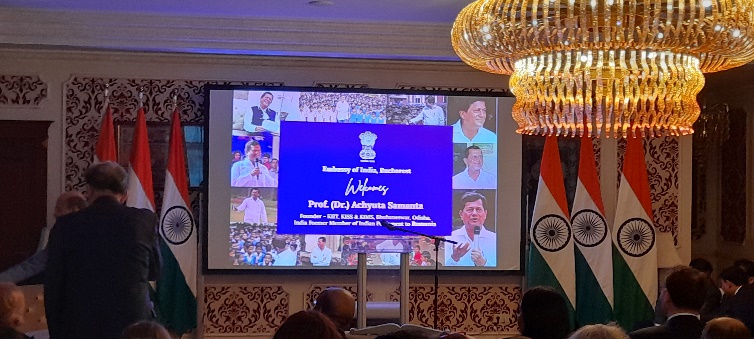
Education, health, culture, the ethics of giving, and training younger generations are areas where India and Romania can identify many points of convergence. The reception honoring Professor Achyuta Samanta thus strengthened Romanian–Indian dialogue in a spirit of respect, cooperation, and shared aspiration toward a more conscious, supportive society open to fruitful collaboration.