Ayurveda Agenda Issue: 10 / 2026 Contents

Contents

Books and publications

pp. 01–02

Educational resources

pp. 02–05

🡺 Study Level 01

pp. 02–03

🡺 Study Level 04

p. 04

🡺 Study Level 06

p. 05

Current updates

p. 06

Books and publications

1

Ayurveda in Romania – Volume 1 – 2018 Edition

An introductory book presenting the conceptual, historical, and educational framework for Ayurvedic study in Romania.

The first volume in the series Ayurveda in Romania presents the main milestones in the emergence and development of Ayurvedic studies in Romania. It offers an overview of how Ayurveda has been studied and integrated into a European cultural and educational context.

Volume 1 introduces fundamental Ayurvedic concepts and explains how to understand and apply them within a modern educational setting. It also traces the organization of Ayurveda study and research activities in Romania, describing educational initiatives, training programs, and publications that helped build a solid foundation for further study of this tradition.

A central contribution came from the ongoing Ayurveda courses organized within AMN-România, which began in 1995 in several Romanian communities. Over the years, these courses have offered a systematic framework for study both to people working in medicine-related fields and to anyone interested in improving health, inner balance, and quality of life.

Alongside teaching, AMN-România's Ayurveda activities have included extensive interdisciplinary research grounded in the practical application of Ayurvedic principles.

This research has sought to connect traditional knowledge with practical observation and has emphasized that Ayurveda offers not only natural means of maintaining health and supporting healing, but also a suitable conceptual foundation for an integrative scientific approach to life and health.

Systematic Ayurvedic education has been supplemented by numerous initiatives: thematic contests, Ayurveda study and practice retreats, serial written course materials, educational audio and video recordings, and the development and updating of online platforms promoting Ayurveda.

Specialist books have also been written, themed seminars delivered, and national and international congresses devoted to this tradition organized.
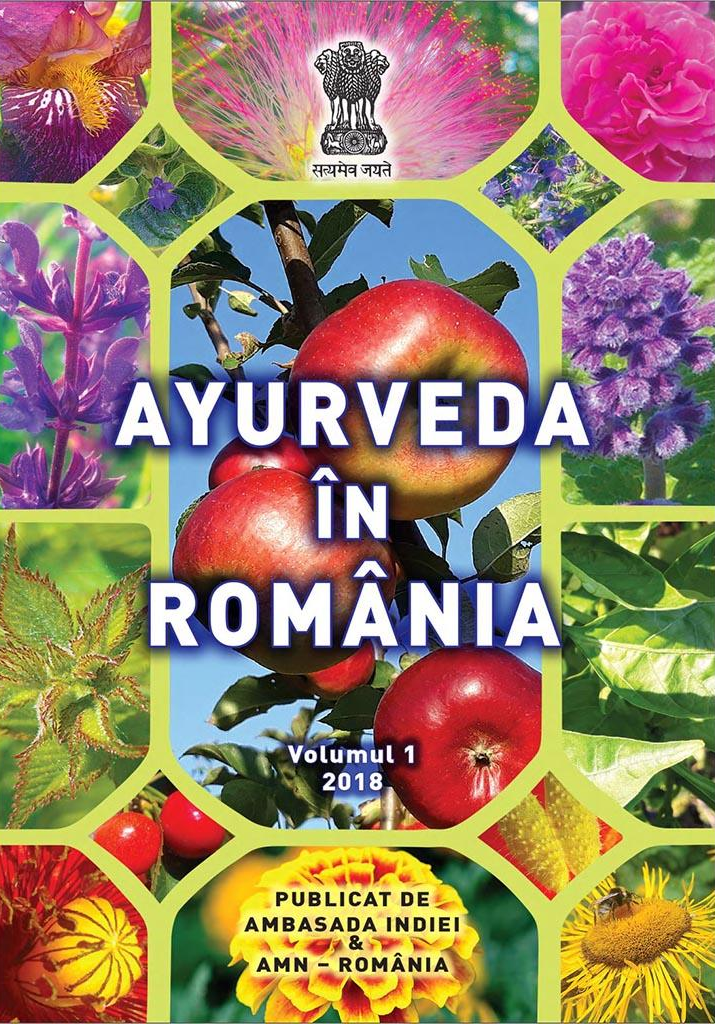
The volume highlights the sustained effort to deepen understanding of Ayurveda's theoretical and historical dimensions. It describes studies and presentations on the history of Ayurvedic science, great Ayurvedic sages, Ayurveda's conceptual structure, and the integration of Ayurvedic principles into contemporary understandings of health.

Educational activities in Romania have also addressed subjects belonging to esoteric Ayurvedic tradition, including Ayurvedic cognitronics (Prabodha-Vijnana), the theory of supramental perspective (Pancha-Artha-Naya), the doctrine of seven stages of harmonious integration (Sapta-Samaya), the study of manifestations of vital energy (Pancha-Prana-Prakara), universal operative principles (Shad-Padartha), the fundamental aims of human existence (Chatur-Vishaya), and Ayurvedic biosignaling research (Jaivika-Sandesha).

Through this broad range of educational, editorial, and research activities, Ayurveda in Romania – Volume 1 depicts a gradual, coherent process of developing Ayurvedic study in Romania.

The book demonstrates that the development of this ancient science in Romania has been a process of cultural and educational integration achieved through systematic study, interdisciplinary research, and dedicated training. It provides a clear picture of how Ayurvedic teaching has been brought into a contemporary educational framework.

The book Ayurveda in Romania thus serves as a documentary record of how this millennia-old tradition has become known, studied, and promoted in Romania in recent decades.

The book is available on the website: animaplant.ro/produs/ayurveda-in-romania-vol-1-ro/

Educational resources

Educational Resources for Ayurveda Study Level 1 (AY01)

2

One course new in the Ayurveda-Padartha series on the role of awareness in constitutional assessment

Lesson 20 explains the functions of awareness in observation, self-observation, and interpretation of constitutional assessment results.

Lesson 20 belongs to the Dosha-Prakriti (AY01) section, within the Ayurveda-Padartha chapter (AY01A1). Available as easy-to-read A4 and foldable A5 PDFs, it completes the practical methodology for Ayurvedic constitutional assessment and concludes the lesson series in the Ayurveda-Padartha.

Awareness – The Foundation of Accurate Observation in Ayurvedic Constitutional Assessment

Explanatory notes
Explanatory notes
3

One course revised in the Ayurveda-Padartha series presenting an Ayurvedic constitutional assessment test

Lesson 19 explains the principles for identifying dosha predominance and introduces an indicative constitutional test for assessing whether vata, pitta, or kapha is predominant.

The lesson belongs to the Dosha-Prakriti (AY01) section, Ayurveda-Padartha (AY01A1) chapter, and is available as easy-to-read A4 and foldable A5 PDFs.

Ayurvedic Constitutional Assessment – Practical Guidelines for Identifying Constitutional Type (dosha-prakriti)

Explanatory notes

Archive name:

Dosha-Prakriti_Ayurveda-Padartha_C19&C20

Educational Resources for Ayurveda Study Level 04 (AY04)

4

Two courses revised in the Avastha-Dhatu series on the Ayurvedic concept of bodily constituents

The courses explain structural and energetic stability in the formation of bodily constituents and describe the relationship among constitutive substance (dravya), physiological functions, and subtle correspondences of bodily structure.

Lessons 2 and 3 belong to the Sharira-Jnana (AY04) section, Avastha-Dhatu (AY04A1) chapter, and are available as easy-to-read A4 and foldable A5 PDFs. They supplement the Avastha-Dhatu lesson series, 2026 edition.

Avastha-dhatu – The Stable Configuration of Bodily Constituents

Explanatory notes
Explanatory notes

Archive name:

Sharira-Jnana_Avastha-Dhatu_C02&C03

Educational Resources for Ayurveda Study Level 06 (AY06)

5

One course new in the Manasa-Jnana series on the role of impressions in consciousness (samskara)

Lesson 18 of the Citta chapter examines the nature of latent traces of experience (samskara), how they form, and how they influence psychological life.

Lesson 18 belongs to the Manasa-Jnana (AY06) section, Citta (AY06A2) chapter, and is available as easy-to-read A4 and foldable A5 PDFs. It is a new course supplementing the existing series, 2026 edition.

Latent Traces of Experience (samskara) in Deep Consciousness (citta)

Explanatory notes
6

One course new in the Manasa-Jnana series on overcoming conditioning from latent impressions in consciousness

Lesson 19 of the Citta chapter examines samskaras' role in forming psychological tendencies, their relationship with karmic processes, and how spiritual practice may reduce the influence of these latent imprints (samskara).

Lesson 19 belongs to the Manasa-Jnana (AY06) section, Citta (AY06A2) chapter, and is available as easy-to-read A4 and foldable A5 PDFs.

Overcoming Conditioning Due to Samskaras and Freedom of Consciousness

Explanatory notes

Archive name:

Manasa-Jnana_Citta_C18&C19

Access: ayushcell.ro/suport_scris

Current updates

7

A New Video in the Ayurvedic Tradition (Amnaya) Series: Sage Gālava

The Ayurvedic sage Gālava is associated with metritherapy, a formative inner practice focused on knowing and appropriately using one's personal resources.

A Deeper Approach to the Causes of Imbalance in Cikitsā-Sthāna

Explanatory notes

The presentation was delivered on March 7, 2026, and is available as a video recording:

Access: ayushcell.ro/traditia_ayurvedica/galava
8

An Online Test for Assessing Ayurvedic Constitutional Type (prakriti)

A digital tool for an indicative assessment of Ayurvedic constitutional predominance.

The Ayurvedic constitutional assessment application on the ayushcell.ro website provides a clear, accessible way to explore constitutional type from the perspective of Ayurvedic tradition.

Through a three-part test, users can assess characteristics associated with the three fundamental principles—vata, pitta, and kapha—and obtain an overview of their own constitutional predominance by following the instructions on the page.

The application is designed to support gradual, straightforward assessment using statements organized around relevant differentiating criteria. Users assign a score to each observed characteristic, producing comparative scores that offer an indicative view of the relative predominance of the three doshas and help explain individual Ayurvedic constitutional characteristics.

Automatic calculation and results-visualization features are available after signing in to a personal account.

The application is a helpful resource for self-knowledge and for becoming familiar with the basic principles of Ayurvedic constitutional assessment (dosha-prakriti).

Access: ayushcell.ro/evaluare_tipologie_ayurvedica