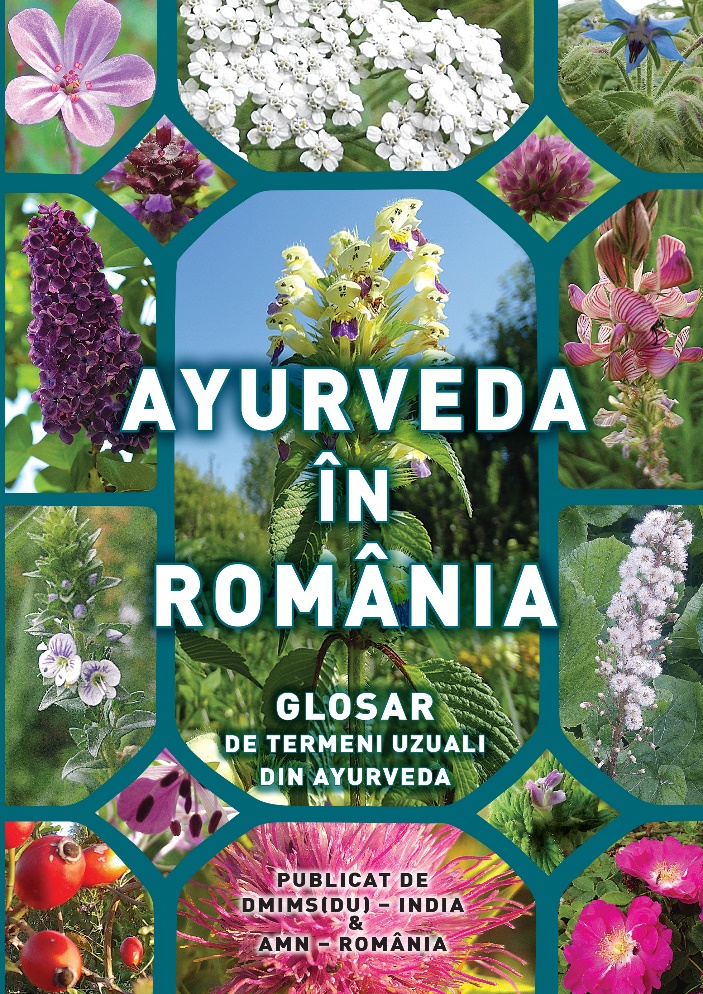
1Ayurveda in Romania: Glossary of Common Ayurvedic Terms
A reference work on terminology devoted to clarifying and organizing the Sanskrit language used in traditional Ayurveda.
Published in 2018 by the National Association for the Promotion of Nonconventional Medicines (AMN România), in collaboration with DMIMS (DU), India, this 208-page volume is an essential component of the broader project Ayurveda in Romania.
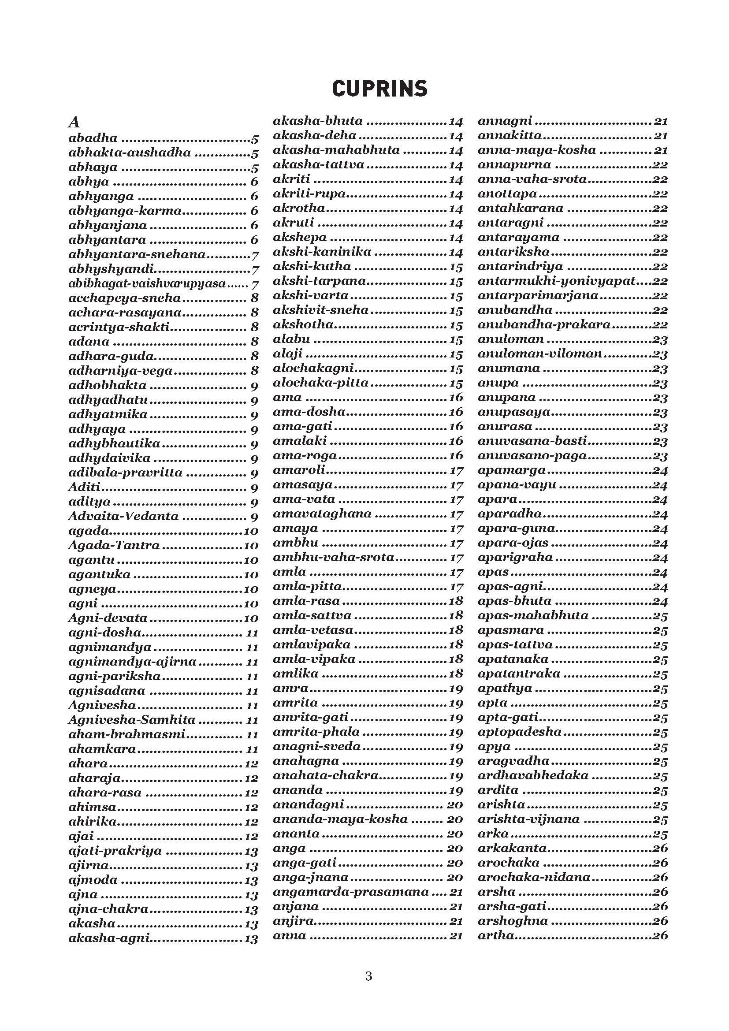
The Glossary of Common Ayurvedic Terms, prepared and edited by Andrei Gămulea and Aurora Nicolae, systematically presents 1,248 Sanskrit-derived terms in alphabetical order, providing a rigorous tool for studying common Ayurvedic concepts.
The dictionary addresses a genuine need for terminological precision in a field where correct understanding of fundamental concepts is essential for both theoretical study and practical application. Its terminology is adapted to contemporary working language in Ayurvedic practice while remaining faithful to traditional meanings established in classical texts.
The book is intended equally for students, practitioners, and therapists using Ayurvedic methods in their professional work and for newcomers exploring this millennia-old tradition.
For practitioners, it provides an indispensable framework for correctly interpreting terms used in diagnosis, dietetics, phytotherapy, Ayurvedic pharmacology, subtle physiology, and constitutional approaches.
Each dictionary entry is rigorously structured: the established Sanskrit term is accompanied by a concise Romanian explanation, followed by detailed contextual clarification with conceptual references and cross-references to related terms. This interconnected arrangement enables thematic reading paths and helps readers understand relationships among concepts such as dosha, agni, dhatu, ojas, prakriti, vikriti, srota, guna or tattva, providing a systems-oriented perspective on the theoretical architecture of Ayurveda.
By interconnecting terms, the glossary becomes a modern reference tool and offers an effective method for studying Ayurveda through semantic relationships. Readers can follow networks of mutually explanatory concepts to build a coherent, integrated understanding of the system.
The dictionary helps establish a consistent, rigorous vocabulary for Romanian-language Ayurvedic studies and supports conceptual clarity.
With its extensive terminology (1,248 terms), interconnected structure, and clear explanations across 208 pages, the volume Ayurveda in Romania: Glossary of Common Ayurvedic Terms – 2018 Edition is a major editorial reference for the development and professionalization of Ayurvedic studies in Romania, offering a solid conceptual foundation for authentic understanding and consistent application of Ayurvedic tradition in Romania.
Educational resources
2Structured Organization of Educational Resources Featured Weekly in Ayurveda Agenda
A set of methodological guidelines for rigorously organizing personal study within the Ayurveda course
Within the Ayurveda Agenda editorial project, the Educational Resources section lists primary codes identifying the study section or level, such as AY01, AY02, or AY06, and a second set of codes identifying the relevant chapter, such as 01A2, 01B3, 02A2, 15A1, and 32A1.
This section-and-chapter system addresses a genuine need for organization in the vast field of Ayurveda, where terminology, concepts, and their relationships require a progressive, contextual approach so that each resource can be understood in its proper setting.
Such a structure clarifies the progression of topics, differentiates levels of depth, and shows where each educational resource belongs within the entire Ayurveda course curriculum.
Organization by chapters and content units reveals relationships among disciplines, from the foundations of Dosha-Prakriti and Svasthavritta to Manasa-Jnana, Nidana-Sthana, Virodha-Cikitsa, and Siddhi-Sthana. Clearly identifying sections and chapters preserves continuity in the learning pathway and supports progressive study of thematic presentations, strengthening an integrated understanding of Ayurveda.
For students, this organization precisely indicates their stage of learning and enables systematic review of earlier material. For practitioners, it provides quick access to previously studied subjects and helps establish the depth of each resource, bringing information into a coherent overall framework.
This section-and-chapter structure is dynamic and expandable, developing gradually as new information is announced in the magazine's Educational Resources section.
As chapters are completed and new thematic sections are introduced, the structure grows to reflect the evolution of the curriculum and the accumulation of content, resulting in a well-indexed system.
Applying internal codes to every resource establishes a stable reference framework, a precise method of referring to materials, and a unified editorial standard, in keeping with traditional Ayurvedic study, in which classification and organization of knowledge are fundamental to its transmission.
Below is a model showing archives mentioned in Ayurveda Agenda Issues 1–8. It has two levels of organization: course sections (AY01, AY02, AY06, etc.) and chapters within those sections (01A2, 01A3, 01B1, 01B3, 02A2, etc.):
Organizing Ayurveda course resources into sections and chapters is an essential methodological undertaking that promotes coherence, educational direction, and thematic continuity, supporting the progressive development of Ayurvedic knowledge within a well-organized framework of systematic learning.
Educational Resources for Ayurveda Study Level 1 (AY01)
3A new course in the Svasthya-Darshana series on the spiritual foundation of holistic health
Lesson 15 of the Svasthya-Darshana chapter clarifies the distinction between the koshas and the Supreme Immortal Self (Atman), the eternal, immutable center of consciousness.
Lesson 15 belongs to the Dosha-Prakriti section (AY01), Svasthya-Darshana chapter (AY01A2), and is available as easy-to-read A4 and foldable A5 PDFs. It completes the Svasthya-Darshana lesson series (AY01A2), 2026 edition.
The Supreme Immortal Self (Atman) and the Five Sheaths of the Person – The Foundation of Holistic Health
Explanatory notes
4A revised course in the Svasthya-Darshana series on the conceptual relationship between consciousness and body
Lesson 1 presents the doshas as functional factors ensuring interdependence between processes of consciousness and bodily manifestations.
The lesson belongs to the Dosha-Prakriti section (AY01), Svasthya-Darshana chapter (AY01A2), available as easy-to-read A4 and foldable A5 PDFs. It opens the Svasthya-Darshana lesson series, 2026 edition.
Consciousness and Body – The Ayurvedic Foundation of Health
Explanatory notes
Archive name:
AY01A2_Dosha-Prakriti_Svasthya-Darshana_C01&C15
Educational Resources for Ayurveda Study Level 04 (AY04)
5A revised course in the Avastha-Dhatu series on the body's structure from the traditional Ayurvedic perspective
Lesson 1 of the introductory Avastha-Dhatu chapter, Sharira-Jnana section, presents the theoretical framework for understanding human bodily structure in traditional Ayurveda.
Lesson 1 belongs to the Sharira-Jnana section (AY04), Avastha-Dhatu chapter (AY04A1), and is available in easy-to-read A4 and foldable A5 PDF formats. It opens the Sharira-Jnana series, 2026 edition.
Sapta-Dhatu and the Principle of Successive Transformation – The Basis of Ayurvedic Physiology
Explanatory notes
Archive name:
AY04A1_Sharira-Jnana_Avastha-Dhatu_C01
Current updates
6Gupta-Cikitsā – The Subtle Approach of the Specialized Science of Therapy
A Presentation on the Deeper View of Causality in the Cikitsā-Sthāna Section
The videos introduce fundamental principles of Gupta-Cikitsā and how they may be integrated into everyday life as tools for self-observation and conscious self-regulation.
A Deeper Approach to the Causes of Imbalance in Cikitsā-Sthāna
Explanatory notesExplanatory notes
The introductory Gupta-Cikitsā presentation is available as two video recordings, each approximately two hours long.