Ayurveda Agenda Issue: 08 / 2026 Contents

Contents

Events

pp. 01–02

Educational resources

pp. 02–05

🡺 Study Level 01

pp. 02–04

🡺 Study Level 15

pp. 04–05

🡺 Study Level 06

pp. 05–06

Current updates

p. 06

Events

1AMN-România Supports Initiatives to Develop Dialogue and Educational Cooperation in Integrative Health

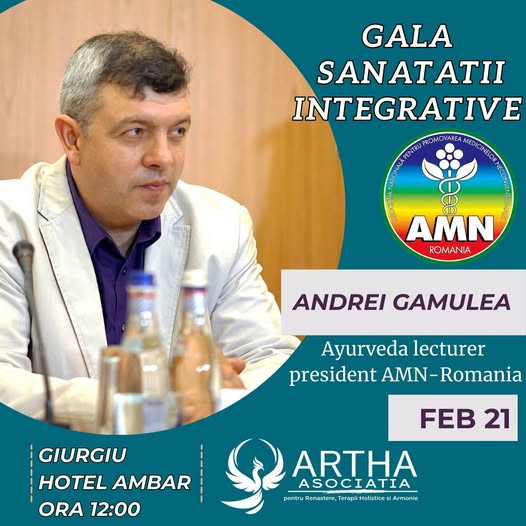
Participation in the Integrative Health Gala Organized by ARTHA Giurgiu

AMN România welcomes the development of initiatives dedicated to holistic health in Romania and encourages associations that responsibly strengthen this field while emphasizing educational quality. In this context, we welcome the Integrative Health Gala organized by the Association for Renaissance, Holistic Therapies and Harmony—ARTHA—in Giurgiu. This initiative reflects the intention to create a well-structured setting for dialogue, education, and cooperation. We especially appreciate the involvement of Ms. Denisa Ciorîcă, who initiated this effort, and the energy, seriousness, and dedication she brought to organizing the event.

Initiatives of this kind are essential to advancing integrative health in Romania, as they bring opportunities for specialized information and reflection closer to local communities.

The invitation to Mr. Andrei Gămulea, President of AMN-România, to participate in this event offered an opportunity for genuine dialogue and reaffirmation of shared values. As coordinator of national Ayurveda training programs, Mr. Gămulea has established a coherent educational framework, with systematically organized programs, ongoing editorial activity, and openness to international cooperation.

Participation in the Integrative Health Gala was a natural extension of this commitment to dialogue and the development of strong collaborative foundations.

In his presentation at the event, Mr. Andrei Gămulea described the Ayurvedic perspective on holistic health, highlighting the traditional understanding expressed by the concept of sampurna-svasthya. This denotes a state of complete harmony in which a person is “established in themselves,” maintaining integrated balance among body, mind, emotions, and consciousness.

He emphasized that in Ayurveda, body and consciousness are not separate entities, but dimensions of the same living system. Health, in this view, is not a fixed state, but a dynamic process of self-regulation and continuous adaptation to internal and external conditions. Particular attention was paid to natural rhythms, nutrition, an appropriate lifestyle, and a healthy relationship with one's social environment, as well as the balance of the vital factors or doshas—vata, pitta, and kapha.

Knowing one's own constitution (prakriti) was presented as an essential first step in Ayurvedic training, preventive care, and cultivating responsibility for one's health.

The central message was that, according to the traditional principles of Ayurveda, holistic health is not an abstract ideal but a daily practice of harmonization based on self-knowledge, discernment, and conscious integration of all dimensions of life—a tangible goal when supported by appropriate education.

Through its participation, AMN-România reaffirms its openness to working with organizations such as ARTHA Giurgiu that seek to build an organized, professional, sustainable framework for unconventional approaches to maintaining health.
It was emphasized that cooperation, dialogue, and educational rigor among organizations with similar goals can help civil society strengthen a genuine culture of integrative health for the benefit of the entire community. Such cooperation also creates opportunities for a shared platform for exchanging experience and developing a unified, coherent vision.


Educational resources

Course Materials for Ayurveda Study Level 1 (Year 1)

2A new course in the Prakriti-Nikasha series on psycho-behavioral criteria

Lesson 34 in the Prakriti-Nikasha chapter introduces the svabhava-anubhava-vyaktitva triad as an instrument for constitutional differentiation.

This lesson emphasizes temperament, the way experiences are perceived, and stable personality traits as fundamental criteria for evaluating constitutional predominance.

The lesson is part of the Dosha-Prakriti section, Prakriti-Nikasha chapter, Level 1 (Year 1), and is available as easy-to-read A4 and foldable A5 PDFs. Lesson 34 provides a practical framework for integrating subtle criteria into Ayurvedic constitutional assessment. It supplements the earlier 2004 and 2010 editions.

Svabhava-Anubhava-Vyaktitva – A Subtle Criterion for Constitutional Differentiation

Explanatory notes

3A new course in the Prakriti-Nikasha series on psycho-behavioral differentiation

Lesson 35 in the Prakriti-Nikasha chapter continues the study of temperament-specific manifestations in the vata and pitta types.

Lesson 35 explains how changing convictions, directional polarization, and conservative stability provide important clues to how each constitutional type experiences, interprets, and shapes life.

The lesson belongs to the Dosha-Prakriti section, Prakriti-Nikasha chapter, Level 1 (Year 1), and is available as easy-to-read A4 and foldable A5 PDFs. It supplements the earlier 2004 and 2010 editions.

Vata, Pitta, and Kapha – The Dynamics of Beliefs and the Direction of Temperamental Energy

Explanatory notes

4A new course in the Prakriti-Nikasha series on harmonizing constitutional temperament

Lesson 36 in the Prakriti-Nikasha chapter develops the analysis of temperament in the pitta and kapha types.

The lesson belongs to the Dosha-Prakriti section, Prakriti-Nikasha chapter, Level 1 (Year 1), and is available as easy-to-read A4 and foldable A5 PDFs. It supplements the earlier 2004 and 2010 editions.

Harmonizing Pitta Temperament and Activating the Kapha Temperamental Nature

Explanatory notes

Archive name: Dosha-Prakriti_Prakriti-Nikasha_C34-36

Course Materials for Ayurveda Study Level 15 (Year 15)

5A new course in the Virodha-Gana series on restoring functional balance in acute pathology

Lesson 1 of the Virodha-Gana chapter, Virodha-Cikitsa section, introduces therapeutic intervention (Gupta-Cikitsa) directed toward restoring normative function.

This new lesson highlights the importance of supporting the elimination of harmful accumulations (ama), reactivating digestive fire (agni), and assessing the doshas.

The lesson belongs to the Virodha-Cikitsa section, Virodha-Gana chapter, Level 15 (Year 15), and is available as easy-to-read A4 and foldable A5 PDFs. Lesson 1 offers a clear framework for understanding functional restoration as a practical principle in acute pathology.

The lesson forms part of the introductory chapter of the Ayurveda curriculum for Module 15 or Study Year 15. It is available to graduates of Study Year 14 who have completed the chapter entitled Kasha.

Virodha-Cikitsa – Restoring Functional Balance in Acute Pathology

Explanatory notes
Presentation: ayushcell.ro/prezentare_gupta_cikitsa

6A new course in the Virodha-Cikitsa series on restoring functional balance

Lesson 2 of the Virodha-Gana chapter examines how deviations from normal functional processes may develop into rapidly spreading disturbances.

This new lesson highlights dosha dynamics, changes affecting blood, and propagation through circulatory channels as essential criteria for choosing therapeutic approaches in acute pathology.

The lesson is part of the Virodha-Cikitsa section, Virodha-Gana chapter, Level 15 (Year 15), available as easy-to-read A4 and foldable A5 PDFs.

The lesson is part of the introductory chapter of the Ayurveda curriculum for Study Year 15. It is available to graduates of Study Year 14 who have fully completed the Kasha chapter.

Virodha-Cikitsa – Spreading Deviations and Proportionate Intervention in Acute Pathology

Explanatory notes

Archive name: Virodha-Cikitsa_Virodha-Gana_C01-02

Course Materials for Ayurveda Study Level 6 (Year 6)

7A new course in the Manasa-Jnana series on the nature, functions, and dynamics of attention

Lesson 17 of the Citta chapter examines the processes through which attention (avadhana) arises, is shaped, and changes.

The lesson emphasizes purification of deep consciousness, managing transformations, and cultivating the witness state as essential conditions for developing integrative attention and accessing the supraconscious level of the person.

The lesson belongs to the Manasa-Jnana section, Citta chapter, Level 6 (Year 6), and is available as easy-to-read A4 and foldable A5 PDFs. Lesson 17 provides a systematic framework for understanding attention as a cognitive, energetic, and transformative mechanism.

Attention (avadhana): Flow, Purification, and Integration of Deep Consciousness (citta)

Explanatory notes

Archive name: Manasa-Jnana_Citta_C17

Current updates

8Accessing Written PDF Course Materials on the Platform

Update on the Organization and Features of the “Written Materials” Page

PDF study materials are available on the Ayush Cell Romania platform at the dedicated page ayushcell.ro/suport_scris. Written lessons and supporting materials for each study section are published here in archive files.

To view these materials, you must have a user account and sign in using the email address provided during enrollment. Access to the materials is strictly associated with the individual account.

After signing in, materials can be accessed from the menu Account → Written materials. This section displays PDF archives organized by module and chapter, along with their access periods, according to the study year reached and the permissions associated with the account.

A New Sorting Feature for Archives Available on the Personal Page

Explanatory notes
Access: ayushcell.ro/suport_scris

9Names of Course Archives Mentioned in Ayurveda Agenda Issues 1–8

No.

Year

Name

1

2

Svasthavritta - Dosha-Vaisamya - C12-19

1

6

Manasa-Jnana - Citta - C01-07

2

1

Dosha-Prakriti - Prakriti-Nikasha - C08-12

2

2

Svasthavritta - Tridosha-Guna - C08-09

2

6

Manasa-Jnana - Citta - C08-16

3

1

Dosha-Prakriti - Prakriti-Nikasha - C27-31

3

10

Nidana-Sthana - Sandhana-Karaniya - C12-C14

4

2

Svasthavritta - Dosha-Vaisamya - C20-22

4

32

Siddhi-Sthana - Phalamatra-Siddhi - C01-03

5

1

Dosha-Prakriti - Svasthya-Darshana - C09-14

6

1

Amnaya_Amnaya-Tantraka_C01-03

6

1

Amnaya_Rishi-Pratna_C01-15

7

1

Dosha-Prakriti_Prakriti-Nikasha_C25-26_C32-33

8

1

Dosha-Prakriti_Prakriti-Nikasha_C34-36

8

6

Manasa-Jnana_Citta_C17

8

15

Virodha-Cikitsa_Virodha-Gana_C01-02