Ayurveda Agenda Issue: 07 / 2026 Contents

Contents

Events

pp. 01–03

Specialized courses

p. 04

Books and publications

p. 04

Educational resources

pp. 05–07

Current updates

pp. 07–10

Events

1The Annual Ayurveda Contest 2026 – A Memorable Edition Dedicated to the Tradition of the Ayurvedic Sages, Rishi-Pratna

The Ayurveda Contest 2026 took place online on Sunday, February 15, 2026, in an extensive, well-structured format, once again confirming its position as a major event in educational activities devoted to the study of Ayurveda.

It brought together many participants, including students in current programs covering various branches of Ayurveda and others interested in the subject who wanted to test and consolidate their knowledge in a rigorous, organized setting.

From the opening of the online event, the atmosphere was dynamic and participatory.

Continuous interaction on the online platform, interest in taking the tests, and quick collective efforts to overcome isolated technical difficulties reflected participants' genuine desire to engage.

The organizing team offered clear guidance and immediate solutions so that the contest remained smooth and accessible to everyone enrolled. This joint effort helped create a stable, safe, professional environment.

The 2026 edition was connected with February 15, regarded in Ayurvedic tradition as the beginning of a new vital cycle. Choosing that date gave the contest a particular symbolic dimension, turning it into an opportunity for renewed direction and inner reflection. Participants could assess their progress within a context encouraging a renewal of inner purpose and clearer learning priorities.

The theme focused on the tradition of the Ayurvedic sages (Rishi-Pratna), highlighting classical models of discernment and the organization of knowledge: Atreya, Agnivesha, Bharadvaja, Charaka, Chayavana, Harita, Jatukarna, Kapila, Kashyapa, Ksharapani, Kumara-Sira, Marichi, Nagarjuna, Parashara and Sushruta. The integrative approach emphasized the ability to connect information, distinguish what matters most, and apply refined criteria for analysis.

Participants had previously received free access to 15 study materials from the Amnaya-Tantraka section, Rishi-Pratna chapter, enabling thorough preparation and reflective reading. During the contest, the structure of the tests—especially the second stage—was praised for its complexity, coherence, and high demands on discernment. Many noted the need for fine distinctions and an intuitive integration of knowledge beyond mere memorization.

The closing atmosphere confirmed that this was a memorable edition. Participants described the experience as a “spiritual marathon,” an intense period of study that brought an uplifting state and a sense of genuine cognitive and inner enrichment. Many spoke of the joy of preparation, the feeling of being inwardly “nourished” by engaging with the sages' models, and deep insights gained from relating traditional teachings to their earlier studies.

Several participants said that reading the materials and taking the tests prompted cognitive and spiritual restructuring, better organization of ideas, and a more coherent grasp of Ayurvedic principles. Some emphasized that particular answers emerged from intuition strengthened through study, while others came from reactivating knowledge accumulated over time, giving the contest a deeply formative dimension.

Sustained interest during the event, requests for clarification, a desire to review the correct answers afterward, and the many messages of thanks and congratulations addressed to organizers and participants confirmed the event's success. The collective atmosphere was one of mutual support, gratitude, and genuine enthusiasm.

The Ayurveda Contest 2026 demonstrated that Ayurvedic tradition can be studied in a living, participatory, rigorous manner, even online. The event was efficiently organized and offered an experience extending beyond a simple assessment, becoming for many a memorable stage of intellectual and inner development.

Through the breadth of participation, quality of engagement, and depth of experience, the 2026 edition remains a milestone in the systematic study of Ayurveda and confirms the educational value of the Ayurvedic sages' tradition, Rishi-Pratna.

The festive awards ceremony provided a fitting conclusion to this edition

Three prizes and ten honorable mentions were awarded. Because some participants had identical scores, two additional honorable mentions were given for positions 8 and 10 to ensure a fair reflection of performance. The atmosphere was one of sincere appreciation, combining recognition of results with a sense of collective achievement.

First prize consisted of extended access for 90 days to the four latest issues of the Digital Medicinal Plants Magazine (November and December 2025, January and February 2026), plus full access to both Narratotherapy modules, including preliminary presentations and accompanying music. Second prize offered 60 days of access to three consecutive magazine issues (December 2025, January and February 2026), as well as Narratotherapy Module 1 and preliminary presentations. Third prize included access to two recent magazine issues (January and February), plus temporary access to Narratotherapy Module 1 and introductory presentations.

Honorable mentions were rewarded with varying access to issues of the Digital Medicinal Plants Magazine from May through February, for either 36 or 90 days depending on the participant's ranking. This award structure was designed to support continued study and practical learning by extending access to the platform's educational resources.

Through these awards, the contest reaffirmed not only its evaluative role but, above all, its educational purpose. The prizes were not merely one-time benefits, but concrete tools for deeper study, fully aligned with the spirit of Ayurvedic tradition celebrated in the 2026 contest.

2Dialogue to Strengthen Romanian–Indian Cooperation in Ayurveda

Setting Directions for Promoting and Developing Ayurvedic Education in Romania

As preparations were made for the 2026 activity calendar, a working meeting was recently held between Mr. Sitesh Kumar, a representative of the Embassy of India, and Mr. Andrei Gămulea, representing Ayush Cell România. The meeting focused on potential areas of cooperation and the development of a coherent action plan for 2026.

Mr. Sitesh Kumar welcomed the constructive nature of the initiative and the willingness to engage in practical dialogue focused on tangible results. He emphasized that such a meeting offers an appropriate setting for clarifying opportunities for collaboration.

Discussions focused on the 2026 program, particularly events promoting Ayurveda in Romania and stronger cultural and educational dialogue between India and Romania. Ayurveda Day 2026 was a central topic, seen as a milestone for raising the visibility and appreciation of Ayurvedic tradition in Romania.

The meeting considered practical possibilities for conferences, themed presentations, and public events through Ayush Cell România to highlight Ayurveda's traditional foundations and its contemporary relevance as a science of life in Europe.

The role of Ayush Cell Romania in providing a well-structured framework for Ayurvedic education in Romania was also acknowledged, including coherent programs, systematically organized content, and an educational approach grounded in rigor and continuity. The participants also discussed joint initiatives to encourage exchanges of expertise and institutional cooperation in Ayurvedic education and promotion.

The active role of Ayush Cell România in supporting international priorities promoted by the Ministry of AYUSH was reaffirmed, alongside its contribution to developing a platform for dialogue and cooperation between Romanian educational institutions and Indian institutional initiatives in Ayurveda.

The meeting took place in an atmosphere of openness and cooperation, laying the groundwork for stronger collaboration in 2026. The dialogue demonstrated a shared interest in projects that honor Ayurvedic tradition and strengthen cultural ties between India and Romania through knowledge-based and educational initiatives.

Specialized courses

3Applied Practical Ayurvedic Nutrition Program – Specific Applications and Advanced Study (Module 2)

A course on integrating Ayurvedic dietary principles into everyday life by connecting digestion, constitution, and personal circumstances.

Module 2 of the Ayurvedic nutrition program expands on the fundamental principles previously introduced, directing study toward practical, individualized dietary applications according to constitutional type, digestive state, and patterns of imbalance.

Nutrition is examined as a complex adaptive process at the intersection of agni (digestive capacity), food qualities (guna), seasonality, and individual constitutional characteristics.

Ayurvedic Nutrition Module 2 provides a systematic framework for understanding how dietary choices affect dosha balance and support the body's self-regulating processes. Topics include food combining, meal timing, dietary adjustments according to age, climate, and psycho-emotional demands, and identification of eating patterns that may lead to imbalance.

By continually applying Ayurvedic principles to real-life situations, the module develops a nuanced view of nutrition, in which food becomes a means of supporting vitality, mental clarity, and emotional stability.

The content strengthens both theoretical understanding and practical application, providing clear reference points for personalizing nutrition in accordance with traditional Ayurvedic principles.

The module is intended for those who have completed the introductory stage and want to deepen their understanding of nutrition and inner balance, an important step toward a coherent vision of an Ayurvedically balanced lifestyle.

Access: ayushcell.ro/nutritie2

Books and publications

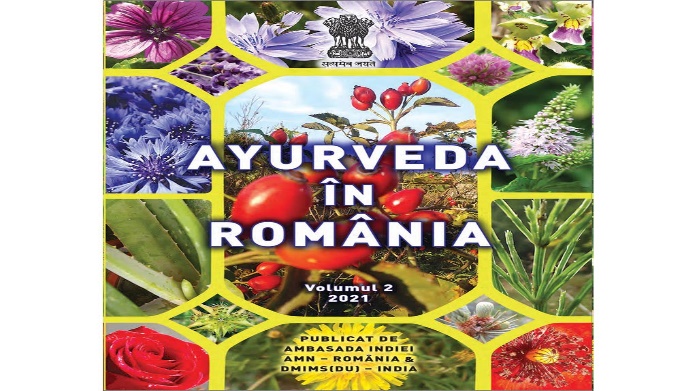
4Ayurveda in Romania – Volume II

A documentary volume on the consolidation and maturation of Ayurvedic study in Romania, documenting a coherent process of integrating Ayurvedic tradition into a local cultural and educational framework.

The second volume in the series Ayurveda in Romania continues documenting and organizing how Ayurvedic principles have been studied, taught, and applied in Romania.

The book highlights stages of development, educational structures, and contributions from the authors involved.

The volume traces the expansion of educational programs, the clarification of the conceptual framework used in teaching, and deeper treatment of fundamental subjects such as dosha theory, the functioning of agni, dietary principles, and integrated natural therapy. It emphasizes teaching rigor and fidelity to classical Ayurvedic sources, while relating them to cultural and therapeutic realities in Romania and Europe.

The book provides a chronology of the development of Ayurveda knowledge in Romania and examines how Ayurvedic tradition has been assimilated through systematic study, practical experience, and sustained editorial effort. It highlights educational initiatives, publications, research, and further study that have helped shape a coherent community of practice.

With its structured, documentary approach, Volume 2 serves as a reference for those interested in how Ayurveda has developed in Romania, offering historical context and conceptual clarification for students, practitioners, and researchers.

Overall, Ayurveda in Romania – Volume II it reinforces the picture of a millennia-old therapeutic tradition being integrated into a European cultural setting, emphasizing the need for a systematic, thorough, consistent approach to studying and applying Ayurvedic principles.

The book is available: animaplant.ro/produs/ayurveda-in-romania-vol-2-romana/

Educational resources

5A New Course in the Prakriti-Nikasha Series on Constitutional Reactivity

Lesson 32 of the Prakriti-Nikasha chapter introduces constitutional reactivity as an essential indicator in Ayurvedic typological assessment.

This new lesson emphasizes that spontaneous reactions to unexpected circumstances reflect dosha predominance and offer fundamental reference points for constitutional differentiation and self-knowledge.

The lesson belongs to the Dosha-Prakriti section, Prakriti-Nikasha chapter, and is available as an easy-to-read A4 PDF and a foldable A5 PDF. In its current form, Lesson 32 offers a clear framework for understanding constitutional reactivity as a practical assessment tool. It replaces the 2004 and 2010 editions.

Constitutional Reactivity – The Spontaneous Expression of Ayurvedic Typology

Explanatory notes

6A New Course in the Prakriti-Nikasha Series on Why Constitutional Reactivity Matters

Lesson 33 of the Prakriti-Nikasha chapter deepens the comparative analysis of constitutional reactivity in the fundamental vata, pitta, and kapha types.

This new lesson in the Dosha-Prakriti series, Prakriti-Nikasha chapter, explains how reaction intensity, the direction of emotional expression, and later integration of events are fundamental to typological differentiation and constitutional assessment.

The lesson belongs to the Dosha-Prakriti section, Prakriti-Nikasha chapter, and is available as easy-to-read A4 and foldable A5 PDFs. The revised Lesson 33 provides a practical framework for using reactivity as a refined tool for constitutional analysis and self-knowledge. It supplements the 2004 and 2010 editions.

Constitutional Reactivity – Typological Differentiation in Challenging Situations

Explanatory notes
Explanatory notes

7An Updated Course on the Role of Verbal Expression in Constitutional Differentiation

Lesson 25 of the Prakriti-Nikasha chapter examines the characteristics of speech and voice when vata-dosha predominates, showing how mobility, rhythm, and variability of expression reflect constitutional structure.

It emphasizes that tone, coherence of speech, speed of verbal response, and stability of expression are fundamental reference points for typological differentiation and constitutional assessment.

The lesson is part of the Dosha-Prakriti section, Prakriti-Nikasha chapter, available as easy-to-read A4 and foldable A5 PDFs. Updated Lesson 25 offers a practical framework for using vocal and verbal criteria as refined constitutional assessment tools. It replaces the 2004, 2010, and 2023 editions.

Speech and Voice in the Vata Type – Expressive Dynamics and Inner Mobility

Explanatory note

8An updated lesson on the role of verbal expression in constitutional differentiation.

Lesson 26 of Prakriti-Nikasha examines speech and voice characteristics when pitta-dosha and kapha-dosha predominate.

The lesson highlights argumentative force, tone, economy of words, and ways of engaging in dialogue as fundamental reference points for typological differentiation and constitutional assessment.

The lesson belongs to the Dosha-Prakriti section, Prakriti-Nikasha chapter, and is available in easy-to-read A4 and foldable A5 PDF formats.

In its updated form, Lesson 26 provides a practical framework for using vocal and verbal criteria as refined tools for constitutional analysis. It replaces the 2004, 2010, and 2023 editions.

Speech and Voice in Pitta and Kapha Types – Expressions of Fire and Stability

Explanatory notes

Current updates

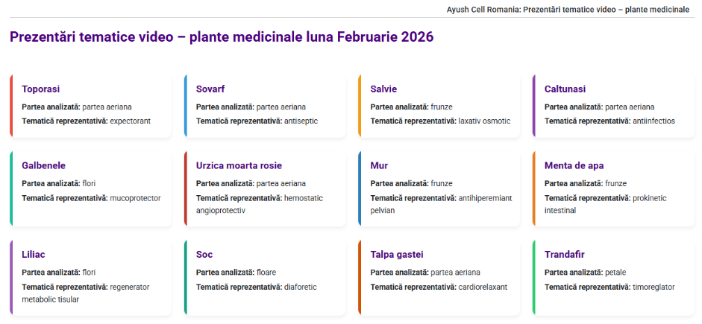
9Digital Medicinal Plants Magazine: February 2026 Presentation Set

A new issue of the digital medicinal plants magazine has been released – February 2026.

Explanatory note

All presentations are organized in a coherent, current, easily navigated format to help readers quickly identify topics of interest.

Viewing the video presentations requires signing in to the platform. Those wishing to stay informed about recent releases can also subscribe to the newsletter.

Access: ayushcell.ro/prezentari_plante_medicinale

10Ayurvedic Tradition – Gargya-Rishi

The contributions of the sage Gargya reveal an integrative view and careful observation of nature.

The page dedicated to Gargya-Rishi explores a profound Ayurvedic perspective on the processes supporting vital balance and how traditional sages understood the interplay between human constituent factors and the emergence of imbalances.

In classical Ayurvedic literature, Gargya is mentioned in doctrinal dialogues recorded in the Charaka Saṃhitā, where great sages discuss the causes of disorders (roga) and the mechanisms behind their onset. His contributions appear within fundamental debates about the relationship among constituent elements, functional factors, and individual predispositions.

The teaching attributed to Gargya emphasizes differentiated causal analysis, showing that imbalance cannot be reduced to a single isolated factor.

The interaction among doshas, the inherent qualities of an individual's constitution, and external conditions creates a complex framework in which health is maintained or disrupted. This reflects the systems-oriented thinking characteristic of classical Ayurveda.

The page also explains the significance of Gargya's name and its traditional context. The name is associated with a lineage of sages, indicating membership in a tradition of knowledge transmission in which direct experience and contemplative depth intertwine with doctrinal analysis.

Particular attention is paid to the subtle dimension of Gargya's perspective, which emphasizes the importance of clarity of discernment (buddhi) and the harmonious functioning of the internal instrument of consciousness (antaḥkaraṇa). In this view, disorders are not merely physical manifestations, but expressions of imbalances whose roots may lie deeper, including in perception and one's relationship with reality.

The page also offers guidance on meditative ways of relating to Gargya's sphere of consciousness. Evocative practices and identificatory meditations are presented as traditional means of deepening resonance with his teachings and internalizing Ayurveda's essential principles.

The materials are available as videos, allowing viewers to study and revisit information at their own pace. Flexible access helps fit study into a personal schedule and supports gradual learning.

The page explains enrollment, access methods, costs, and viewing periods, helping interested people use the available content in an organized way.

Access: ayushcell.ro/traditia_ayurvedica/gargya

11Accessing Written Ayurveda Course Materials in PDF Format

How to View Materials on the Online Platform

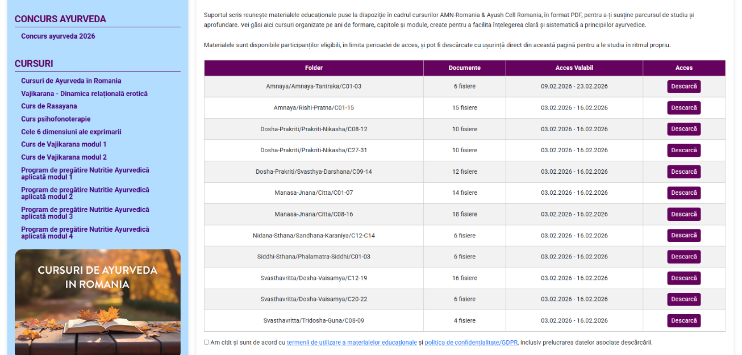
PDF study materials are available on the Ayush Cell România platform at the dedicated page: ayushcell.ro/suport_scris.

Written lessons and materials for each area of study are published here.

Explanatory notes
Explanatory notes

Materials are initially available for a free-access period determined by the program structure. After this period expires, they remain visible in the list but can no longer be downloaded until access is reactivated. Extensions can subsequently be requested for an additional 14 days by following the procedure described on the platform. This system allows easy navigation of study materials, supports educational continuity, and provides clear, predictable management of written-material access.

Access: ayushcell.ro/suport_scris

Issuing Certificates of Participation in Ayurveda Courses

Administrative Request Procedure

12Administrative Procedure for Requesting Certificates of Participation and the Required Steps

Educational activities are conducted through cooperation among Ayush Cell România, Ayus Grup România, and AMN-România. Certificates of participation are issued exclusively through Ayush Cell România, which represents these activities administratively within Romania's AYUSH initiatives.

Explanatory note

Submitting a Request

Explanatory notes

Administrative Fee and Payment Method

The administrative fee for issuing a certificate of participation is 12 RON per document. Once the request is confirmed, payment is made online through the official platform ayushcell.ro.

Explanatory notes

Issuing and Sending Certificates

Once payment is confirmed, certificates are issued electronically, signed, and sent by email.

Explanatory note