Ayurveda Agenda Issue: 06 / 2026 Contents

Contents

Events

p. 01

Specialized courses

p. 02

Books and publications

p. 03

Educational resources

pp. 03–04

Current updates

pp. 05–06

Events

1The Annual Ayurveda Contest 2026 – An Edition Dedicated to the Ayurvedic Tradition of the Sages (Rishi-Pratna)

The annual Ayurveda contest is a landmark among the educational activities devoted to advanced Ayurvedic study

The Ayurveda Contest is an annual educational event designed as an opportunity to synthesize, clarify, and evaluate acquired knowledge.

From the beginning of the Ayurveda course, the contest was conceived as a teaching tool to help students build a coherent understanding of Ayurvedic principles.

The 2026 edition takes place in a specific symbolic context, connected with a landmark in traditional Ayurvedic time cycles: February 15. In Ayurveda, this date marks the beginning of a new vital cycle associated with renewed inner direction, reorganized priorities for learning, and a personal assessment of one's progress in study.

The theme of this edition explicitly focuses on Ayurvedic tradition, emphasizing recognition and understanding of classical sources of authority.

The Ayurveda Contest 2026 invites participants to become familiar with a distinct branch of Ayurvedic knowledge centered on the ways of thinking and discernment exemplified by the great sages of Ayurvedic tradition (Rishi-Pratna): Atreya, Agnivesha, Bharadvaja, Charaka, Chayavana, Harita, Jatukarna, Kapila, Kashyapa, Ksharapani, Kumara-Sira, Marichi, Nagarjuna, Parashara, Sushruta.

This approach seeks to foster an integrated perspective on how Ayurvedic knowledge has been structured, validated, and passed down through generations.

To support this effort, a set of 15 study materials from the Amnaya-Tantraka section, Rishi-Pratna chapter, of the Ayurveda course is made freely available. These materials provide clear, accessible reference points for the subject.
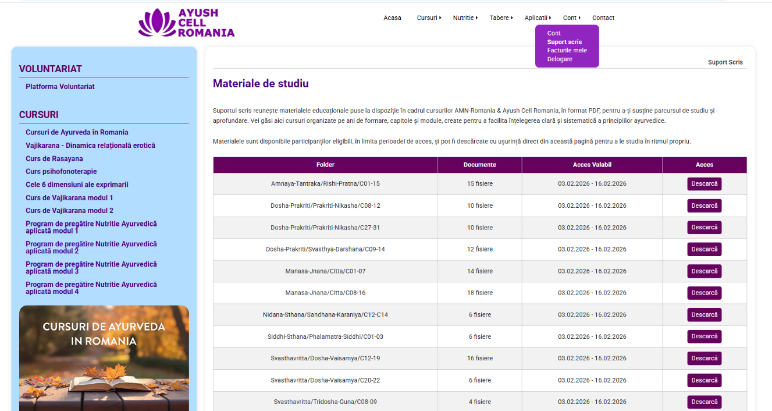
Access: ayushcell.ro/suport_scris

These resources enable in-depth preparation at one's own pace and support familiarity with key concepts, specialized terminology, and avenues of study in Ayurvedic tradition. Free access is intended to encourage reflective reading and the gradual integration of Ayurvedic thought.

The Ayurveda Contest is designed for online participation, making it accessible to a wide range of participants.

The Ayurveda Contest thus forms part of a coherent educational vision in which study is inseparable from the development of consciousness and tradition is regarded not as a static body of texts but as a living system of knowledge. The emphasis is on the educational value of the process and on fostering a direct relationship with Ayurvedic tradition.

The event offers an opportunity for deeper study, recognition of individual effort, and renewed appreciation of systematic Ayurvedic learning, in keeping with its fundamental principles and the demands of rigorous study.

Explanatory notes

Specialized courses

2Vajikarana, Practical Methods with Aphrodisiac Effects – Module 1: Basic Principles and Methods

A specialized course exploring Vajikarana, the Ayurvedic branch devoted to regeneration and the development of human potential.

The first module in the Vajikarana series provides a structured presentation of the theoretical foundations of this Ayurvedic discipline. Vitality, creative potential, and the capacity for regeneration are understood as expressions of a deep balance among body, mind, and consciousness. The course clarifies Vajikarana's place within the wider traditional science of Ayurveda.

The course approaches Vajikarana as the science of preserving and refining vital energy, with direct implications for resilience, longevity, and emotional stability. It offers conceptual reference points for understanding how imbalances in lifestyle, biological rhythms, and personal conduct influence revitalization.

The content provides a coherent foundation for further study, supporting both theoretical understanding and practical application. It is intended for those wishing to deepen their knowledge of Ayurveda, understand the subtle mechanisms of vitality, and develop a conscious relationship with their own life resources.

Access: ayushcell.ro/vajikarana/modul1

Books and publications

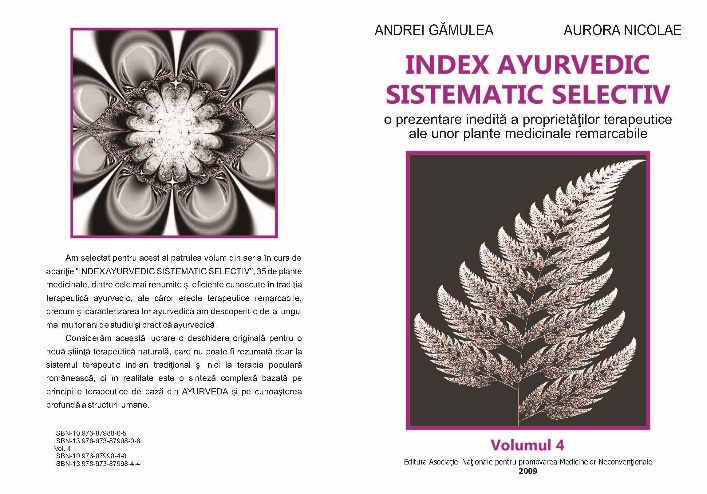
3Selective Systematic Ayurvedic Index – An Original Presentation of the Therapeutic Properties of Remarkable Medicinal Plants – Vol. 4, 2009

A reference work characterizing medicinal plants traditionally used in Ayurveda from an Ayurvedic perspective.

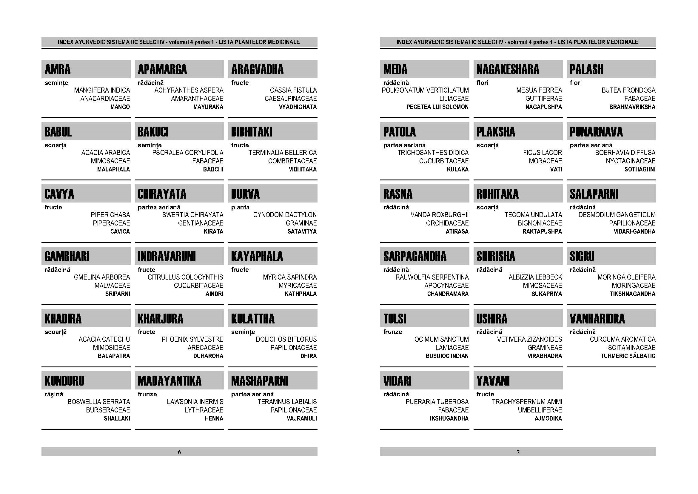
This volume of the 2009 edition of the Selective Systematic Ayurvedic Index brings together profiles of 35 of the most representative and effective medicinal plants known in Ayurvedic tradition, selected through many years of study and therapeutic practice.

The plants featured include key examples of Ayurvedic phytotherapy, such as Amra (Mangifera indica), Apamarga (Achyranthes aspera), Aragvadha (Cassia fistula), Bibhītakī (Terminalia bellirica), Bakucī (Psoralea corylifolia), Chirāyatā (Swertia chirayata), Gambhārī (Gmelina arborea), Punarnavā (Boerhavia diffusa), Tulsi (Ocimum sanctum), Śārpagandhā (Rauwolfia serpentina), Uśīra (Vetiveria zizanoides), and Vānharidrā (Curcuma aromatica), each examined through a common Ayurvedic framework.

The book develops an original perspective on natural therapy, going beyond the strict boundaries of the traditional Indian system or local folk phytotherapy to offer a synthesis grounded in a deep understanding of human structure and mechanisms of vital regulation.

The work offers a structured approach that examines therapeutic effects through fundamental principles of Ayurvedic thought.

Overall, the book forms part of an effort to shape a science of natural therapy for the future, bringing together traditional knowledge and rigorous systematic thinking while remaining faithful to the authentic spirit of therapeutic knowledge.

The book is available on the website: animaplant.ro/produs/index-ayurvedic-sistematic-selectiv-vol-4-editia-2009/

Educational resources

4One Revised Course in the Amnaya Series on the Unique Perspective Offered by Ayurvedic Tradition

Lesson 1 of the Amnaya-Tantraka chapter introduces the traditional framework for transmitting Ayurvedic knowledge.

This revised lesson emphasizes revelation, direct experience, and inner discernment as fundamental foundations for understanding the traditional science of Ayurveda.

The lesson belongs to the Amnaya section, Amnaya-Tantraka chapter, and is available as an easy-to-read A4 PDF and a foldable A5 PDF. In its revised form, Lesson 1 provides a clear foundation for deeper study of Ayurvedic tradition. It replaces the 2018 edition.

5Two New Courses in the Amnaya Series on the Importance of Knowing the Tradition of the Ayurvedic Sages

Lessons 2 and 3 of the Amnaya-Tantraka chapter develop the revelatory perspective on the tradition of Ayurvedic sages (Rishi-Pratna).

These lessons belong to the Amnaya section, Amnaya-Tantraka chapter, and are available as easy-to-read A4 PDFs and foldable A5 PDFs. They complement each other and are intended for all Ayurveda students.

Archive name: Amnaya_Amnaya-Tantraka_C01-03

Rishi-Pratna – The Living Realm of Revealed Knowledge in Ayurveda

Explanatory note
Explanatory notes

Current updates

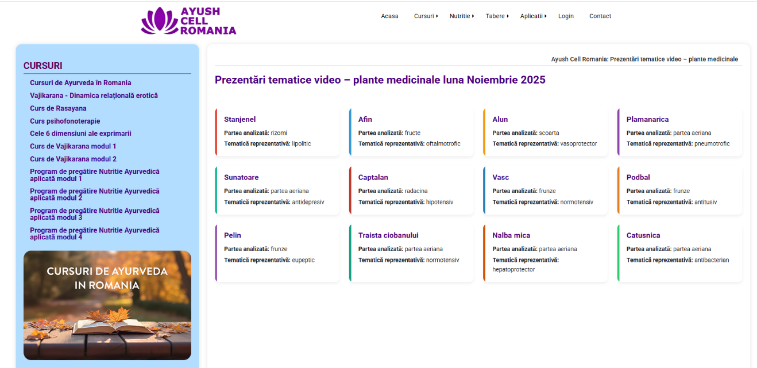
6Digital Medicinal Plants Magazine: December 2025 Presentation Set

Explanatory note

Viewing the video presentations requires signing in to the platform. Those wishing to stay up to date with new materials can also subscribe to the newsletter.

Access: ayushcell.ro/prezentari_plante_medicinale

7Ayurvedic Tradition – Saunaka-Rishi

An in-depth exploration of a distinctive Ayurvedic perspective on the structure of human beings.

Saunaka-Rishi – An Original View of the Determining Factors of Human Constitution

Explanatory notes
Explanatory note

The content is available as video recordings, allowing viewers to study and revisit the material at their own pace. Recorded-only access offers flexibility, letting participants watch during their allotted access period without scheduling constraints.

The page provides clear information about access, enrollment, participation, the cost of each recording, and the duration of access. This structure makes it easier to fit the study of Ayurvedic tradition into a personal schedule for those seeking to deepen their knowledge of Ayurveda's history and teachings.

Access: ayushcell.ro/traditia_ayurvedica/saunaka

8Accessing Written PDF Course Materials on the Ayush Cell România Platform

Written courses and study materials in PDF format are available through the dedicated page ayushcell.ro/suport_scris

To view the materials, you must have a user account and sign in with the email address previously provided during enrollment.

Access to these materials is strictly tied to the user's account. Each participant is therefore encouraged to use the same account throughout their studies to maintain consistent access to all available resources.

After signing in, open the menu Account → Written materials. This section displays available PDF study materials organized by module, chapter, and access period, depending on the study year reached and the access permissions associated with the account.

Explanatory notes

After the initial free access period expires, the materials remain visible in the list, but the access period can be extended upon request.

Access to existing materials may be extended for a further 14 days.

This organization and access method helps users find materials quickly, maintain educational continuity, and manage their studies consistently.

Access: ayushcell.ro/suport_scris